Quick answer: what Lagna means
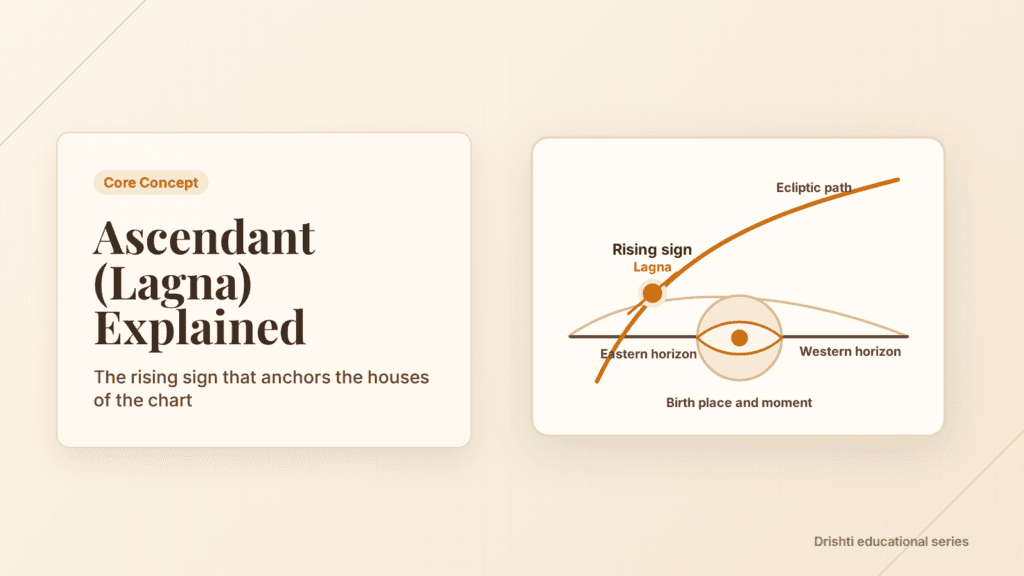
Your Lagna — also called the Ascendant, or Udaya Lagna — is the zodiac sign that was rising on the eastern horizon at the exact moment and place you were born. That rising sign becomes the first house of your Kundli, the anchor everything else is measured from. In Vedic astrology this single point does more heavy lifting than your Sun sign or even your Moon sign, because it decides how all twelve houses get arranged around your chart. Change the Lagna and you rearrange the entire chart. That is why two people born on the same day, even in the same city, can have very different charts if they were born a few hours apart. If you only ever learn one term in Jyotish, learn this one.
Why the Lagna sets the whole chart
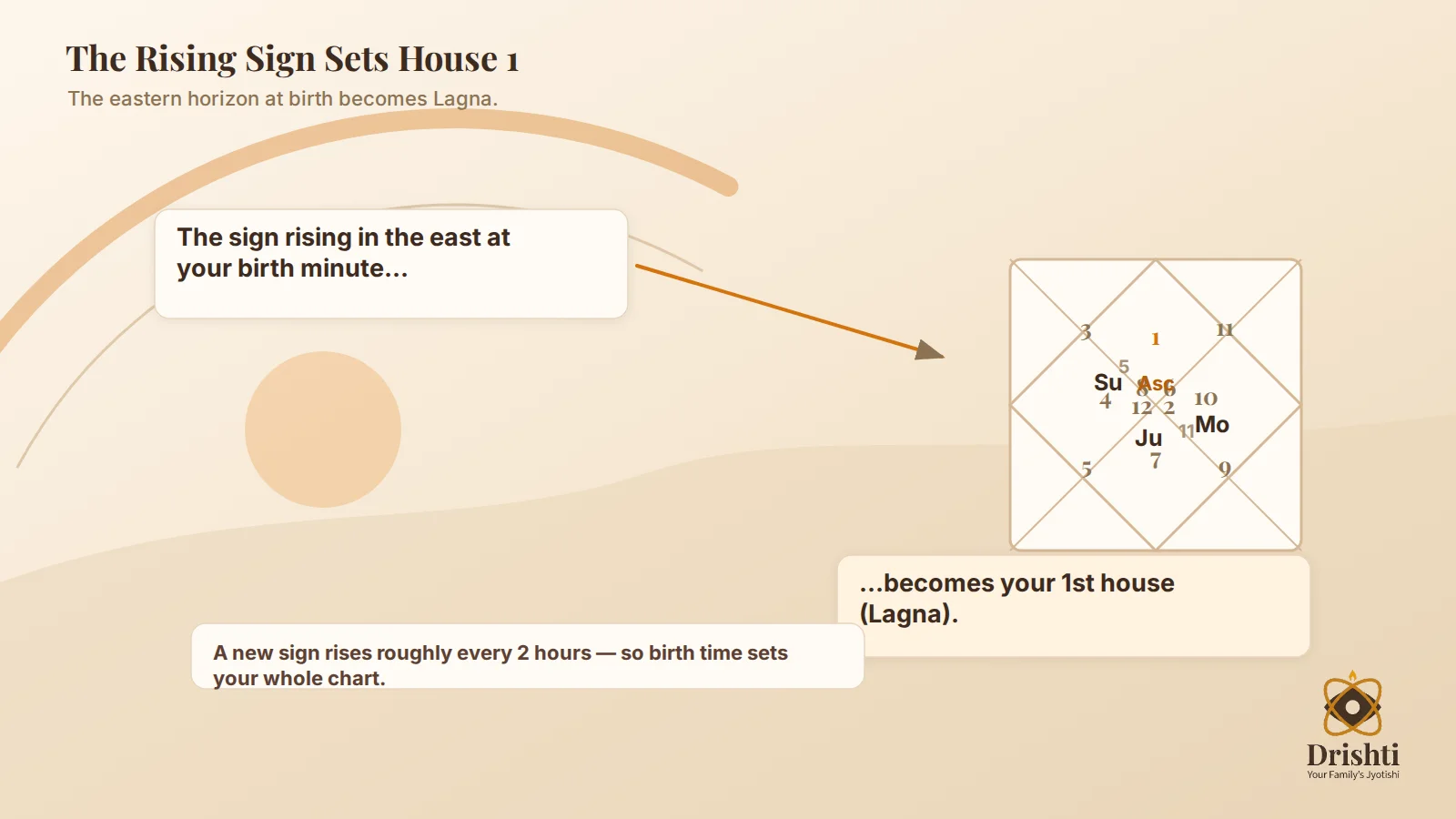
Picture the sky as a wheel turning behind the horizon. The Sun rises in the east, climbs, sets in the west — and the twelve zodiac signs ride that same wheel. Roughly every two hours, a new sign finishes climbing over the eastern horizon and a new one begins to rise. Whichever sign is in the middle of that rise at your birth minute is your Lagna.
Here is why that matters so much. A Kundli is not just a scatter of planets. It is a house system — twelve bhavas that stand for different areas of life: self and body, wealth and speech, siblings and effort, home and mother, and so on. Those houses have to start somewhere, and the Lagna is where they start. The first house is your Lagna. The second house is the next sign, the third the one after, all the way around.
So the Lagna is the frame. Once it is fixed, every planet in your chart lands in a specific house, and every house takes on the meaning of a specific sign. Move the frame and a planet that sat quietly in your “home and comfort” house can slide into your “career and public life” house instead. The planets have not moved — the reference point has. This is the mechanical reason astrologers fuss over your birth time: they are really fussing over your Lagna.
If you want to see how this frame sits inside a complete birth chart, our walkthrough on how to read your Kundli shows where the Lagna appears and how to trace the houses from it.
Lagna vs Moon sign vs Sun sign
Three “signs” get thrown around and constantly confused. They answer different questions, and in Vedic astrology they carry very different weight.
Lagna (Ascendant / rising sign) is set by the time and place of birth. It reflects the outward you — your body, temperament, how you meet the world, the overall architecture of your life’s houses. Because it changes roughly every two hours, it is the most time-sensitive of the three and the most personal.
Moon sign (Rashi / Chandra Lagna) is the sign the Moon occupied at your birth. In Indian tradition this is often what people mean by “my sign” — it is the basis of your nakshatra, your name syllable in many families, and a great deal of predictive work like Vimshottari dasha. The Moon governs the mind and emotions, so the Rashi speaks to your inner world. It shifts as the Moon moves, spending roughly two and a bit days in each sign, so it is far less time-sensitive than the Lagna but still needs an accurate date.
Sun sign is the sign the Sun occupied at birth — the one Western newspaper horoscopes use. The Sun stays in a sign for about a month, so your Sun sign only needs your birth date, not the time. That convenience is exactly why it is the least specific of the three. It is a broad brushstroke where the Lagna is a fingerprint.
A quick way to hold it: the Sun sign is the month, the Moon sign is the mood, the Lagna is the moment. Vedic practice leans hardest on the Moon and the Lagna, and treats the Sun sign as one factor among many rather than the headline.
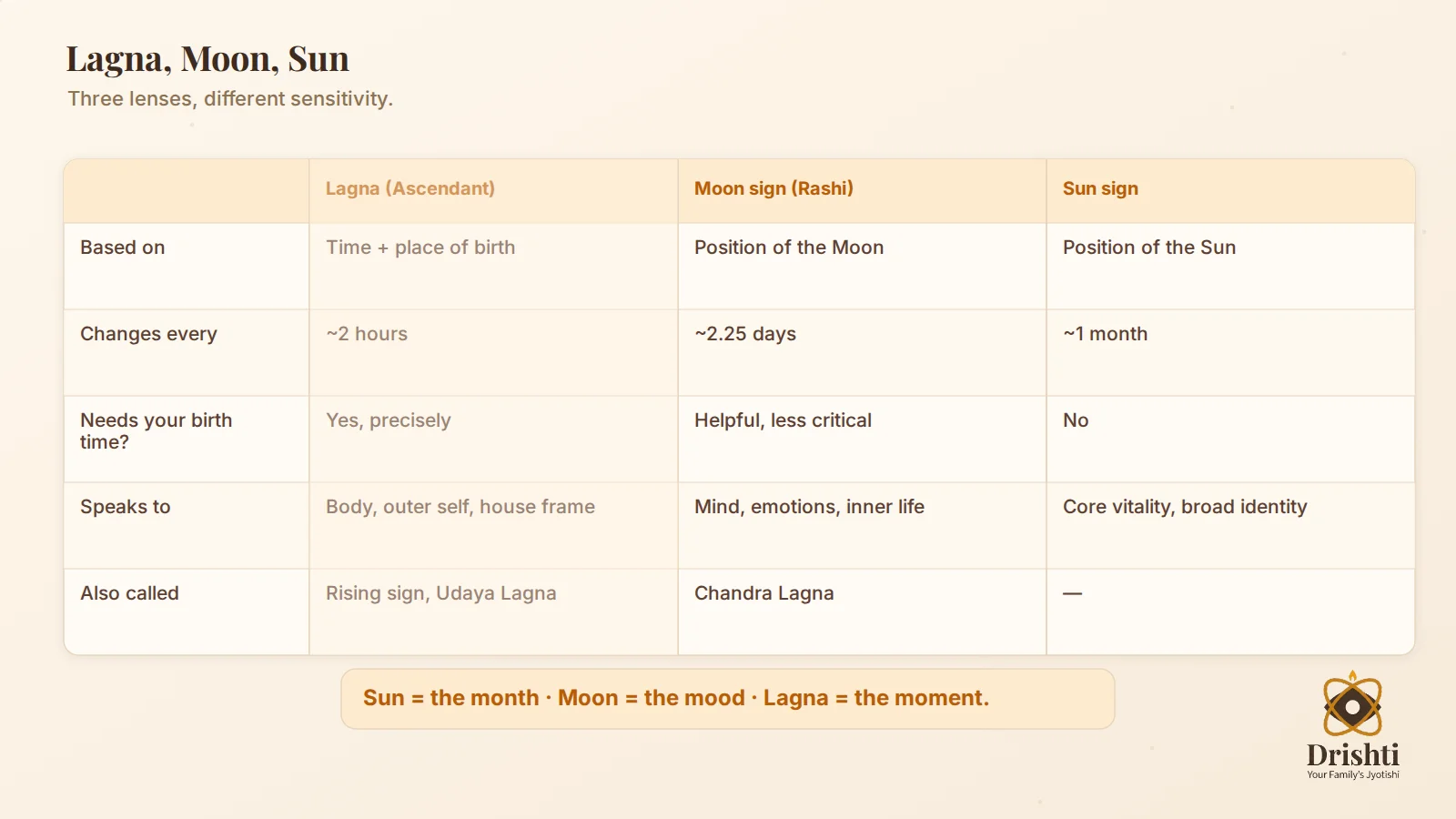
| Lagna (Ascendant) | Moon sign (Rashi) | Sun sign | |
|---|---|---|---|
| Based on | Time + place of birth | Position of the Moon | Position of the Sun |
| Changes every | ~2 hours | ~2.25 days | ~1 month |
| Needs your birth time? | Yes, precisely | Helpful, less critical | No |
| Speaks to | Body, outer self, house frame | Mind, emotions, inner life | Core vitality, broad identity |
| Also called | Rising sign, Udaya Lagna | Chandra Lagna | — |
What is the Lagna lord?
Every zodiac sign has a ruling planet. Since your Lagna is a specific sign, the planet that rules that sign becomes your Lagna lord — Lagnesh in Sanskrit. If your Ascendant is Mesha (Aries), Mars rules it, so Mars is your Lagna lord. If it is Tula (Libra), Venus is. The Lagna lord is treated as a significant planet for the whole chart because it “carries” the first house — the house of the self.
What astrologers actually do with the Lagna lord is look at where it sits and how it relates to the rest of the chart: which house it occupies, which planets it sits with, whether it is comfortable or under stress. From that they build a picture of themes and tendencies.
Here I want to be plain and careful, because this is where a lot of astrology writing overreaches. The Lagna lord is a lens for character and life-emphasis — not a verdict on your health, your fate, or how your life “must” turn out. A well-placed Lagna lord is not a guarantee and a stressed one is not a sentence. Good Jyotish reads it as one input among many, alongside free will, effort, and everything else a real life contains. Anyone who tells you your Lagna lord alone dictates your future is selling certainty that the tradition itself does not claim.
Why birth time matters so much
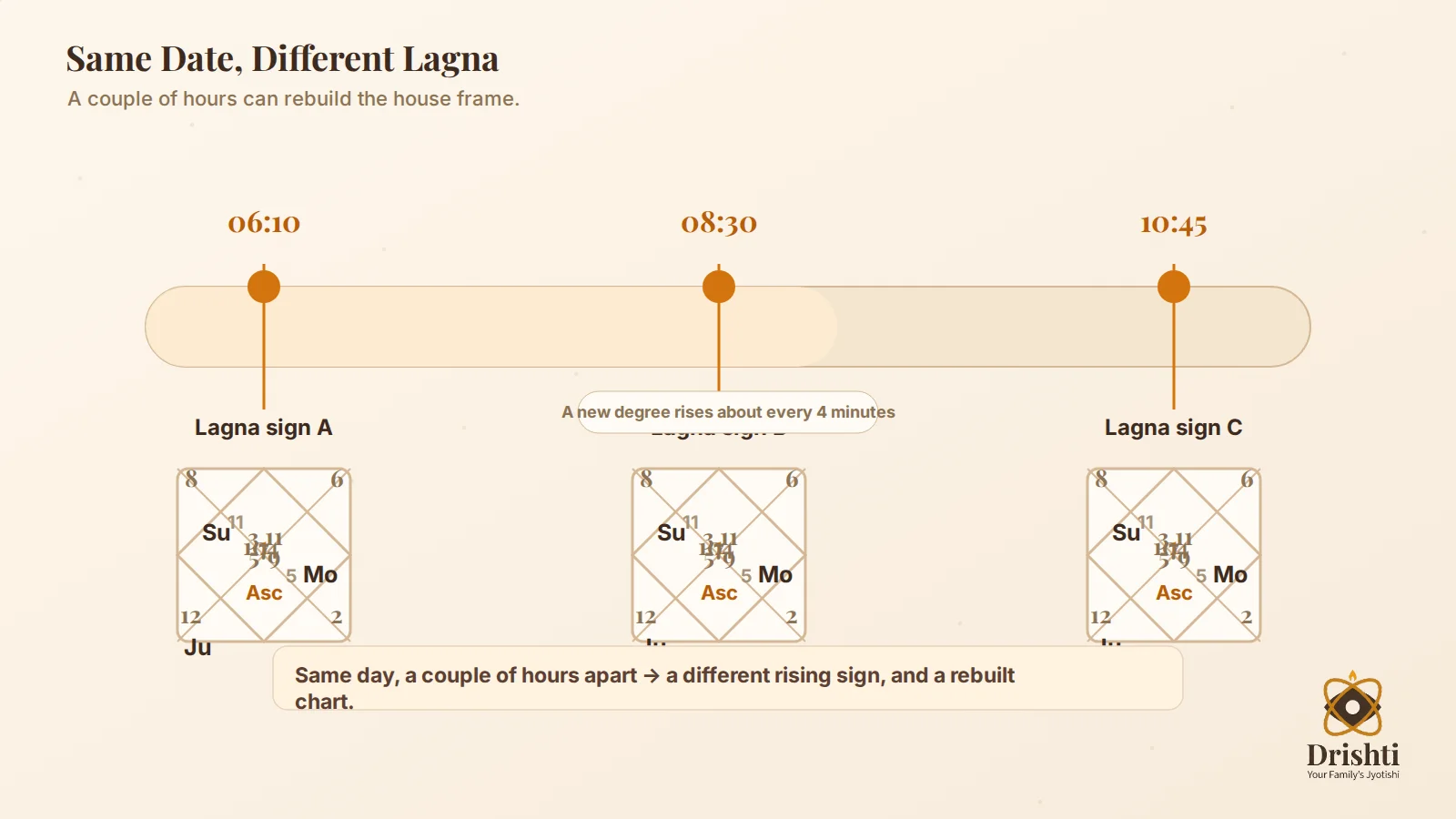
The Lagna moves fast — a fresh degree of the zodiac rises about every four minutes. That pace is the whole reason your recorded birth time deserves care.
Two consequences follow. First, the sign boundary. If you were born close to the moment one sign finished rising and the next began, even a ten- or fifteen-minute error in the recorded time can flip your Lagna to the neighbouring sign — and, as we saw, that rebuilds your entire house frame. Second, the finer structure inside the chart. Even when the Lagna sign is safely correct, its exact degree feeds sensitive calculations such as the divisional charts and certain timing methods, where small shifts matter.
Birth place matters for the same reason time does: the horizon is a local thing. The sky rising in the east over Chennai at 6:10 a.m. is not the sky rising over Delhi at the same clock time, because the two cities sit at different longitudes and latitudes. An accurate Lagna needs the birth location, not just the hour, so the calculation can use the correct local horizon.
This is also why a computed chart is only as trustworthy as the inputs you feed it. We go deeper into how small timing differences ripple through a chart in our piece on birth time and chart accuracy — worth a read if your recorded time is a guess or a rounded-off number.
The 12 Lagnas at a glance
Any of the twelve signs can rise, so there are twelve possible Ascendants, each with its own ruling planet. This table is a map, not a personality reading — the point is to show which planet becomes your Lagna lord for each rising sign, so the earlier section makes sense. Real interpretation always depends on the whole chart, never the Lagna sign alone.
| Lagna (rising sign) | Sanskrit name | Lagna lord (ruling planet) |
|---|---|---|
| Aries | Mesha | Mars |
| Taurus | Vrishabha | Venus |
| Gemini | Mithuna | Mercury |
| Cancer | Karka | Moon |
| Leo | Simha | Sun |
| Virgo | Kanya | Mercury |
| Libra | Tula | Venus |
| Scorpio | Vrishchika | Mars |
| Sagittarius | Dhanu | Jupiter |
| Capricorn | Makara | Saturn |
| Aquarius | Kumbha | Saturn |
| Pisces | Meena | Jupiter |
Notice that some planets rule two signs — Mercury rules both Gemini and Virgo, Venus both Taurus and Libra, and so on. That is normal in the traditional seven-planet scheme, and it is one more reason the Lagna lord is read by placement and condition, not by its name alone.
If you are still building the picture of what houses and signs even are, our beginner’s guide to the birth chart lays the foundation this table sits on.
What to do if your birth time is uncertain
Plenty of people simply do not have an exact birth time — the hospital recorded “morning,” a parent remembers “around lunch,” or the certificate rounds to the hour. That is common, and it is workable. Here is how I’d approach it.
Start with the most reliable source you have. A hospital record or birth certificate usually beats memory. If family members disagree, note the range rather than picking one number and pretending it is exact.
Understand what stays usable even without a precise time. Your Sun sign needs only the date. Your Moon sign is usually reliable too, since the Moon lingers a couple of days in each sign — only if you were born near a Moon sign change does the hour become critical. So even with a shaky time, a good deal of Vedic reading is still on solid ground.
Treat the Lagna as provisional, and say so. If the recorded time is a rough guess, hold your Ascendant loosely — especially if the guess sits near a two-hour boundary where the rising sign could plausibly be one of two.
Consider birth-time rectification for anything important. Rectification is the practice of narrowing an uncertain time by working backwards from known life events and physical traits. It is a specialist skill, it is an estimate rather than a proof, and honest practitioners present its result as a best-fit, not a fact. If your chart is going to inform a real decision, this is worth doing properly rather than guessing.
The healthy attitude is the same one good astrology takes everywhere: work with the best information you have, be honest about its limits, and don’t dress an estimate up as certainty.
That honesty is, frankly, the spirit we try to build Drishti around. Drishti is meant to be Your Family’s Jyotishi — a calm, trustworthy family astrologer that shows its work, speaks your language, and never traffics in fear. It generates an accurate Vedic Kundli from your birth details, keeps family profiles for more than one person, and aims to explain why a reading says what it says instead of handing down a verdict. When the inputs are uncertain, the right answer is to show the uncertainty — not to paper over it with false confidence.
FAQ
What is Lagna in Vedic astrology? Lagna is the zodiac sign rising on the eastern horizon at the exact time and place of your birth. It becomes the first house of your Kundli and sets the frame for all twelve houses, which is why it is treated as the anchor of the whole chart.
Is Lagna the same as Ascendant? Yes. “Lagna” is the Sanskrit term and “Ascendant” (or “rising sign”) is the English one — they refer to the same point. You may also see it written as Udaya Lagna, meaning the rising Lagna.
Is Lagna more important than Sun sign? In Vedic astrology, generally yes. Your Sun sign only needs your birth date and is a broad marker, while your Lagna depends on your precise time and place and determines how your entire chart is built. Vedic practice leans far more on the Lagna and the Moon sign than on the Sun sign.
How do I find my Lagna? You need your date, exact time, and place of birth. From those, a Vedic astrology app or astrologer calculates which sign was rising on the eastern horizon at that moment. You cannot reliably work it out from your birth date alone, because the Lagna changes roughly every two hours.
What if I do not know my birth time? You can still get a lot from your chart — your Sun sign needs only the date, and your Moon sign is usually reliable too. Treat your Lagna as provisional, use the most trustworthy time source you have (a hospital record beats memory), and consider professional birth-time rectification if the chart will inform an important decision. Be honest that an uncertain time makes the Lagna an estimate.
What is Lagna lord? The Lagna lord, or Lagnesh, is the planet that rules your Ascendant sign — for example, Mars for an Aries Lagna or Venus for a Libra Lagna. Astrologers study where it sits in the chart to read life themes and tendencies, but it is one lens among many, not a fixed verdict on your health or fate.