Quick answer: what a Vedic birth chart maps
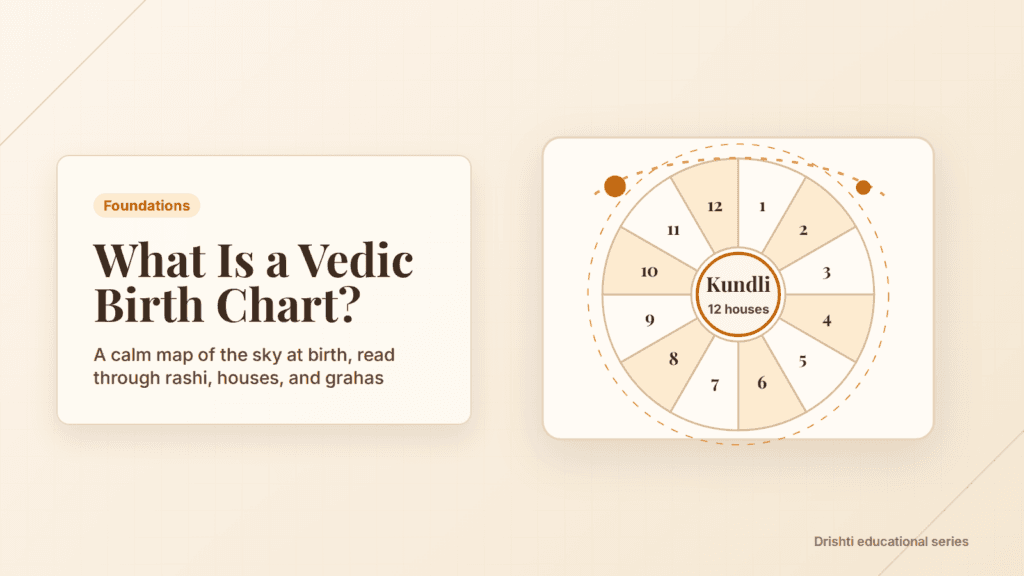
A Vedic birth chart is a snapshot of the sky at the exact moment and place you were born, drawn as a diagram. It records where the Sun, Moon and other planets sat against the zodiac, and which sign was climbing over the eastern horizon at your first breath — the Lagna, or Ascendant. From those two facts, the whole map is built.
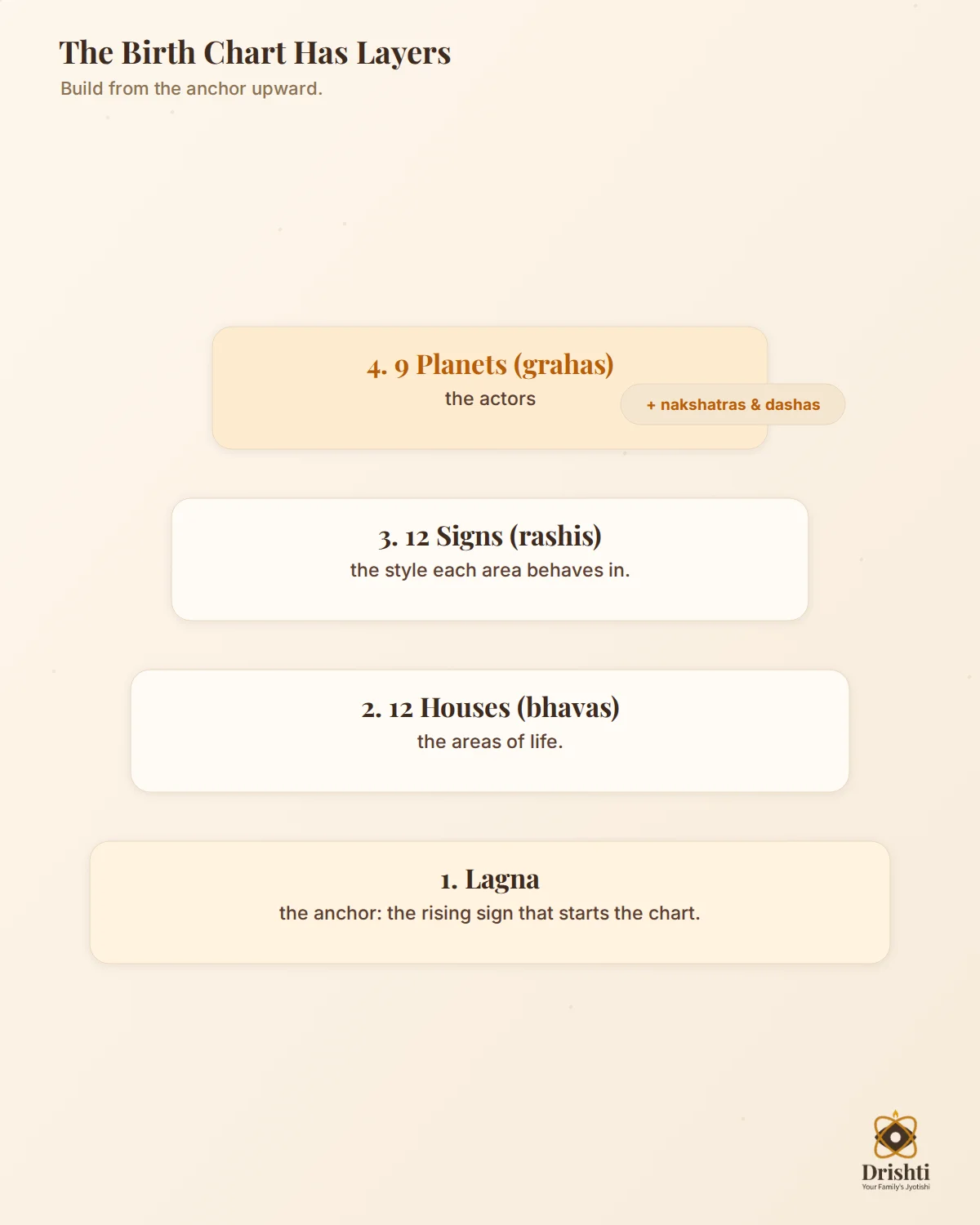
Read the chart on four layers, and it stops looking cryptic. The Lagna anchors it. The twelve houses (bhavas) mark the areas of life. The twelve signs (rashis) colour how each area behaves. The nine planets (grahas) are the actors moving through it, with nakshatras and dashas adding a finer layer of timing. That’s the entire skeleton. Everything else in Jyotish is interpretation built on top.
This post is the conceptual map — what the pieces are and how they fit. If you want the step-by-step method for actually sitting with your own chart, see how to read your Kundli (#7).
Kundli, Janam Kundli, birth chart — names for the same map
The word changes with the language; the object doesn’t. Kundli and Janam Kundli are the Hindi/Sanskrit terms for the same diagram English speakers call a birth chart or natal chart. In South India you’ll hear jataka or jatakam. A grandmother asking for your Janam Kundli and an app generating your “Vedic birth chart” are pointing at the identical thing: your natal sky, mapped.
One honest caveat: a Kundli is only as accurate as the birth data behind it. The Lagna shifts roughly every two hours, so a birth time off by an hour can hand you the wrong rising sign — and a differently arranged chart. Date and place matter too, but time is the fussy one. This is why a good app asks for your birth time, not just your birthday, and why families dig out the hospital record or the janam patri the pandit wrote decades ago.
In my testing, the Kundli generators that quietly ask “not sure of the exact time?” and explain what that costs you are the ones treating you like an adult. The tagline Drishti works to — Your Family’s Jyotishi — leans on the same idea: a calm astrologer that shows its work rather than hiding the machinery.
The Lagna: where the chart begins
Everything in a Vedic chart is numbered outward from the Lagna, so it deserves to come before the houses, not after. The Lagna — the Ascendant — is the sign of the zodiac that was rising on the eastern horizon at your moment of birth. Because the Earth turns a full circle every day, all twelve signs take a turn rising, each for about two hours. Whichever one was cresting the horizon when you arrived becomes your first house, and the chart counts forward from there.
Why does this anchor everything? Because the houses are positions, not fixed signs. Your Lagna decides which sign sits in the first house, which in the second, and so on around the wheel. Two people born the same day in the same city can carry very different charts if born hours apart — same planetary positions, different Lagna, so the same planets land in different houses and mean different things.
This is also the split between Jyotish and the “sun sign” of newspaper columns. Western pop-astrology leads with your Sun sign; Jyotish leads with your Lagna and gives the Moon sign (the janma rashi) heavy weight too. If a newspaper horoscope ever felt like it described a stranger, a Sun-sign-versus-Lagna mismatch is often why. For a deeper look at the rising sign, see understanding your Lagna (#9).
The 12 houses: where life themes play out
If the chart is a stage, the twelve houses are the rooms of the house — each one holding a department of life. They’re called bhavas, and they stay in the same order for everyone: the first house is always the self, the seventh always the partner, and so on. What changes person to person is which sign and which planets occupy each room.
The houses are grouped in ways that experienced readers lean on. The 1st, 5th and 9th are the dharma (purpose) houses; the 2nd, 6th, 10th the artha (resources and work) houses; the 3rd, 7th, 11th the kama (desire and connection) houses; the 4th, 8th, 12th the moksha (inner and endings) houses. You don’t need to memorise that to read a chart, but it explains why certain houses “rhyme.”
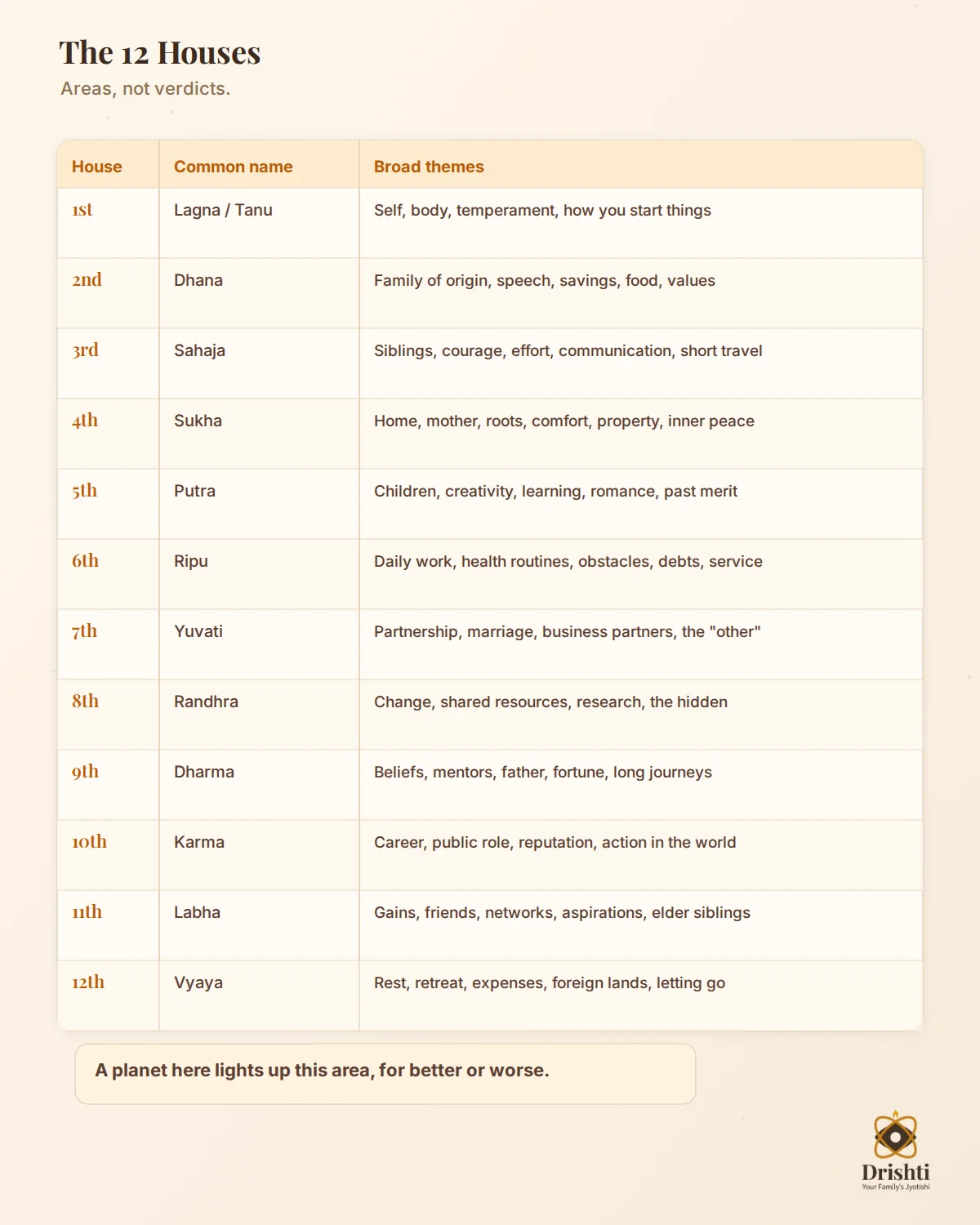
| House (Bhava) | Common name | Broad life themes it signifies |
|---|---|---|
| 1st | Lagna / Tanu | Self, body, temperament, how you start things |
| 2nd | Dhana | Family of origin, speech, savings, food, values |
| 3rd | Sahaja | Siblings, courage, effort, communication, short travel |
| 4th | Sukha | Home, mother, roots, comfort, property, inner peace |
| 5th | Putra | Children, creativity, learning, romance, past merit |
| 6th | Ripu | Daily work, health routines, obstacles, debts, service |
| 7th | Yuvati | Partnership, marriage, business partners, the “other” |
| 8th | Randhra | Change, shared resources, research, the hidden |
| 9th | Dharma | Beliefs, mentors, father, fortune, long journeys |
| 10th | Karma | Career, public role, reputation, action in the world |
| 11th | Labha | Gains, friends, networks, aspirations, elder siblings |
| 12th | Vyaya | Rest, retreat, expenses, foreign lands, letting go |
Treat these as areas, not verdicts. A planet in the 6th house doesn’t mean “you will be sick.” It means matters of work, routine and resolving obstacles are lit up in your story — for better or worse depending on the planet and the sign around it.
The 12 signs: how energy expresses
The signs — rashis — are the twelve 30-degree slices of the zodiac, the same familiar cast: Aries (Mesha), Taurus (Vrishabha), Gemini (Mithuna), and so on to Pisces (Meena). If the houses are where something happens and the planets are what is acting, the signs describe the style in which it happens.
Each sign carries a temperament — fire signs push, earth signs build, air signs connect, water signs feel — and each is ruled by a planet, which is how signs and grahas hand off to each other. Mars rules Aries and Scorpio; Venus rules Taurus and Libra; and so on. A planet in the sign it rules tends to act from comfort; a planet in a sign it dislikes has to work harder to express itself.
Here’s the practical bit newcomers trip on: in a Vedic chart the sign is not fixed to a house number. Whatever sign your Lagna is, that sign occupies the first house, and the rest follow around the wheel in order. So one person’s tenth house of career might be Capricorn while another’s is Cancer — same house, different sign, different flavour of how career shows up. Sign plus house plus planet is the sentence; no single one of the three is the whole meaning.
The 9 planets: what is acting in the chart
Vedic astrology works with nine “planets,” the navagraha — and the word planet is loose here, since the list includes the two luminaries and two mathematical points, not just planets in the astronomical sense. They are: Surya (Sun), Chandra (Moon), Mangal (Mars), Budha (Mercury), Guru/Brihaspati (Jupiter), Shukra (Venus), Shani (Saturn), and the two lunar nodes, Rahu and Ketu. Notably, the outer planets Uranus, Neptune and Pluto — standard in Western charts — are not part of the classical navagraha.
Each graha carries a set of significations. The Sun speaks to identity, vitality and the father; the Moon to mind, emotion and the mother; Mercury to intellect and speech; Jupiter to wisdom, growth and teachers; Venus to relationships, comfort and art; Mars to drive and conflict; Saturn to discipline and hard-won maturity. Rahu and Ketu — the north and south nodes, where the Moon’s path crosses the Sun’s — are the eclipse points, read as an axis of amplified craving (Rahu) and detachment (Ketu).
A planet’s meaning in your chart comes from three things at once: the house it sits in, the sign it occupies, and how it relates to other planets by aspect. This is where reading gets genuinely skilled. The takeaway here is simpler: houses and signs are the board; the grahas are what’s played on it.
Nakshatras and dashas: the finer timing layer
The signs divide the zodiac into twelve. The nakshatras divide the same circle into a finer grid of twenty-seven “lunar mansions,” each spanning 13°20′. Where the Moon sits by nakshatra at birth is treated as one of the most personal points in the whole chart — it’s often what a traditional astrologer asks for first, and it’s the basis for the name-syllable many families choose from. The twenty-seven are named Ashwini, Bharani, Krittika, Rohini, and so on through Revati.
Nakshatras add nuance that signs alone can’t. Two people with the Moon in the same sign can fall in different nakshatras and read quite differently. For the full tour of the twenty-seven and what each is associated with, see the 27 nakshatras explained (#11). Where a specific ruling deity, symbol or classical attribution matters, we hold it to native-source verification rather than repeating folklore.
Timing comes from the dasha system, most commonly Vimshottari dasha, a 120-year cycle that assigns long planetary periods across a lifetime and is calculated from your birth nakshatra. Each planet “runs” for a set span — Sun 6 years, Moon 10, Mars 7, Rahu 18, Jupiter 16, Saturn 19, Mercury 17, Ketu 7, Venus 20 (totalling 120) — and those periods are subdivided further. The idea is that a chart is a fixed map, but dashas describe when a given part of it becomes active. For how these periods are read and used, see Vedic dashas explained (#10).
Vedic vs Western birth charts
The most common question I get from readers coming over from Western astrology: why is my sign different here? The answer is one measurement, not a disagreement about you.
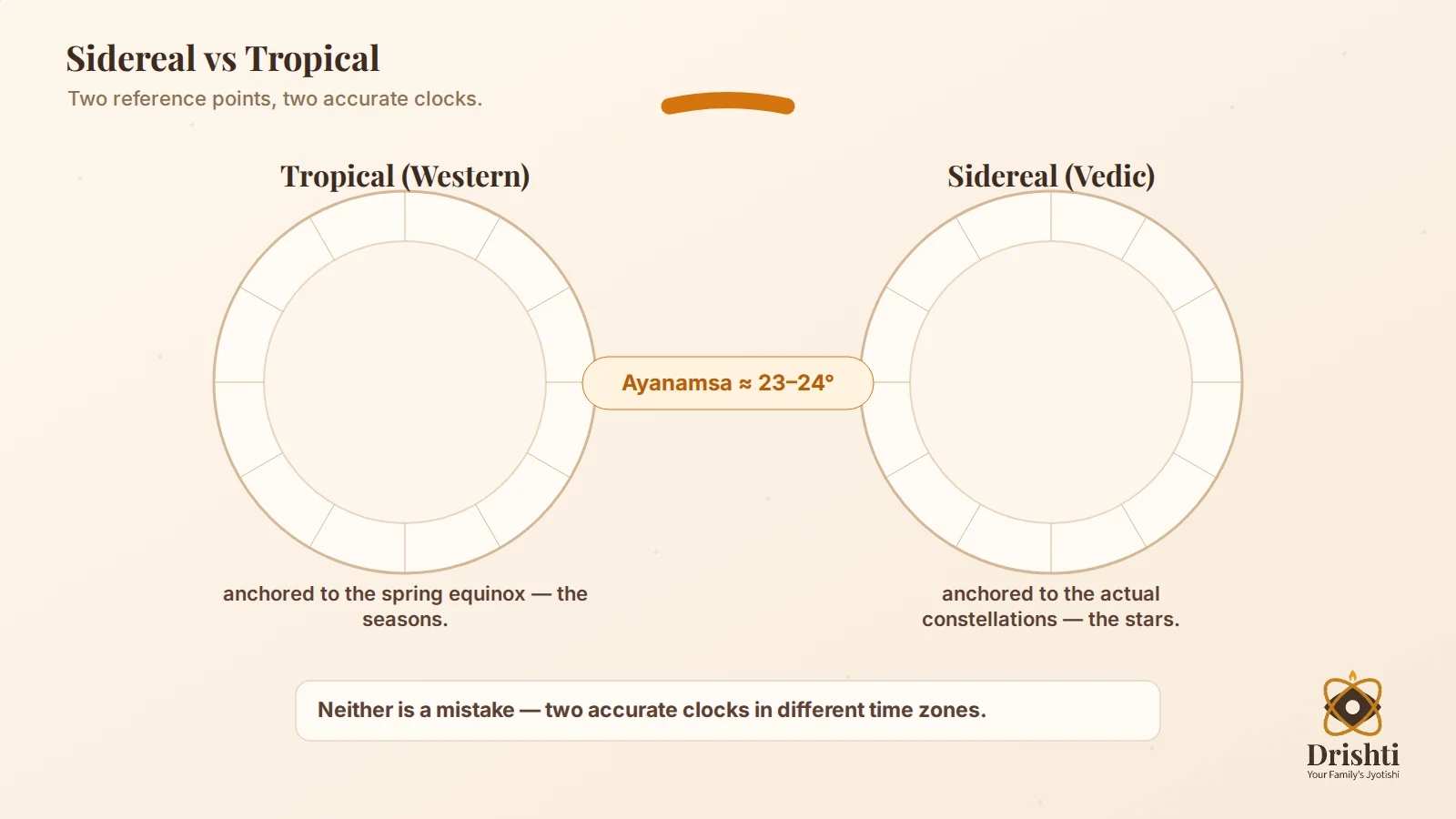
Both systems chart the same sky and use the same twelve signs. The difference is the reference point they measure from. Western astrology mostly uses the tropical zodiac, which fixes the start of Aries to the spring equinox — a point tied to Earth’s seasons. Vedic astrology uses the sidereal zodiac, which fixes the signs to the actual constellations. Over centuries the equinox has drifted against the stars (a slow wobble called precession), so the two systems now sit roughly 23–24 degrees apart. That gap is the ayanamsa.
That drift is why many people land one sign “earlier” in their Vedic chart — a late-Aries Sun in the tropical system often reads as Pisces in the sidereal one. Neither is a mistake. They answer slightly different questions from different anchors: seasons versus stars, like two accurate clocks in different time zones.
One more surface difference: chart shape. A North Indian chart is a fixed diamond grid where the houses stay put and the signs rotate into them; the Lagna always sits top. A South Indian chart is a fixed square grid where the signs stay put and you locate the Lagna wherever it falls. East Indian charts use yet another square layout. They look completely different and can throw a beginner, but encode identical information — pick the one your family or astrologer reads fluently. For how the same birth data is computed and rendered accurately across these formats, see Kundli calculation and accuracy (#13).
What a chart can and cannot tell you
A birth chart is a map of tendencies and timing, not a script. It can point to where your natural strengths and friction sit, which life areas are emphasised, and — through dashas — roughly when certain themes come forward. Used well, it’s a mirror and a planning tool, most useful when it prompts a better question rather than handing you an answer.
What it can’t do is deliver certainties about your health, your finances, whether a marriage will “work,” or a fixed date for any outcome. Anyone who reads your chart as doom or as a guarantee has left the tradition for fortune-telling theatre. Jyotish at its best is decision support — it helps you act with more self-knowledge, not less agency. That’s the line Drishti holds: a calm, transparent reading that shows its reasoning and never traffics in fear, built for a whole family.
Start with the four foundations — Lagna, houses, signs, planets, with nakshatras and dashas layered on — and the chart becomes readable. Then, when you’re ready to move from what it is to how to read it, how to read your Kundli (#7) is the next step.
FAQ
What is a Vedic birth chart? A Vedic birth chart (Kundli) is a diagram of the sky at your exact birth time, date and place. It maps the Ascendant (Lagna), the twelve houses, the twelve signs, and the nine planets — plus nakshatras and dashas for finer detail — using the sidereal zodiac. It’s the foundational tool of Jyotish, read as a map of tendencies and timing rather than a fixed prediction.
Is Kundli the same as birth chart? Yes. “Kundli” and “Janam Kundli” are the Hindi/Sanskrit names for what English calls a birth chart or natal chart; in the south you’ll hear jataka or jatakam. It’s the same object — your natal sky mapped as a diagram — described in different languages.
What are the 12 houses in Vedic astrology? The twelve houses (bhavas) are fixed areas of life the chart is divided into, numbered from your Lagna: 1st self, 2nd family and wealth, 3rd siblings and effort, 4th home and mother, 5th children and creativity, 6th work and health, 7th partnership, 8th change and the hidden, 9th beliefs and fortune, 10th career, 11th gains and networks, 12th rest and letting go. Which sign and planets fall in each house is what makes a chart personal.
What are the 9 planets in Vedic astrology? The navagraha are the Sun (Surya), Moon (Chandra), Mars (Mangal), Mercury (Budha), Jupiter (Guru), Venus (Shukra), Saturn (Shani), and the two lunar nodes Rahu and Ketu. Vedic astrology doesn’t use Uranus, Neptune or Pluto. Each carries specific significations that are read through the house and sign it occupies.
Why is my Vedic sign different from my Western sign? Because the two systems measure from different reference points. Western astrology mostly uses the tropical zodiac (anchored to the spring equinox); Vedic uses the sidereal zodiac (anchored to the actual constellations). Precession has spread them about 23–24 degrees apart — the ayanamsa — so many people’s Sun lands in the previous sign in their Vedic chart. Neither is wrong; they’re answering from a seasonal versus a star-based anchor.