Quick answer: the order to read a Kundli
Read a Kundli in a fixed order, from the frame outward: Lagna first (the ascendant, which sets which house is which), then the Moon sign and nakshatra (your Rashi and the star the Moon sits in), then planets in houses (where the nine grahas land), then signs and house lords (which sign owns each house and where its lord sits), and finally the current dasha (the planetary period running now). Build the stage, place the actors, then check what act you’re in. Everything else — aspects, yogas, divisional charts — comes later. This guide walks each step with a ten-minute exercise for your own chart.
What a Kundli is and what it is not
A Kundli — your Janam Kundli, or birth chart — is a map of the sky at the exact moment and place you were born, frozen into a diagram of twelve houses, twelve signs, and the nine grahas. It reads as a snapshot of tendencies: strengths you lean on, areas that ask for effort, timing of themes across a life. A model, not a verdict.
Here is what it is not, because most confusion starts here. It is not a fortune-teller’s slip predicting a fixed event on a fixed date, and it is not the “sun sign” horoscope in a newspaper — a single data point stretched across a twelfth of humanity. It is also not something to fear. A well-read Kundli reads like a weather forecast for temperament and timing: useful for planning, honest about uncertainty, never a doom sentence. If a reading leaves you scared rather than informed, the reading was wrong, not the chart.
Its power is that it is specific to you — your birth time and place produce a chart no generic horoscope can. That’s also its demand: read it carefully, in order, or you’ll misread it confidently. For the deeper definition and history, see what is a Vedic birth chart. This post assumes you have a chart open.
First, orient yourself to the chart style
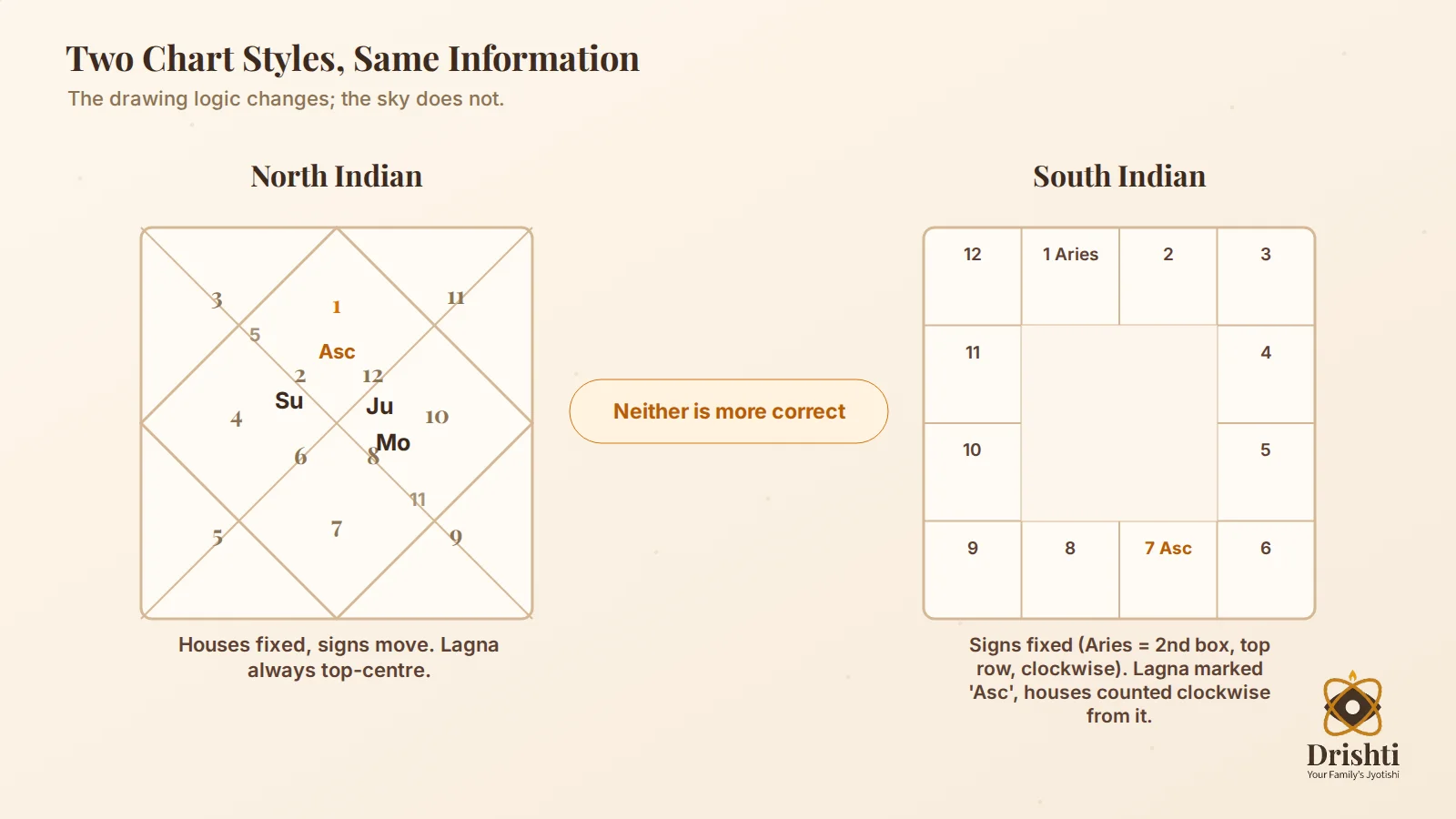
Before you read a single placement, work out which drawing style you’re looking at. The same chart gets drawn two completely different ways in India, and beginners routinely misread one by assuming it follows the other’s rules. The core difference: in the North Indian style the houses are fixed on the page and the signs move; in the South Indian style the signs are fixed and the houses move. Get that backwards and your entire reading inverts.
North Indian chart
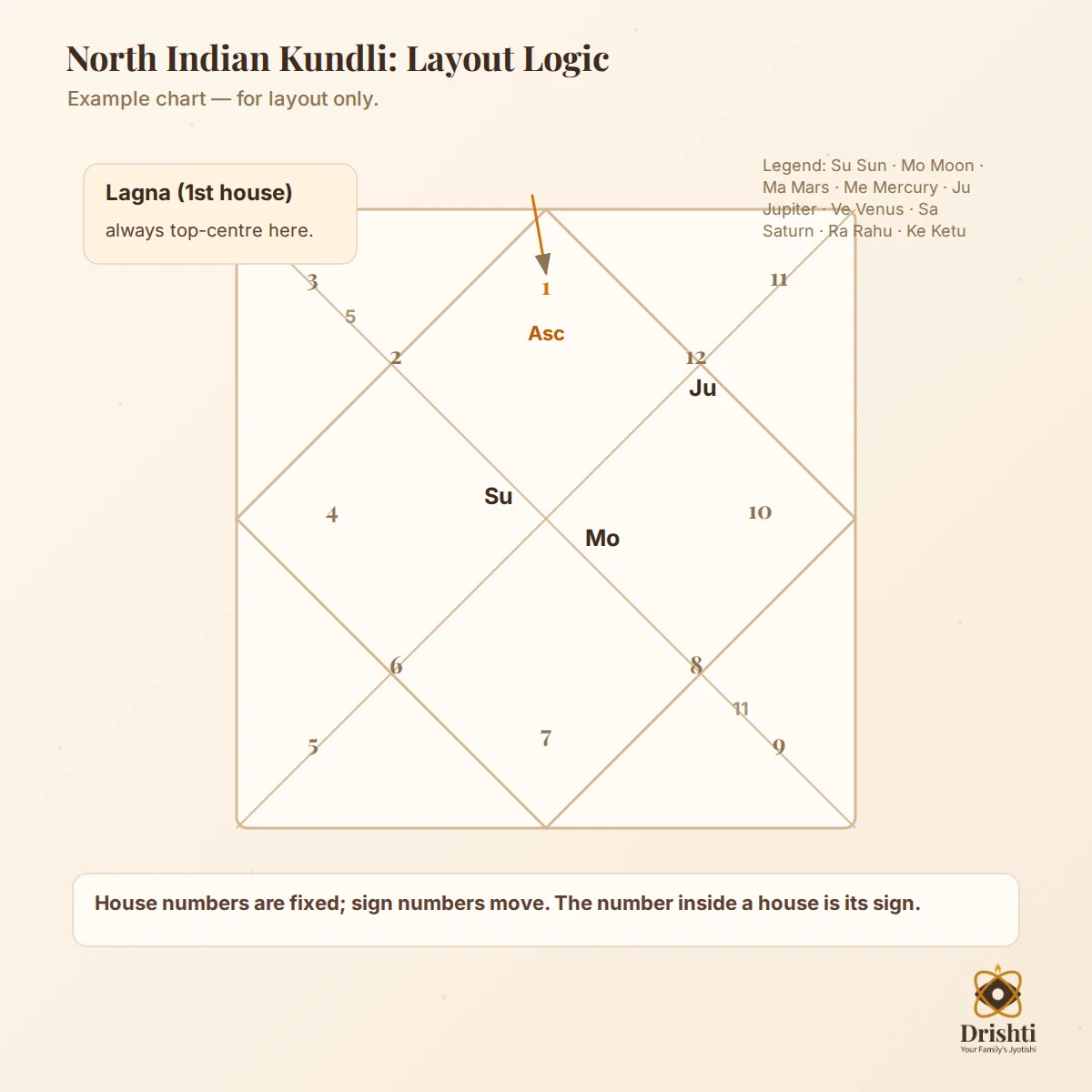
The North Indian Kundli is a diamond-in-a-square with a fixed house layout. The first house (Lagna) is always the top-centre diamond, and the houses run counter-clockwise from there. Because the houses never move, what you read off the chart is the sign number written inside each — signs are numbered 1 to 12 (Aries = 1 through Pisces = 12). So the number in the top-centre house is your Lagna sign; the planets drawn in a house are what’s placed there.
South Indian chart
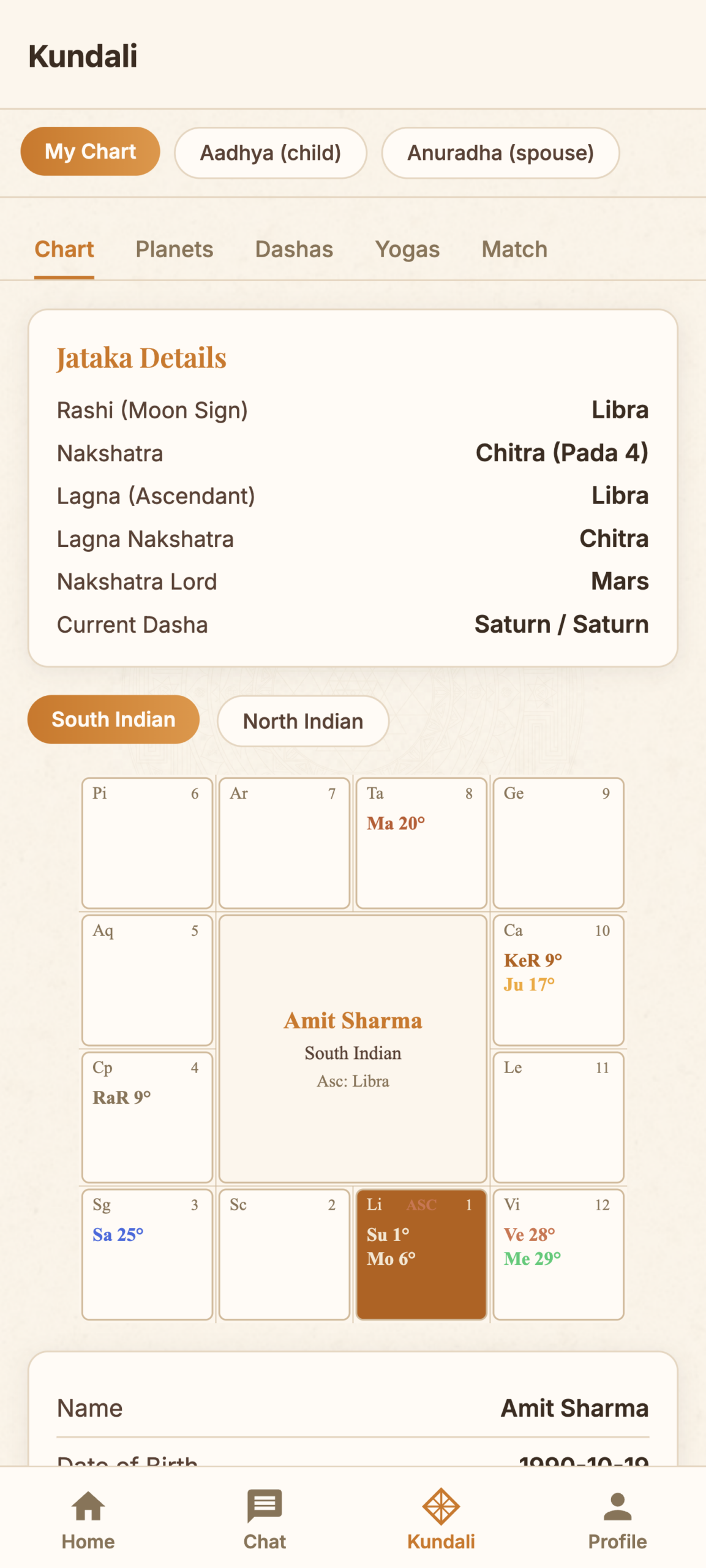
The South Indian Kundli is a grid of twelve boxes, and here the signs are fixed in place — Aries always sits in the second box of the top row, running clockwise around the border, no matter whose chart it is. What moves is the Lagna, marked with a diagonal line or “Asc” in whichever sign box holds the ascendant. From that box you count houses clockwise: Lagna box is house 1, the next clockwise is house 2, and so on. Same information, opposite drawing logic. Neither is “more correct” — pick whichever your app or family astrologer uses and stay consistent. If your chart came from Drishti, the app labels the Lagna and house numbers on the diagram, which removes the most common orientation slip for beginners.
Step 1 – Find the Lagna
The Lagna — also called the Ascendant — is the zodiac sign that was rising on the eastern horizon at your birth moment, and it is the anchor of the entire chart. It decides which sign becomes your first house, and therefore which signs fill houses 2 through 12; change it and every house-lord relationship changes too. It shifts roughly every two hours, which is why two people born the same day can have very different charts.
To find it: on a North Indian chart, read the sign number in the top-centre diamond; on a South Indian chart, find the box marked “Asc.” That house is house 1 — self, body, and the overall tone of the chart — and its lord (the planet ruling that sign) becomes one of the most important planets in your chart specifically. We go deeper in understanding your Lagna and Ascendant.
Step 2 – Find the Moon sign and nakshatra
The Moon is the second anchor, and in Vedic practice it often does more day-to-day work than the Lagna. Your Moon sign (Rashi) is the sign the Moon occupied at birth — what a traditional Indian astrologer usually means by “what’s your Rashi?”, and the basis for most predictive dasha work. The Moon governs the mind and emotion, which is why it carries so much weight. Find it in the chart (labelled “Mo” or “Ch” for Chandra), and note its sign and house.
Then find its nakshatra. The zodiac’s 360° is divided into 27 nakshatras of 13°20′ each, and the Moon always falls in one of them. Your Janma Nakshatra (birth star) is the nakshatra the Moon sits in, and it’s not decoration — it’s the starting point of your Vimshottari dasha timeline, so you can’t compute your life periods without it. A good app prints it (often with its pada, or quarter) on the chart. The 27 names and their spans are settled calculation facts; the deities, symbols, and finer per-star meanings deserve care, and we treat them properly in the 27 nakshatras explained.
Step 3 – Read planets in houses
Now place the actors. There are nine grahas — the Navagraha: Sun (Su), Moon (Mo/Ch), Mars (Ma), Mercury (Me), Jupiter (Ju), Venus (Ve), Saturn (Sa), and the lunar nodes Rahu (Ra) and Ketu (Ke). Go house by house, 1 through 12, and note which grahas sit in each. Some houses will be empty — that’s normal; an empty house is read through its lord (Step 4).
Read a planet-in-house as a plain sentence: this planet is doing its work in this area of life. Jupiter in the fifth speaks to learning, children, and creativity; Saturn in the tenth to career built through effort and time. Keep it tendency-based and non-fatal — a “difficult” planet is a theme to work with, not a sentence handed down. Note the placement, keep moving, and interpret the whole picture at the end.
Step 4 – Add signs and house lords
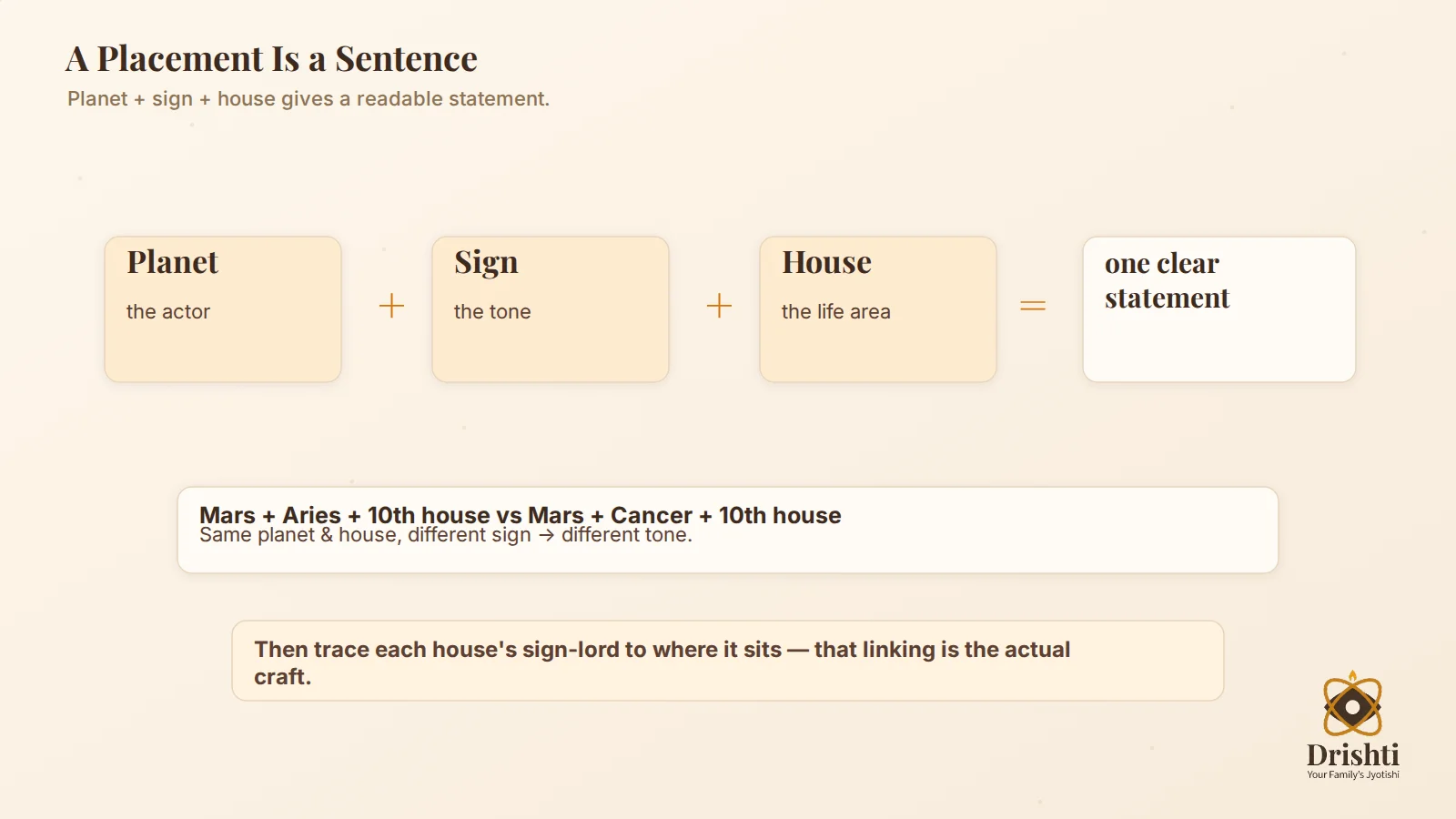
This step separates a real reading from a glossary lookup, and it’s where most beginners stop too early. Each house sits in a sign, and each sign has a ruling planet — its lord. The house takes on the flavour of its sign, and where that lord sits tells you where its energy “goes.”
Work it like grammar. A placement is three words: planet + sign + house. “Mars in Aries in the tenth” reads differently from “Mars in Cancer in the tenth” — same planet and house, different sign, different tone. Then add the lordship layer: find the sign on each house, identify its ruling planet, and see where that lord sits. If the lord of your tenth house (career) sits in your eleventh (gains, networks), that connects career to networks. That linking is the actual craft of chart reading.
You don’t need to memorise all rulerships on day one; a chart app labels each house’s sign, so you can look up the lord and trace it. Do the four houses you care about most first (usually 1, 4, 7, 10) — depth beats completeness in a first session.
Step 5 – Check the current dasha
A chart shows the whole life at once, which is why it can’t tell you about now on its own. The dasha system is the clock that activates different parts of the chart over time. The default is the Vimshottari dasha, a 120-year cycle of nine planetary periods (Mahadashas) with fixed lengths: Ketu 7 years, Venus 20, Sun 6, Moon 10, Mars 7, Rahu 18, Jupiter 16, Saturn 19, Mercury 17. Your birth started somewhere inside this cycle, decided by the Moon’s nakshatra from Step 2 — which is why that nakshatra mattered.
To read timing: find which Mahadasha you’re in now, and the sub-period (Antardasha) inside it. Then look at that planet in your chart — its house, sign, and lordship — because the running dasha spotlights that planet’s themes for its stretch of years. A chart app calculates your current Mahadasha and Antardasha, so you just read the active planet’s placement. Keep the framing honest: a dasha is a season, not a sentence — a period that emphasises certain themes, never a fixed event on a fixed date. We break down how the Vimshottari periods are calculated in the Vimshottari dasha explained.
A simple first-reading example
Here’s the ten-minute workflow. Open your chart and do these in order, before reading a single interpretation:
| Minute | Do this | Write down |
|---|---|---|
| 0–1 | Identify the chart style (North = house fixed top-centre; South = signs fixed) | “North” or “South” |
| 1–3 | Find the Lagna sign and mark house 1 | Lagna sign |
| 3–5 | Find the Moon: its sign, house, and nakshatra | Moon sign + house + nakshatra |
| 5–7 | Go house 1→12, note which grahas sit where | Planets per house |
| 7–9 | For houses 1, 4, 7, 10: note the sign and where its lord sits | Four house-lord placements |
| 9–10 | Find your current Mahadasha + Antardasha; look at that planet’s placement | Running dasha planet + its house |
Now read it as one paragraph, in your own words: “I’m a [Lagna] ascendant, Moon in [sign] in the [n]th house in [nakshatra]. My tenth house is [sign] and its lord sits in the [n]th, so career links to [that area]. I’m in [planet] Mahadasha, and that planet sits in my [n]th house, so this season leans toward [that theme].” That paragraph — built from the five steps, hedged as tendency not fate — is a genuine first reading. It’s rough, and it should be. One rule: collect all six data points first, then synthesise, because meaning lives in the combination, not the individual placement.
Common beginner mistakes
These account for most bad first readings, and each is avoidable once you’ve named it.
- Reading one placement as destiny. A single “bad” planet is not a verdict — it’s modified by sign, lord, aspect, and dasha. Synthesise, don’t sentence.
- Reading it like a Sun sign. The newspaper “Aries horoscope” is Western sun-sign entertainment. A Vedic Kundli leads with the Lagna and Moon; the Sun is one graha among nine, not the headline.
- Ignoring or approximating birth time. The Lagna shifts about every two hours and the whole house framework hangs on it, so a wrong time quietly breaks everything downstream, including your dasha — see Kundli calculation accuracy.
- Skipping the current dasha. A chart without its running dasha tells you about the whole life but nothing about now — usually the actual question you came with.
- Confusing the two chart styles. Applying North Indian rules (fixed houses) to a South Indian chart (fixed signs) inverts the whole reading. Identify the style first.
- Chasing depth before basics. Divisional charts, obscure yogas, and advanced techniques are premature. Get the five steps solid across several sittings first.
When you actually need an astrologer
Reading your own chart is genuinely doable, and you should — it builds intuition no app or consult can hand you. Do it yourself for learning and everyday self-understanding. Bring in an experienced astrologer when the stakes are real and specific — a major decision where you want a trained second read, a birth time you need rectified, or a chart with contradictory signals you can’t reconcile. That’s judgement, not fear. A good astrologer, like a good Kundli, informs a decision — it never issues a doom verdict or pressures you with urgency.
This is the posture Drishti is built for: a calm, trustworthy family astrologer that shows its work, speaks your language, and never traffics in fear. It generates an accurate Vedic Kundli, labels the Lagna, houses, Moon nakshatra, and dasha on the chart, and holds profiles for multiple family members — so the whole household’s charts live in one place, in the language you actually think in. Your Family’s Jyotishi.
FAQ
How do I read my Kundli for beginners? Read it in a fixed order: identify the chart style, find the Lagna (which sets house 1), find the Moon’s sign and nakshatra, note which planets sit in which houses, add each house’s sign and where its lord sits, and check your current dasha. Collect all of it first, then synthesise into one plain-English paragraph. The ten-minute table above is your first pass.
What should I look at first in a Kundli? The Lagna (Ascendant) — the top-centre house on a North Indian chart, or the box marked “Asc” on a South Indian chart. It anchors the whole reading, deciding which sign becomes house 1 and therefore every house-lord relationship. After the Lagna, look at the Moon’s sign and nakshatra.
Do I need exact birth time? Yes, as exact as you can get it. The Lagna moves roughly every two hours, and the house framework and your dasha timeline both depend on it, so even a ten-minute error near a sign boundary can shift your ascendant. If your time is uncertain, treat the Lagna and dasha as provisional and consider getting it rectified.
Is Moon sign or Sun sign more important? In Vedic astrology, the Moon sign (Rashi). The Moon governs mind and emotion and is the basis for the Vimshottari dasha timeline — it’s what a traditional Indian astrologer usually means by “your Rashi.” The Sun matters, but it’s one of nine grahas, not the headline it is in Western sun-sign horoscopes.
What is Lagna in Kundli? The Lagna, or Ascendant, is the zodiac sign that was rising on the eastern horizon at your birth moment. It becomes your first house and sets the arrangement of all twelve houses — the anchor of the chart. Because it depends on your exact birth time, it’s the placement most sensitive to timing accuracy.
Can I read my own Kundli? Yes. The five-step sequence here — Lagna, Moon, planets in houses, signs and lords, current dasha — is designed for your own chart, and doing it repeatedly is the best way to learn. Bring in an astrologer for high-stakes decisions, an uncertain birth time, or genuinely contradictory charts — but everyday reading is well within a motivated beginner’s reach.