Quick answer: the best alternative depends on why you are leaving
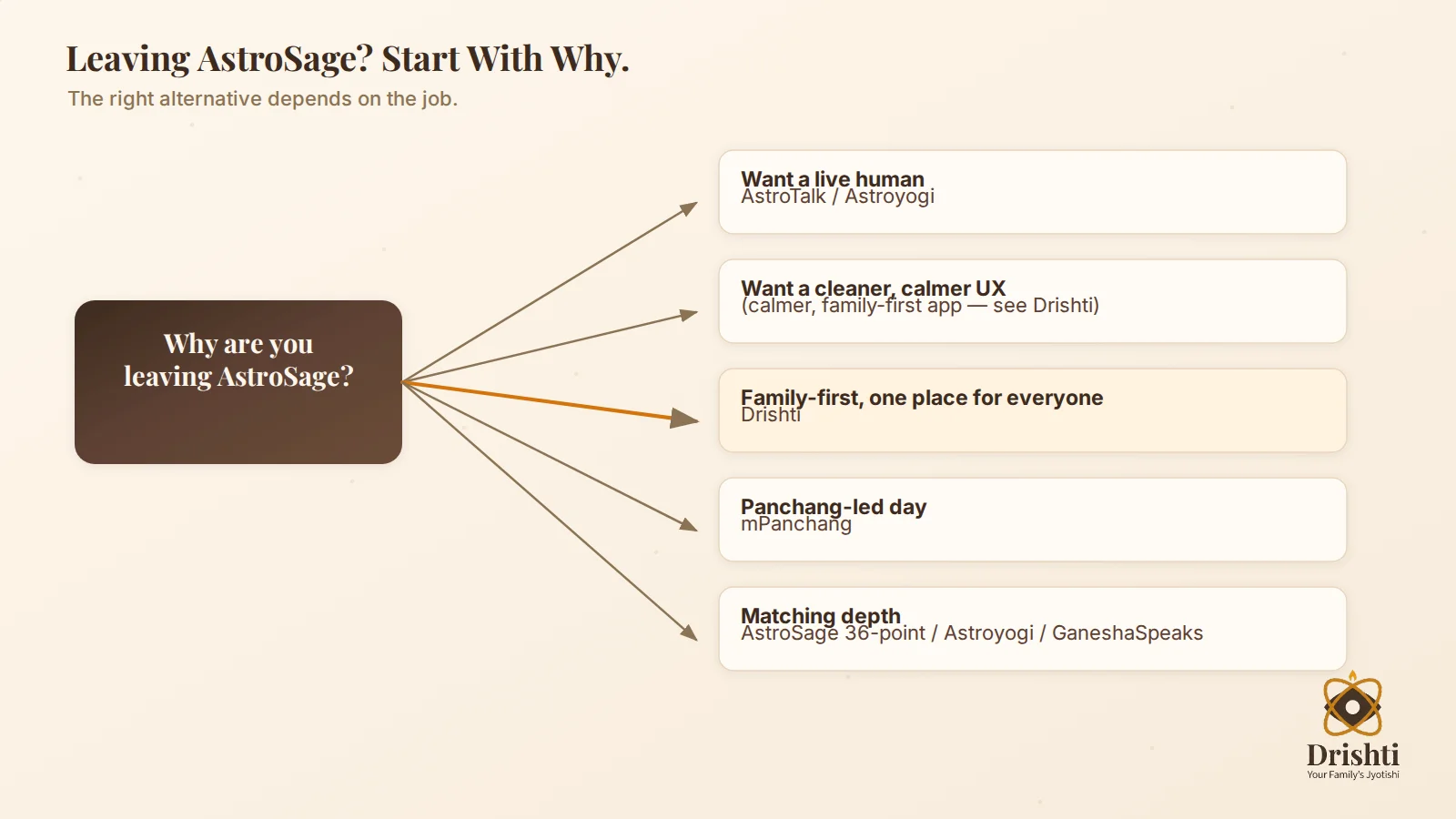
There is no single “best” AstroSage alternative, and anyone who tells you otherwise is selling something. The right pick follows the reason you are looking. Want to talk to a human astrologer tonight? Look at AstroTalk or Astroyogi. Want a legacy Vedic brand with reports and consults? GaneshaSpeaks. Want Panchang, muhurat and Choghadiya as your daily anchor? mPanchang. Want a calm, family-first app that explains its reasoning instead of just handing you a verdict? That is where Drishti fits. Below I break each one down by the job you are actually hiring it for — with competitor facts sourced to official listings, and no invented ratings or prices.
What AstroSage does well
Before you switch, it is worth being honest about why AstroSage Kundli earned its place. It is a genuinely broad free Vedic toolkit, and for a lot of people that breadth is the whole appeal.
The official listing (“AstroSage Kundli: AI Astrology”, developer Ojas Softech Pvt Ltd) covers most of what a casual-to-serious chart reader wants in one app: Kundli generation with Rasi and Navamsa, 36-point Ashtakoota horoscope matching, daily, monthly and annual predictions, and Dasha and planetary analysis. It also carries the systems that intermediate users start asking for — KP System and Lal Kitab — plus multiple ayanamsa options, PDF export, an AI astrology chat, and paid astrologer consults on top. It runs on both Android and iOS.
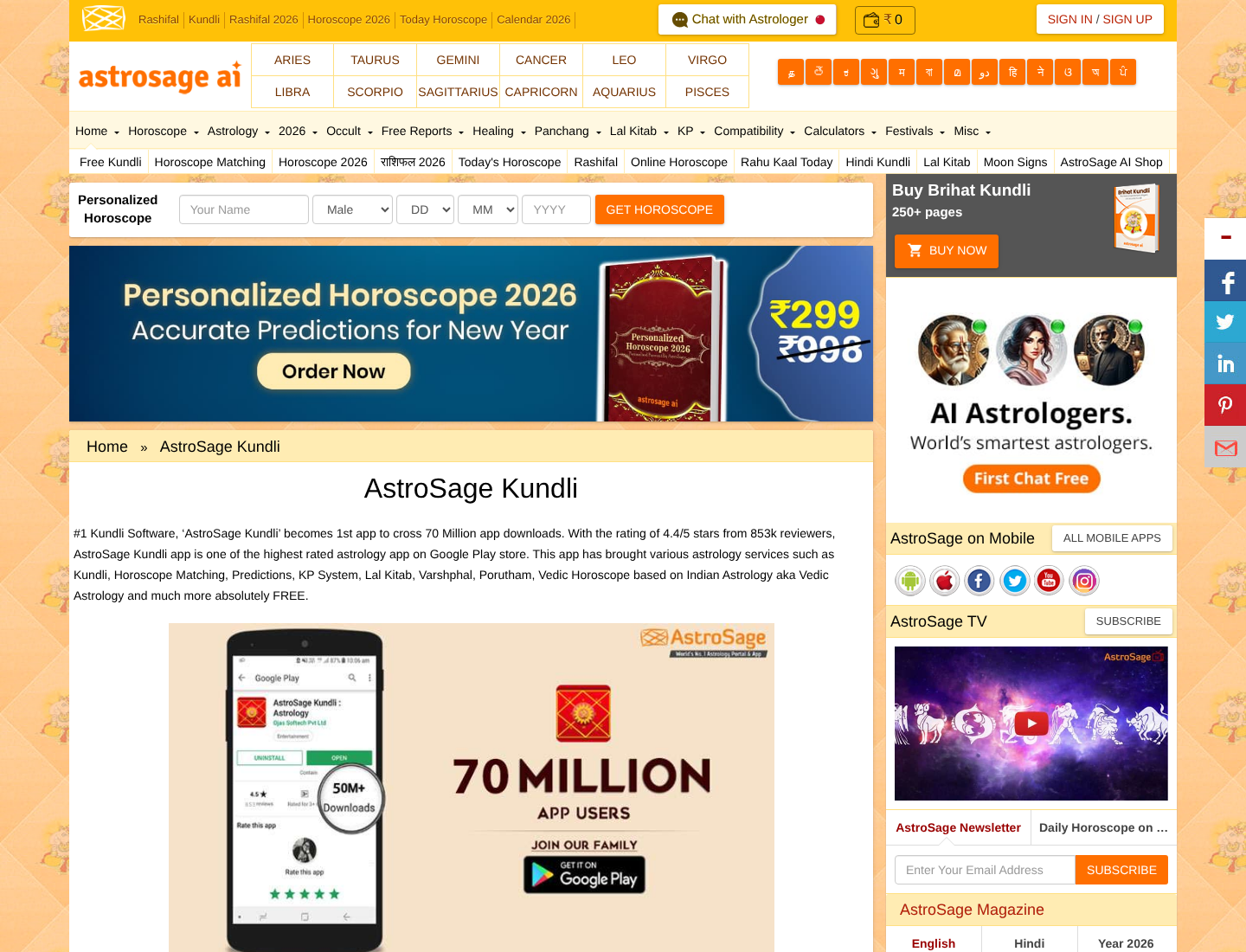
That combination is the reason it shows up on almost every “apps like AstroSage” list. If you want one free app that does Kundli, matching, dasha, and a spread of calculation systems without pushing you toward a paywall on the basics, it holds up. AstroSage describes itself as the “#1 Astrology App” — that is the company’s own marketing line, not an independent ranking, so read it as positioning rather than a verdict.
In my testing, the honest trade-off with a do-everything toolkit is exactly that: it does everything, which means it is dense. That density is a feature if you are a hobbyist who likes options, and a friction point if you just want a clear, guided answer. Which brings us to why people go looking.
When to consider an alternative
You do not leave a capable app for no reason. You leave it because your need changed. In practice, the switch usually comes from one of five places.
You want a live human, not a self-serve chart — someone to talk through a marriage or career question in your language. You want a cleaner, calmer interface because the full toolkit feels like too much. You want a Panchang-first workflow, where muhurat and tithi drive your day and the horoscope is secondary. You want something family-first, so you can keep charts for parents, a spouse and children in one calm place. Or you want guidance that shows its reasoning rather than delivering a flat prediction you are asked to simply trust.
I want to be fair here: none of these are knocks on AstroSage’s accuracy or intent, and I am not going to state unverified claims about its ads or UX as fact. It is a question of fit. If you have never wished for any of the five things above, you probably do not need an alternative at all. If one of them jumped out, keep reading — the section below is organised by exactly those reasons.
For the wider field beyond this shortlist, see our full best astrology apps comparison and, if your priority is staying on the free tier, our guide to the best free astrology apps.
Alternatives by use case
AstroTalk – live astrologer consults
If your real need is to talk to someone, this is the category leader people mean when they say AstroSage vs AstroTalk. The official app (“Astrotalk – Talk to Astrologer,” developer Codeyeti Software Solutions Pvt Ltd) is built around an astrologer-consultation marketplace: chat or call practitioners about love, career, marriage and finance.
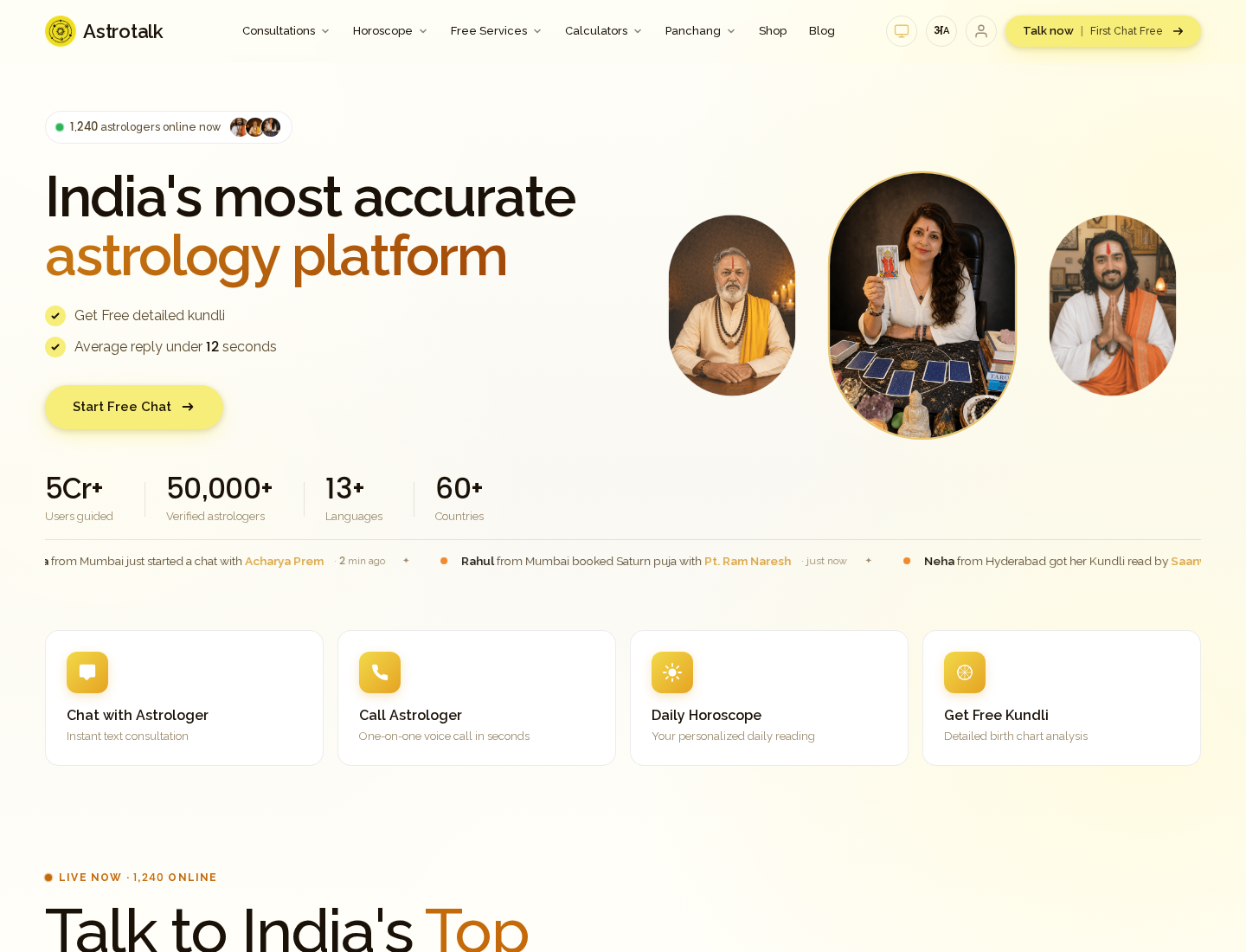
It works on a free-with-paid-consultations model — the first chat is promoted free, and you get free Kundli and daily horoscope, with paid chat and call funded through wallet recharge. Beyond Vedic, it spans Tarot, Numerology, KP, Nadi, Western and palmistry, and adds an “AstroMall” for remedies and gemstones. The homepage calls it “India’s most accurate astrology platform” — again, the company’s own claim, and “most accurate” is not something anyone can assert as independent fact.
Choose AstroTalk when the conversation is the product. Its weakness is the flip side of that strength: it is a consultation marketplace first, so if you want a quiet self-serve chart tool without being nudged toward a paid session, it can feel busy.
Astroyogi – consults plus horoscopes/Kundli
Astroyogi sits a step toward the middle: consults, but with a fuller free horoscope and Kundli layer around them. Note the store names differ — it is “Astroyogi – Astrology & Kundli” on Play and “Astroyogi Chat with Astrologer” on the App Store (developer Netway India Pvt Ltd). Use whichever name matches the store you are actually on.
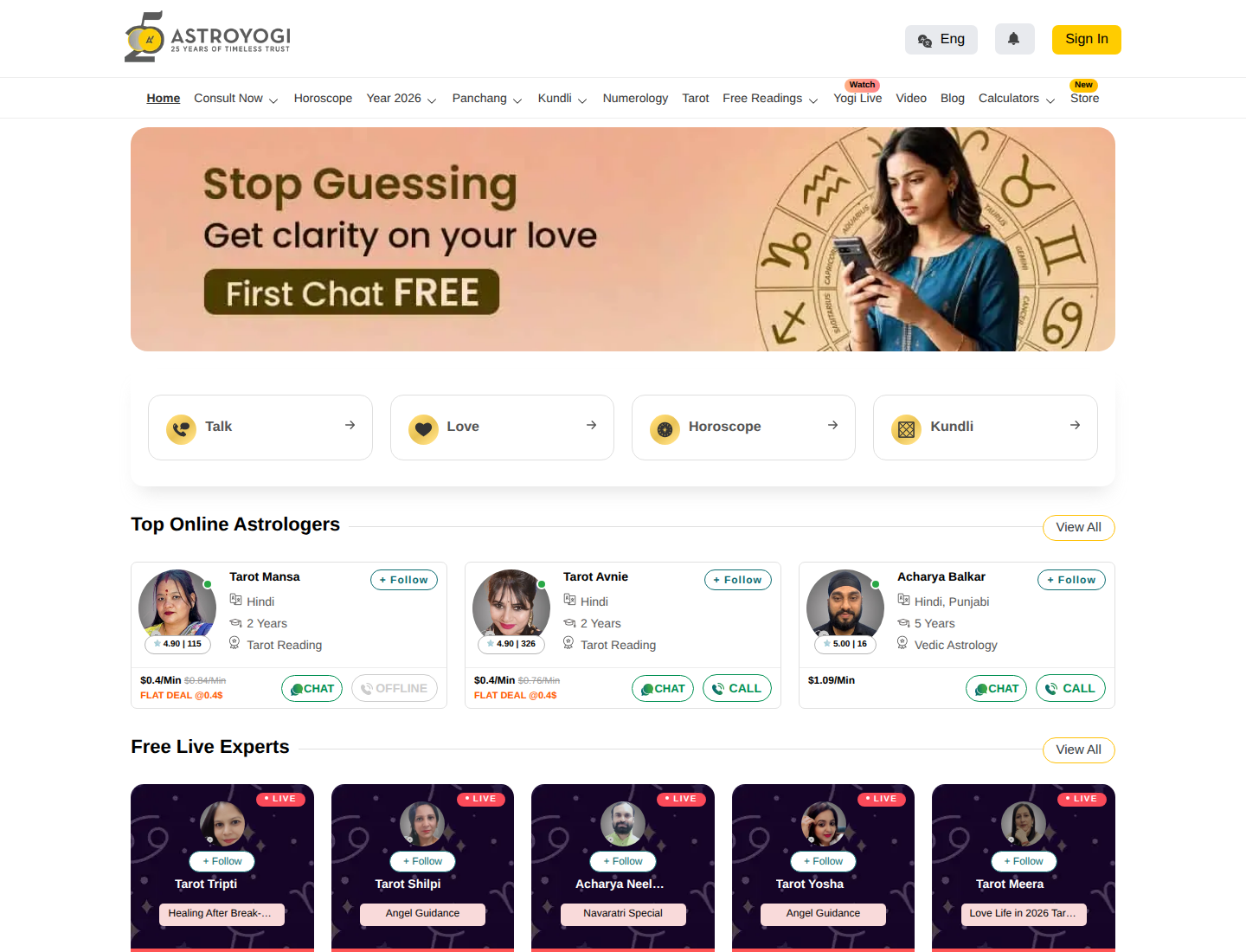
On the freemium model, it promotes a first chat free, keeps daily horoscope and instant Kundli free, and charges for chat and call with certified astrologers. It also covers annual predictions, Kundli matching, Tarot (one-card and three-card), numerology, vastu, palmistry, face reading and Panchang. (Any per-minute figure you spot on the US App Store is a region-specific US price, not an India rupee rate, so don’t read it as INR.)
Pick Astroyogi if you want a bit of both worlds — self-serve horoscope and Kundli you can browse for free, with live consults available when you actually want them. For a head-to-head on the consult-heavy pair, the community write-ups comparing these two are a reasonable read, but verify any hard numbers against the live listings.
GaneshaSpeaks – legacy brand and reports
Some people want the reassurance of a name with history behind it. GaneshaSpeaks is built on the legacy of astrologer Bejan Daruwalla, which is a large part of its pull. Store titles vary — you will see “GaneshaSpeaks – Astro, Zodiac” / “GaneshaSpeaks Kundli Astrology” on Play and “GaneshaSpeaks – Astrology Chat” on the App Store — and it is operated by Wellness Technologies Pvt Ltd.
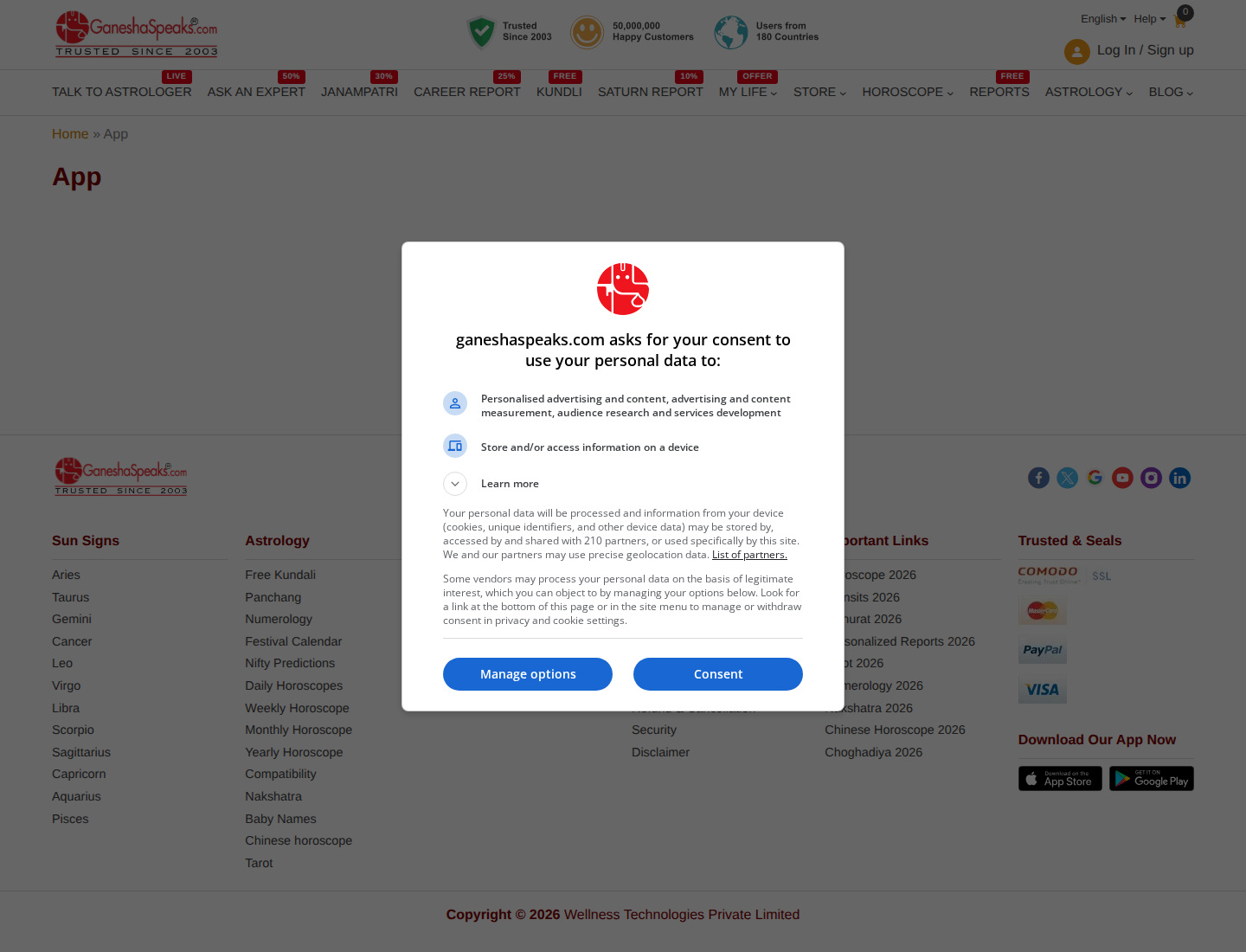
It is a freemium Vedic app: free Kundali and birth chart, daily-to-yearly horoscopes, live chat and call with astrologers, Kundli matching and compatibility, plus Tarot, numerology, vastu, a Panchang and festival calendar, and a remedies store. GaneshaSpeaks describes itself as “Bharat’s Best Astrology App” and cites “50M+ consultations across 180 countries” — both are self-reported marketing figures, not independently verified, so treat them as the brand’s own words.
Reach for GaneshaSpeaks if the pull of an established brand and a report-and-remedy ecosystem matters to you more than a minimalist interface. If independent accuracy is your actual worry, our pieces on how astrology apps calculate charts and reading accuracy claims critically are the better starting point than any brand’s own tagline.
mPanchang – Panchang-first use
Not everyone opens an astrology app for predictions. A lot of Indian households open one for the Panchang — the tithi, the muhurat, the Rahu Kaal — and that is exactly the workflow mPanchang is built around.
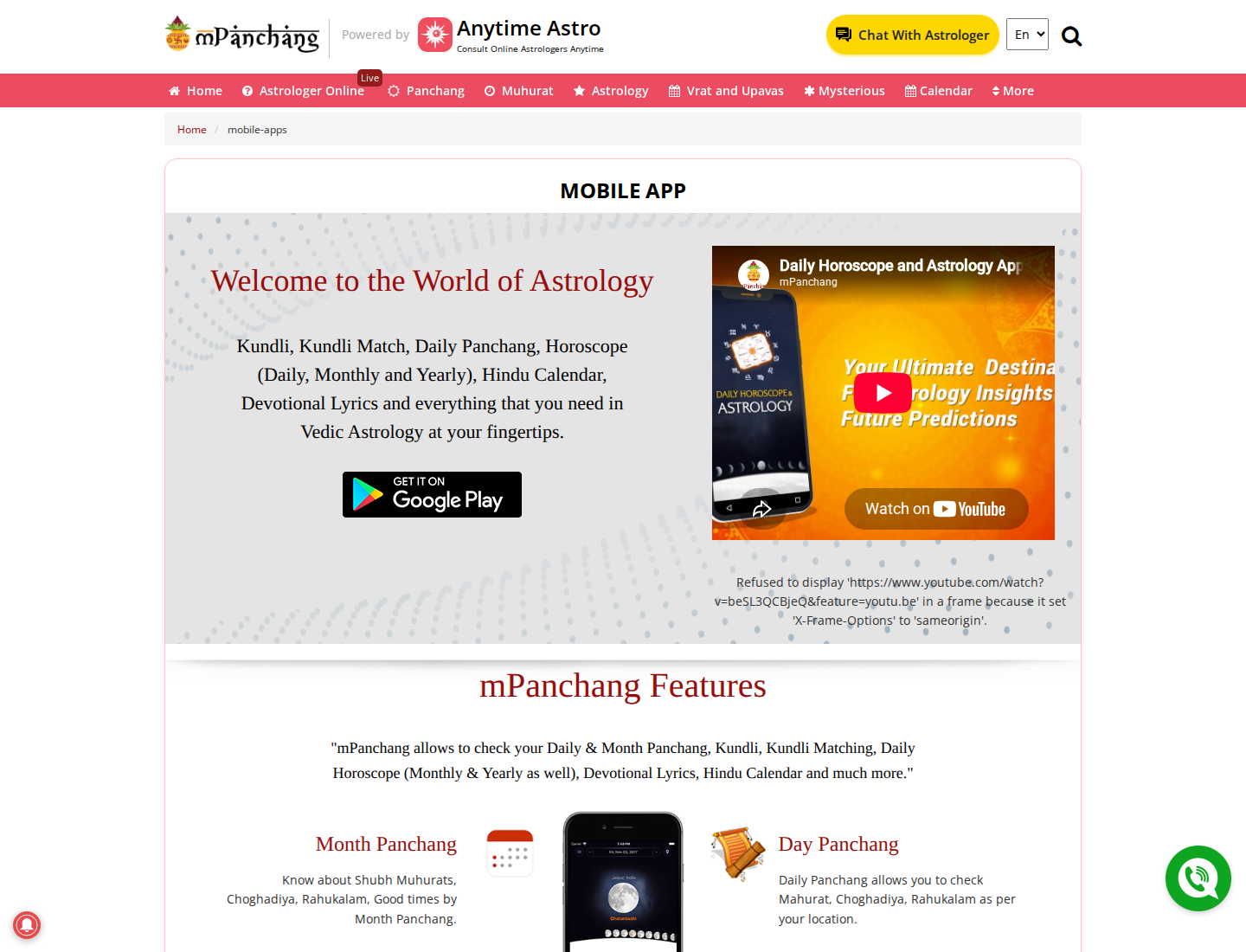
Officially “mPanchang — Hindu Calendar, Kundli Making and Kundali Matching” (developer PCVARK Software Pvt Ltd), it leads with daily and monthly Panchang: Muhurat, Choghadiya and Rahu Kaal by your location. On top of that it makes Kundli, does Kundli matching (Guna Milan), carries horoscopes, and bundles a Hindu calendar with vrats and festivals plus devotional content like Aartis, Chalisas and Mantras. It runs on a freemium model, with paid detailed reports promoted on the official site. One caveat worth flagging: Android availability is confirmed, but a live Apple App Store listing was not confirmed at the time this brief was researched — so if you are on iPhone, check the store first before assuming it is there.
Use mPanchang when the calendar is the point and predictions are the side dish. If your day runs on muhurat and festival dates, it is a more natural home than a prediction-first app.
Drishti – family-first, explainable guidance
If none of the above quite fits — if what you actually want is a calm app for the whole family that explains itself rather than just declaring — that is the gap Drishti is built for. “Your Family’s Jyotishi.”
Drishti’s intent is a calm, trustworthy family astrologer that shows its work, speaks your language, and never traffics in fear. Concretely, that means accurate Vedic Kundli generation, family profiles so you can hold charts for parents, a spouse and children in one place, and multilingual intent across Indian languages with Hindi, Kannada, Tamil and Telugu as the priority. It is privacy-first by posture, and the voice is deliberately anti-fear: decisions over superstition, no “what the stars have in store for you” theatre.
The part I care most about as a reviewer is the “shows its work” stance. Most apps hand you a conclusion. Drishti’s positioning is that you should be able to see why — the reasoning behind the reading, in language a family member can actually follow. That is a different promise from a consultation marketplace or a do-everything calculator, and it is the honest reason to choose it: not because it replaces AstroSage’s toolkit feature-for-feature, but because it is built for a different job — the family, the calm, the explanation.
If family-first use is your driver, our guide on choosing a family astrology app goes deeper on what that actually should mean.
Side-by-side comparison table
Here is the shortlist by the job you are hiring it for. Pricing is shown as model, not rupee prices — exact prices shift and region-specific figures are not India prices. Ratings, download counts and astrologer counts are deliberately omitted because none could be verified from a live listing.
| App (store-accurate name) | Best for | Pricing model | Vedic / system notes | Platforms |
|---|---|---|---|---|
| AstroSage Kundli: AI Astrology | Broad free Vedic toolkit (Kundli, matching, dasha, KP, Lal Kitab, ayanamsa options) | Freemium | Vedic; wide system coverage + AI chat + paid consults | Android + iOS |
| Astrotalk – Talk to Astrologer | Live astrologer consults | Free with paid consultations | Vedic + Tarot, Numerology, KP, Nadi, Western, palmistry | Android + iOS |
| Astroyogi (Play: Astrology & Kundli / App Store: Chat with Astrologer) | Consults plus free horoscope & Kundli | Freemium | Vedic + Tarot, numerology, vastu, palmistry, Panchang | Android + iOS |
| GaneshaSpeaks (store titles vary) | Legacy brand, reports & remedies | Freemium | Vedic + Tarot, numerology, vastu; festival calendar | Android + iOS |
| mPanchang | Panchang-first daily use (muhurat, Choghadiya, Rahu Kaal) | Freemium | Vedic; Kundli + Guna Milan; Hindu calendar & devotional | Android confirmed; iOS unconfirmed |
| Drishti | Family-first, calm, explain-the-reasoning guidance | — | Vedic Kundli; family profiles; multilingual intent; privacy-first | — |
A note on the apps people ask about but that do not belong on this list. Co-Star comes up constantly, but it is Western / tropical astrology built on NASA ephemeris data — not Vedic/Jyotish — so it is not a like-for-like AstroSage alternative (more on that in the FAQ). And TrustAstrology and Astrojyoti are frequently name-checked, but both are web platforms, not apps — do not go hunting for them in the Play Store, where similarly named but unrelated apps will only confuse you.
FAQ
What is the best AstroSage alternative? There isn’t one universal answer — it depends on why you are switching. For live consultations, AstroTalk; for consults plus free horoscope and Kundli, Astroyogi; for a legacy brand with reports, GaneshaSpeaks; for a Panchang-led daily workflow, mPanchang; and for a calm, family-first app that explains its reasoning, Drishti. Match the app to the job you are hiring it for.
Is AstroSage free? It runs on a freemium model. Core Kundli and horoscope features are free; premium reports and astrologer consultations are paid in-app. There is no reliable official India rupee price to quote, and it works on both Android and iOS.
Which app is better than AstroSage for live consultation? For talking to a human astrologer, AstroTalk and Astroyogi are the strongest picks. AstroTalk is built around the consultation marketplace with a first chat promoted free; Astroyogi offers a similar first-chat-free model alongside a fuller free horoscope and Kundli layer. Both charge for chat and call beyond the free intro.
Which AstroSage alternative is best for Kundli matching? Most Vedic apps here do Kundli matching. AstroSage itself offers 36-point Ashtakoota matching; Astroyogi and GaneshaSpeaks include Kundli matching and compatibility, and mPanchang does Guna Milan. Treat matching as decision support — a calm read on compatibility factors — not a verdict on whether a marriage will or won’t work.
Is Co-Star an AstroSage alternative? Not for Vedic astrology. Co-Star is Western/tropical astrology (the sun/moon/rising natal framework) built on NASA ephemeris data — a fundamentally different system from the sidereal Vedic/Jyotish approach AstroSage and the Indian apps use. It is a fine Western-astrology app, but it is not a like-for-like replacement if Kundli, Dasha and Ashtakoota matching are what you came for.