Quick answer: two apps can disagree for technical reasons
Feed the same birth details into two astrology apps and you can get two different Kundlis. That is rarely proof that one is “wrong.” It usually means the apps made different technical choices in a short, boring chain: how they read your birth time, how they resolved your birth place and time zone, which ayanamsa converts sky-positions to sidereal, which ephemeris supplied the planetary data, and how they set up houses and divisional charts. Interpretation — the words about your life — sits on top of that. If the numbers underneath disagree, the words will too. So the honest question is not “which app is most accurate” as a slogan, but “which app shows me its settings.” This post walks through where the differences come from and gives you a checklist to test any app before you trust it.
Calculation vs interpretation
Two completely separate things happen inside every astrology app, and most confusion comes from treating them as one.
The first is calculation: turning your birth moment into astronomy. Where was the Moon? What degree was rising on the eastern horizon? Which nakshatra held the Moon; which mahadasha were you born into? This part is math. Given the same inputs and settings, it should be reproducible to the arc-minute, and two competent engines with identical settings should agree.
The second is interpretation: what those positions are said to mean. “Saturn in the tenth suggests a slow, earned career” is a reading — a tradition-based judgement, and reasonable astrologers differ.
Calculation errors and interpretation differences look identical to a user — you just see two apps disagreeing — but they have nothing to do with each other. An app can calculate flawlessly and interpret shallowly; it can also interpret beautifully on top of a chart with the wrong Lagna, in which case the polish is wasted. So separate them. Ask first: are the raw positions correct and the settings visible? Only then: do I find the reading grounded and useful? A tool that shows its calculation openly earns more trust than one that hides the math and leads with confident prose — the transparency-first posture we apply across the free astrology apps comparison.
The five sources of chart accuracy
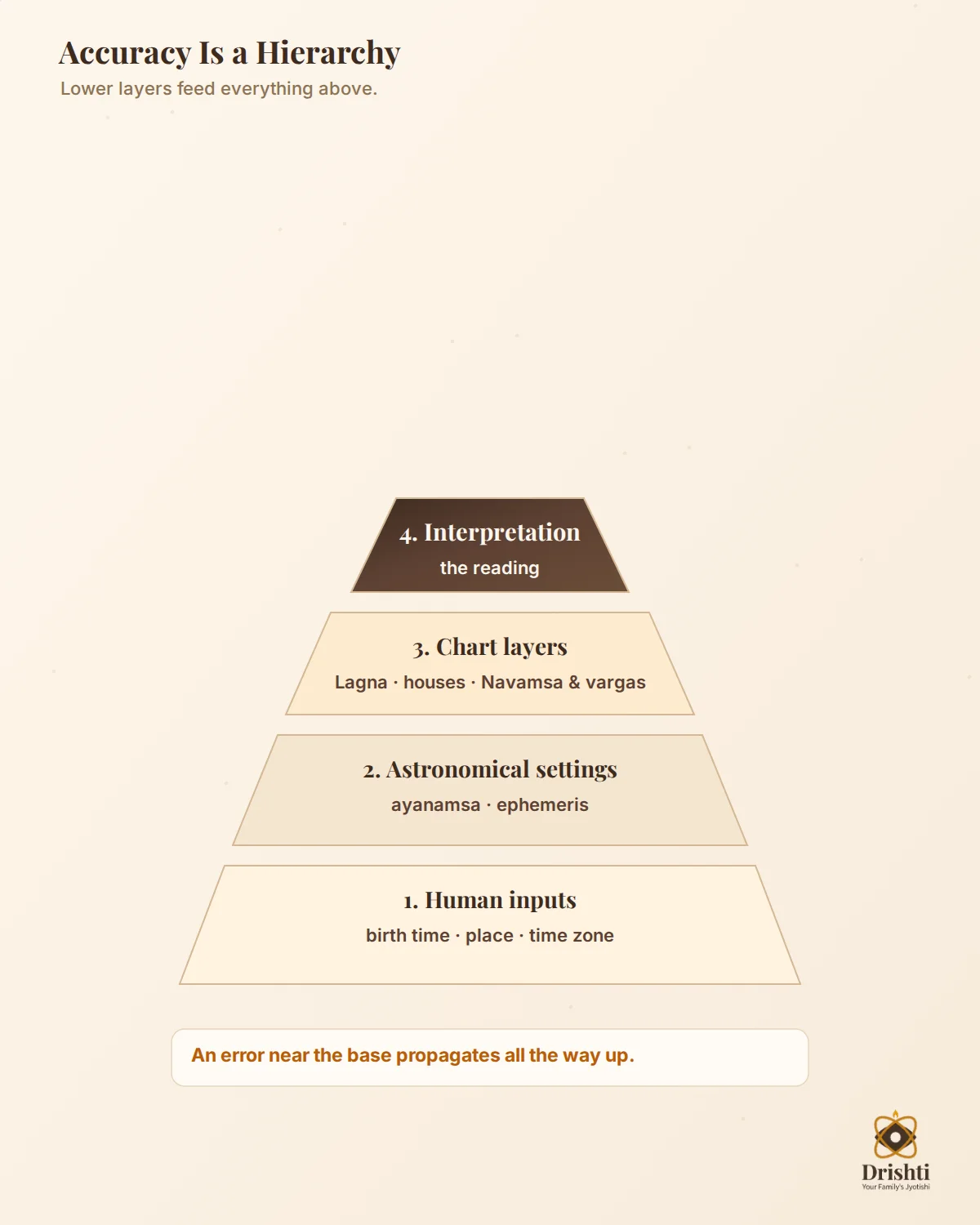
Almost every disagreement between two Kundlis traces back to one of five inputs. Think of them as a stack: the lower ones feed the higher ones, so an error near the bottom propagates upward.
Birth time
This is the input you control and the one most often wrong. A birth certificate that rounds to the nearest ten minutes, a time remembered by a relative, a hospital clock nobody checked — all introduce uncertainty. Birth time matters because the eastern horizon (your Lagna, or Ascendant) moves fast: the rising sign changes roughly every two hours, and the exact rising degree shifts every few minutes. A time off by even four minutes can nudge the Ascendant degree, and near a sign boundary it can flip the whole Lagna into the next rasi. When people say two apps “disagree on my rising sign,” the culprit is often not the app — it is an uncertain birth time handled slightly differently. If your time is shaky, treat any time-sensitive reading with caution and consider birth-time rectification. We go deeper on why the Ascendant is so sensitive in the Lagna and Ascendant explainer (#7).
Birth place and time zone
Your birth place does two jobs: it provides the latitude and longitude the house math needs, and it anchors the correct time zone and any historical daylight-saving offset for that date. This is a quiet source of large errors. If an app geocodes a town to the wrong coordinates, or applies today’s time-zone rule to a birth from decades ago, your local sidereal time is off — and that shifts the Ascendant and house cusps even when the birth time you typed was perfect. India uses a single time zone (IST, +5:30) with no daylight saving, which spares us some of the mess other regions face, but historical edge cases and mis-geocoded towns still bite. A good app lets you confirm the exact coordinates and the resolved time zone rather than guessing silently from a place name.
Ayanamsa
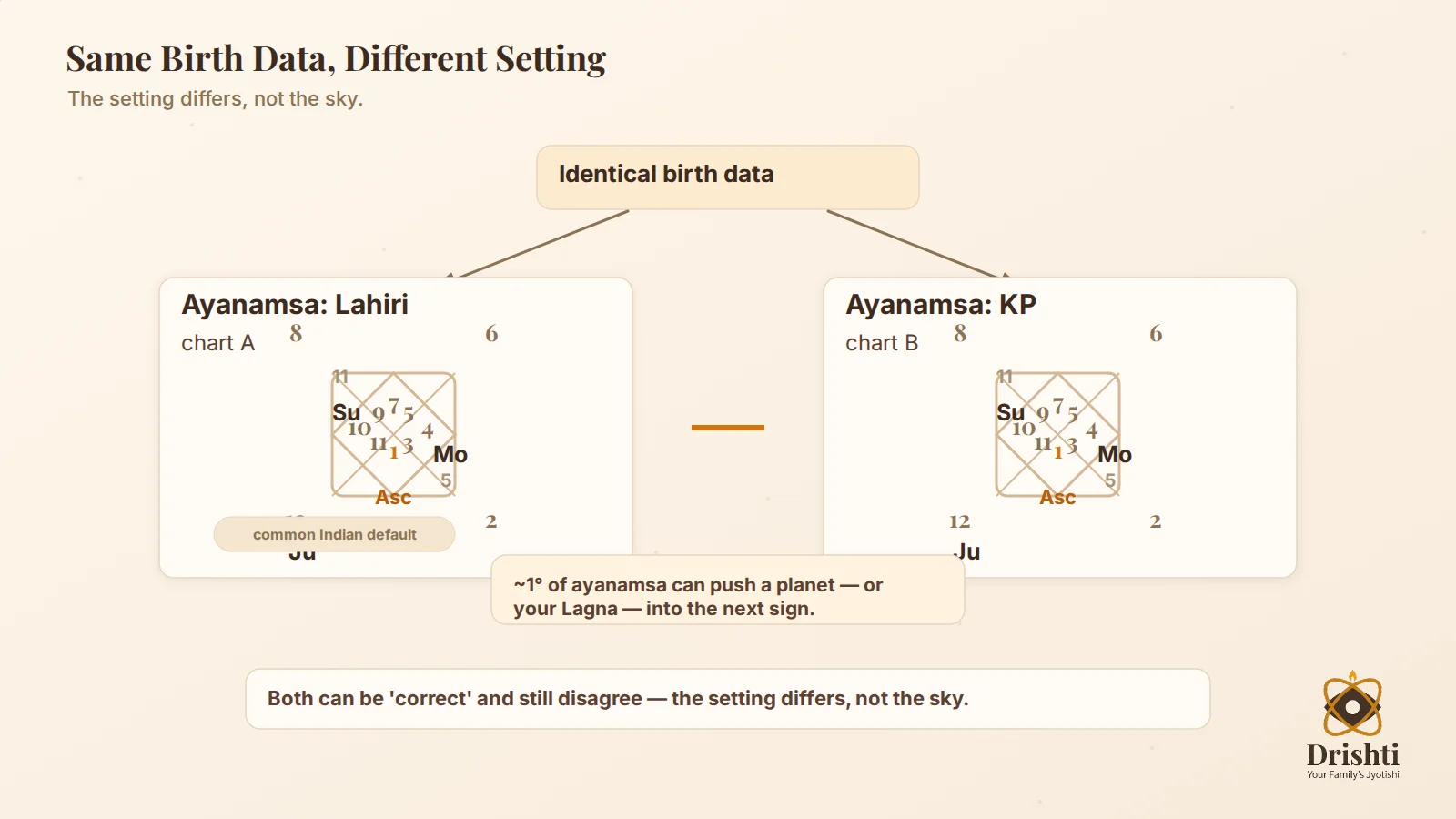
Vedic (sidereal) astrology measures planets against the fixed stars; Western (tropical) astrology measures them against the seasons. The gap between these two zero-points, widening over centuries because of the precession of the equinoxes, is the ayanamsa. To build a sidereal Kundli, an engine takes tropical sky-positions and subtracts an ayanamsa. The catch: there is no single agreed value. Lahiri (Chitrapaksha) is the most widely used in Indian software and the official Government of India standard, but Raman, Krishnamurti (KP) and others differ by roughly a degree or more — enough to push a planet near a sign edge into the next sign, and to shift every nakshatra boundary. So two apps can both be “correct” and still disagree because one used Lahiri and one used KP. This is the single most common reason Vedic Kundlis differ, and why the ayanamsa setting must be visible, not buried.
Ephemeris
An ephemeris is the table of where the planets actually were at a given moment. Modern engines don’t hand-compute this; they read a precomputed astronomical dataset. Several product pages advertise the Swiss Ephemeris (itself derived from NASA JPL planetary data) as a mark of precision. Take that as the company’s own claim about their build, not an independent guarantee your chart is correct. Swiss Ephemeris is a genuinely strong, widely respected source — but the ephemeris almost never explains why two mainstream Indian apps disagree. For ordinary modern birth dates, competent ephemerides agree to a precision far finer than any birth time you actually have. If two apps show different charts, look at ayanamsa, time, and place long before you blame the ephemeris. “We use Swiss Ephemeris” tells you the raw star-data is good; it says nothing about whether the app resolved your time zone or ayanamsa correctly.
House and divisional-chart settings
Once the Ascendant is fixed, the app divides the sky into twelve houses (bhavas) and generates divisional charts (vargas) — another place reasonable systems diverge. Many Indian charts use whole-sign houses, where the rising sign is the entire first house; others compute Bhava Chalit, where cusps fall at specific degrees and a planet can sit in one rasi but a different bhava. Both are legitimate, and an app offering both should say which it is showing. Divisional charts raise the stakes. The Navamsa (D9) divides each sign into nine parts; higher vargas like D30 or D60 divide it into thirty or sixty. The finer the division, the more a tiny error in Ascendant degree is magnified — a birth time “close enough” for the main chart can throw your D60 into a different sign. Product pages that boast “D1 to D60 divisional charts” — again, their feature claim — advertise precision that only pays off if your birth time is genuinely accurate to the minute.
Which parts of a Kundli are most sensitive?
Not every part of your chart reacts equally to a wobbly birth time, and knowing the hierarchy tells you what to trust and what to double-check.
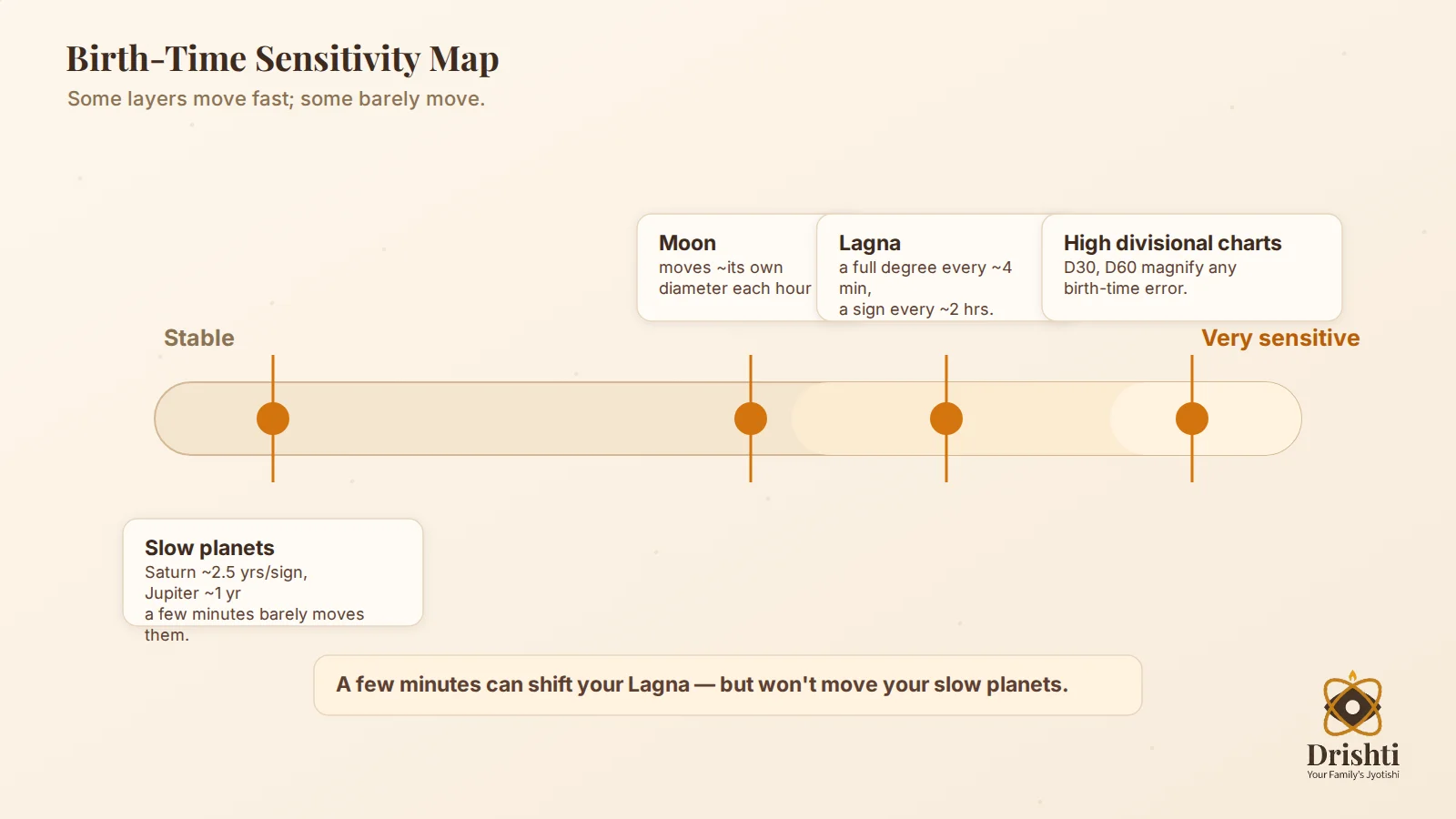
The slow planets are the stable ones. Saturn takes about two and a half years to cross a sign; Jupiter about a year; the outer points crawl. Over a few minutes — or even a few hours — their sign and usually their degree barely move, so a birth time uncertain by ten minutes leaves your Saturn placement essentially safe. The fast-moving points are fragile. The Lagna moves a full degree every few minutes and a full sign every couple of hours, making it the most time-sensitive point in the chart. The Moon moves too — roughly its own diameter each hour — which matters more than people expect, because so much of Vedic practice hangs off the Moon.
That is the core asymmetry: a few minutes can shift your Lagna but will not move your slow planets. It also explains why two apps might agree on nine planetary placements and still hand you different rising signs — they didn’t disagree about astronomy, but about which minute you were born, or which ayanamsa nudged the boundary.
How calculation differences affect Lagna, nakshatra, dasha and matching
Because the Moon and the Ascendant are the sensitive points, the parts of astrology built on them inherit that sensitivity — and this is where calculation quietly reshapes the reading.
Lagna sets your house framework. Change the rising sign and every planet lands in a different house, changing which life areas each is said to govern — so a wrong birth time or mismatched ayanamsa doesn’t tweak one detail, it rearranges the whole chart’s storyline. The Lagna explainer (#7) walks through what shifts when the Ascendant moves.
Nakshatra is defined by the Moon’s exact longitude, sliced into 27 lunar mansions of 13°20′ each. Because the Moon moves and the bands are narrow, a small change in Moon position — from birth time, or from a different ayanamsa moving the boundaries — can drop it into an adjacent nakshatra. The nakshatra guide (#11) covers why those boundaries are so tight.
Dasha inherits all of it. The Vimshottari timeline is calculated from the Moon’s nakshatra at birth, so a Moon that shifts nakshatra can change your starting dasha lord and re-date every planetary period that follows — a large downstream effect from a small upstream error. The Vimshottari dasha guide (#10) shows how the timeline is derived from the Moon.
Matching compounds two charts’ worth of this. Guna Milan / Ashtakoota scoring leans heavily on each partner’s Moon nakshatra, so any nakshatra shift moves the score, and two apps on different ayanamsas can return different match numbers off the same birth data. That is exactly why matching output is decision support, not a verdict — as we treat it calmly in the Kundli matching guide (#5) and the compatibility deep-dive (#12): a number that moves when you change a setting was never a fate to fear.
How to check whether an app is transparent
You don’t need to be an astronomer to audit an app. You need to know which settings to look for and whether the app is willing to show them. Run this checklist before trusting any Kundli:
| Check | What to look for | Why it matters |
|---|---|---|
| Birth time precision | Can you enter time to the minute, and does the app flag time as uncertain? | The Ascendant, Moon, nakshatra and dasha all depend on it. |
| Place and time zone | Does it show the resolved coordinates and the exact time-zone/DST offset it used? | A wrong offset silently shifts the whole chart. |
| Ayanamsa named | Is the ayanamsa (Lahiri, KP, Raman…) stated and ideally selectable? | The most common reason two Vedic charts disagree. |
| Ephemeris disclosed | Does it say what astronomical data it uses? | “Swiss Ephemeris” is a fair signal — but treat it as the app’s claim, not proof. |
| House and varga settings | Whole-sign vs Bhava Chalit stated? Divisional charts labelled? | Determines which house — and which divisional sign — a planet falls in. |
| Reproducibility | Same inputs, same output, every time? | Calculation should be deterministic; wobble is a red flag. |
| Shows its work | Does it explain the reasoning behind a reading, or just assert? | Separates a grounded tool from horoscope-entertainment copy. |
Two more habits help. First, cross-check one point manually — pick your Moon’s nakshatra or Lagna degree and see if two apps set to the same ayanamsa agree; if they do, the engines are sound and any remaining difference is a settings choice. Second, judge interpretation separately from calculation. Comparing the big Indian apps — AstroSage Kundli (#1), AstroTalk (#2), or Astroyogi (#3) — apply the same audit to each rather than trusting whichever leads with the loudest slogan. Several describe themselves as “#1” or “most accurate”; that is their marketing, not a measured result.
Where Drishti fits, capability-neutral
Drishti — “Your Family’s Jyotishi” — is built around exactly the principle this post argues for: a calm, trustworthy family astrologer that shows its work, speaks your language, and never traffics in fear. The point of a family Jyotishi isn’t to win an accuracy contest with a bigger number; it’s to generate an accurate Vedic Kundli and then let you follow the reasoning behind it, in plain terms, in your family’s language.
In my testing across this category, the apps I trust make their settings legible and their reasoning followable; the ones I set aside hide the math and lead with confidence. That transparency-first posture — accurate Kundli generation, reasoning you can trace, family profiles, and a privacy-first stance — is where Drishti aims to sit. No fear, no doom, no “the stars have decided.” Just the chart, the working behind it, and a reading you can question — which is the most useful accuracy signal a family astrology app can offer.
FAQ
Why do astrology apps show different charts? Because they made different technical choices — most often a different ayanamsa, a slightly different reading of your birth time, or a different time-zone/coordinate resolution for your birth place. House and divisional-chart settings add further variation. The astronomy underneath is usually consistent; the settings on top are where apps diverge.
What is ayanamsa? Ayanamsa is the offset between the tropical (season-based) zodiac and the sidereal (star-based) zodiac used in Vedic astrology. To build a sidereal Kundli, an engine subtracts an ayanamsa from tropical positions. There are several standards — Lahiri (the Government of India standard and the most common in Indian software), Raman, KP and others — and they differ by around a degree, which is enough to move planets and nakshatra boundaries.
Is Swiss Ephemeris more accurate? Swiss Ephemeris is a widely respected astronomical dataset derived from NASA JPL data, and when an app says it uses it, that is a fair signal about the quality of its raw star-data. But treat it as the company’s claim about their build, not as independent proof your chart is right. For ordinary modern birth dates, competent ephemerides agree far more precisely than your birth time does — so ephemeris is rarely the reason two apps disagree.
Does birth time change my Kundli? Yes, more than any other input you control. Birth time sets the Ascendant, which moves through a full sign roughly every two hours and a full degree every few minutes. It also fixes the Moon’s exact position, which drives your nakshatra and your Vimshottari dasha timeline. An uncertain time is the single biggest source of chart doubt.
Why do apps disagree on Lagna? The Lagna is the fastest-moving point in the chart, so it is the most sensitive to two things: a birth time that is even a few minutes off, and a different ayanamsa that nudges the rising degree across a sign boundary. Two apps can agree on every planet and still show different rising signs if their time handling or ayanamsa differs.
How do I know an astrology app is accurate? Check that it lets you enter birth time to the minute, shows the coordinates and time zone it resolved for your place, names its ayanamsa (ideally lets you pick), discloses its ephemeris, and states its house and divisional-chart settings. Then confirm it’s reproducible and that it explains its reasoning rather than only asserting conclusions. An app that shows its work is more trustworthy than one leading with an accuracy slogan.