Quick answer: what a family astrology app should do
A family astrology app has to do one thing a solo horoscope app never worries about: hold several people at once. That means saved profiles for your spouse, children, and parents; fast switching between them without re-entering birth details; language flows an elder can actually read in Hindi, Kannada, Tamil, or Telugu; a matching workflow you can run for a real decision; sane privacy controls over everyone’s birth data; and a calm, explain-it-to-me tone instead of doom labels. If an app can’t keep multiple profiles and switch between them cleanly, it’s a personal-horoscope app you’re sharing by logging in and out — not a family astrology app. Below is a concrete checklist, an honest look at how the popular Indian apps stack up on family features, and where Drishti fits.
Why family use is different from solo horoscope use
Most astrology apps are built around a single chart — yours. You open it, read today’s transit, close it. Family use breaks that model in four practical ways, and I’ve watched every one trip people up in testing.
First, you’re managing other people’s birth data. The moment you save your mother’s time of birth or your child’s rasi, you’ve taken on a custodial responsibility — that data is sensitive and, in many families, not yours to hand around casually.
Second, the readers aren’t uniform. You might be comfortable in English; your grandmother is not. A family app that only speaks fluent English quietly excludes the people who most want to look at a Kundli.
Third, the questions are shared. “Is this a good muhurat for the housewarming?” or “how do these two charts read together?” are household conversations a solo horoscope feed can’t answer — you need matching and muhurat tools that treat two or more people as a unit.
Fourth, the stakes feel higher, which is where tone matters. A blunt one-liner about a partner or a child lands very differently from a daily meme about your mood. For families, the calm, decision-support framing isn’t a nicety — it’s the difference between a tool people trust and one they quietly stop opening.
Family-friendly app checklist
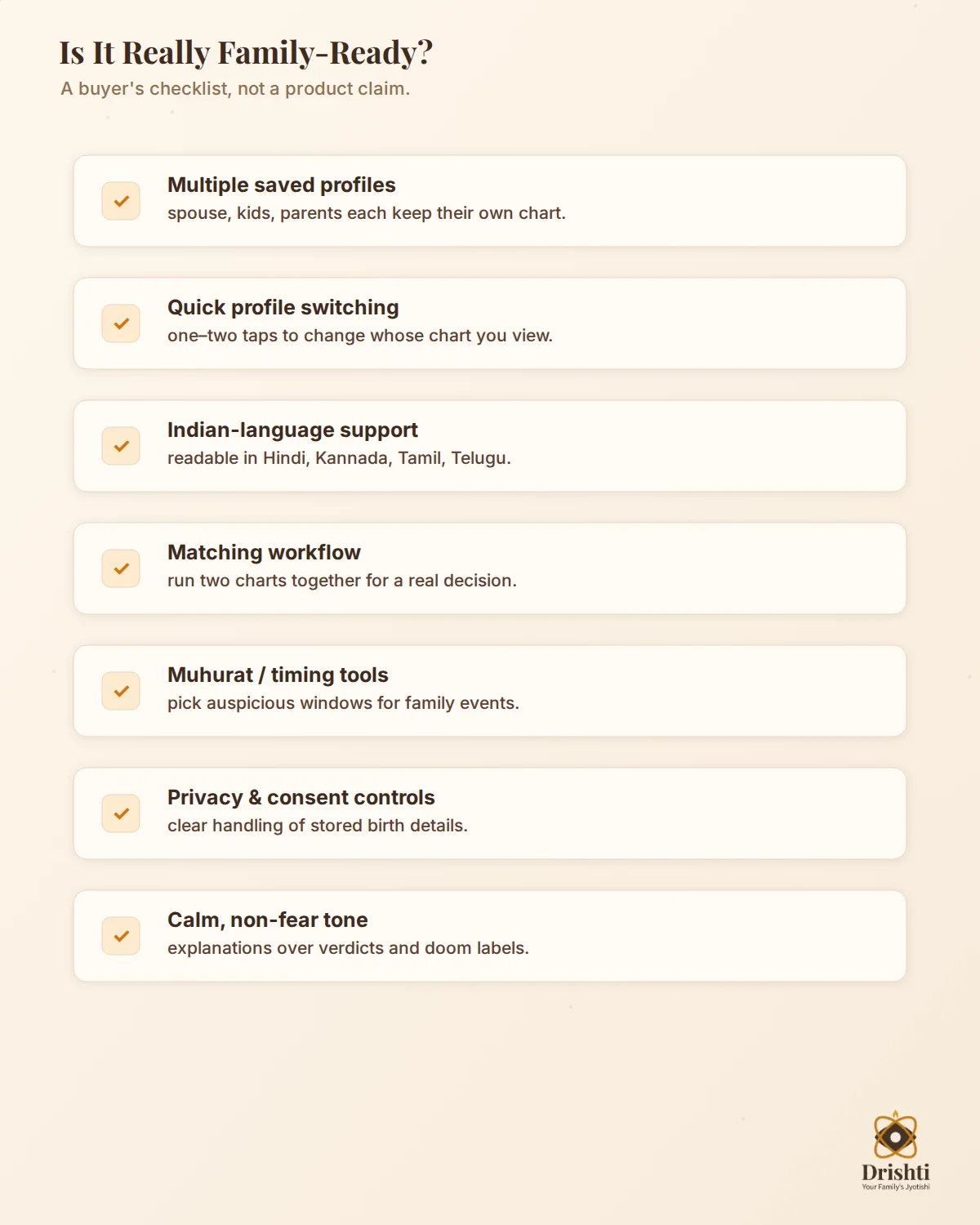
Here’s what I look for before calling an app family-ready. Treat it as a buyer’s checklist you can run against any app in the store.
| Family criterion | What “good” looks like | Why it matters for a household |
|---|---|---|
| Multiple saved profiles | Add spouse, kids, parents; each keeps its own chart | Stops you re-entering birth data every session |
| Quick profile switching | One or two taps to change whose chart you’re viewing | Elders and busy parents won’t fight a clunky flow |
| Indian-language support | Readable flows in Hindi, Kannada, Tamil, Telugu | Grandparents can read their own Kundli, not a translation-of-a-translation |
| Matching workflow | Run two charts together for a real decision | Marriage and compatibility questions are shared, not solo |
| Muhurat / timing tools | Pick auspicious windows for family events | Housewarmings, weddings, ceremonies are household calls |
| Privacy & consent controls | Clear handling of stored birth details | You’re custodian of other people’s sensitive data |
| Calm, non-fear tone | Explanations over verdicts and doom labels | Trust survives when the app doesn’t scare people |
Multiple profiles and quick switching
This is the feature that separates a family app from a personal one, and the hardest to verify from the outside. A genuine family app lets you keep your spouse, each child, and both sets of parents as distinct saved charts, then move between them in a tap or two. What you don’t want is to log out, change the birth details, regenerate, and log back in to check someone else — that’s a single-user app wearing a family label.
Look specifically for a “profiles,” “family,” or “add member” area rather than an editable “my birth details” field. The difference is architectural: one is built to hold many people; the other holds you and gets edited. For most popular Indian apps, whether they truly support multiple persistent family profiles is not publicly documented on their listings, so I won’t assert it either way — check the profile screen yourself before you commit the whole family’s data.
Languages for parents and grandparents
Language is where “family-friendly” gets real. It’s easy to ship an English app and call it inclusive; it’s much harder to give a Telugu-first grandmother a Kundli she can read comfortably in her own language. Several Indian apps advertise multilingual support broadly, but the useful question isn’t “how many languages” — it’s whether the person who most wants to read this can actually read it end to end, without hitting an English wall halfway through.
South-Indian families feel this especially. If your household runs in Kannada, Tamil, or Telugu, an app that translates the headline horoscope but keeps Kundli labels and matching output in English isn’t really speaking your language. Test it with the elder who’ll use it most: hand them the phone, set the language, watch where the English creeps back in. For broader options, our best astrology apps comparison walks through the popular Indian apps side by side.
Matching and muhurat workflows
Matching is the most common shared question a family brings to an astrology app — and where tone matters most. A family-ready app should let you run two Kundlis together (Guna Milan / Ashtakoota, or Porutham in the Tamil tradition) as decision support, then explain what the score does and doesn’t mean. Several apps offer this; AstroSage lists 36-point Ashtakoota matching, and Astrotalk, Astroyogi, and GaneshaSpeaks list matchmaking or compatibility features (freemium, with paid consultations on top).
The framing is everything. Compatibility scoring is a starting point for a conversation, not a verdict on a marriage — and a good family app treats it that way rather than issuing pass/fail judgments. Read it as one input among many. For the fuller picture, see our guides on Kundli matching for marriage and reading a compatibility report calmly.
Muhurat and Panchang tools round out the family workflow — picking an auspicious window for a housewarming, naming ceremony, or wedding is a household decision. mPanchang, for instance, is built around daily and monthly Panchang (Muhurat, Choghadiya, Rahu Kaal by location) alongside Kundli making and matching, a common pick for timing-led households. Its Android listing is confirmed; a live iOS listing wasn’t verified, so check the App Store before assuming it’s there.
Privacy and consent for birth details
The moment you save your child’s or your parents’ birth time, you’ve become the custodian of data that isn’t fully yours. Birth details — date, exact time, place — are unusually sensitive: permanent, identifying, and often shared without the person present to consent.
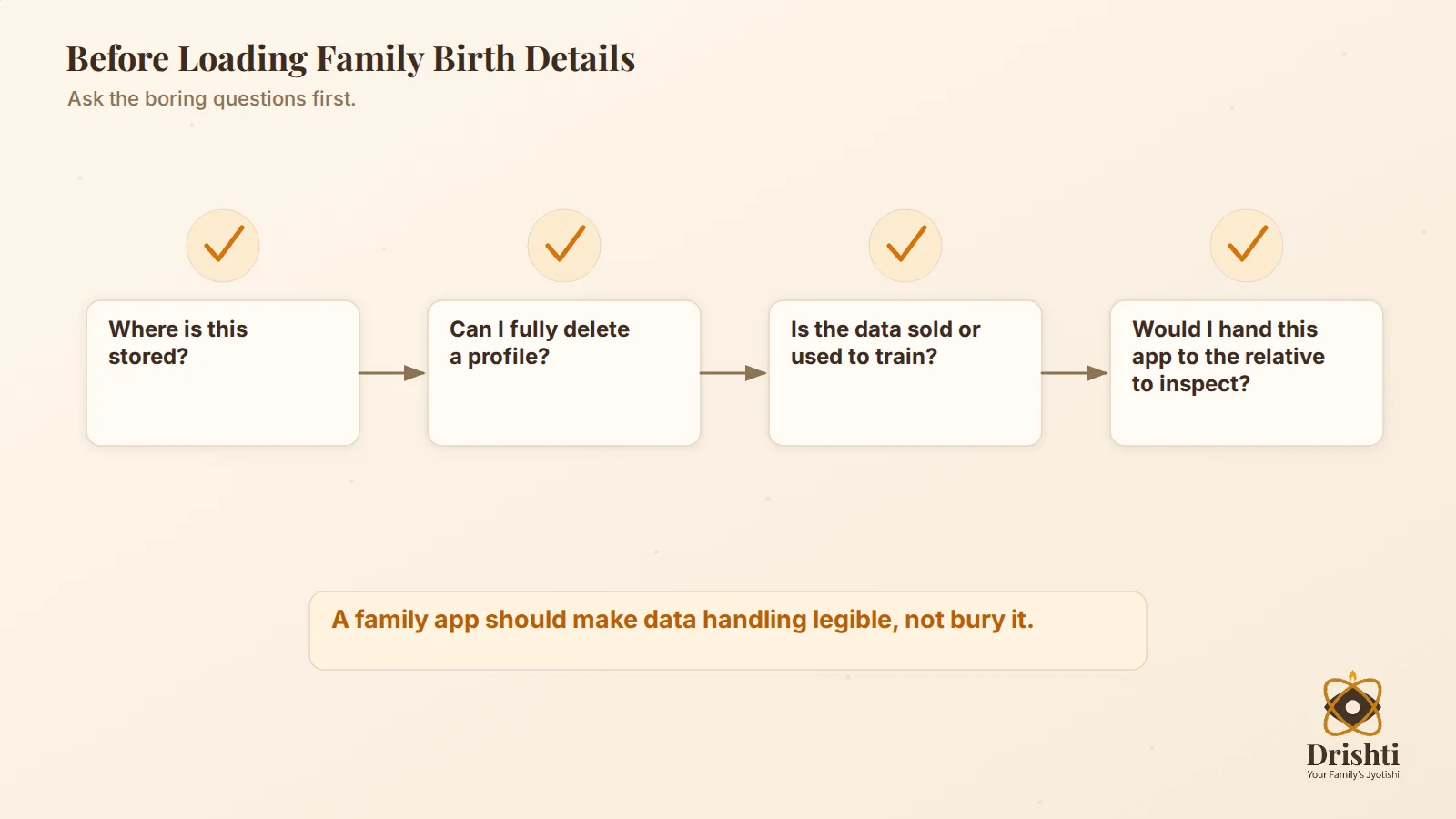
Before you load the whole family into an app, ask the boring questions: Where is this stored? Can I delete a profile completely? Is the data used to train something or sold onward? Most listings won’t answer this cleanly, which is itself a signal — a family app should make its data handling legible, not bury it. My rule of thumb: don’t store a relative’s birth details in an app you wouldn’t hand that relative to inspect. If exact birth-time accuracy is why you’re entering sensitive data, our birth-time accuracy and rectification guide covers what to double-check first.
Calm explanations, not fear labels
The tone test is the one families notice last and remember most. An app that greets you with doom — “danger period,” “this match will fail,” urgency countdowns — is fine as entertainment and corrosive as a family tool. When several people read the same app, fear compounds. A calm app explains the reasoning, shows how it got there, and leaves the decision with you.
Co-Star sits at the extreme edge of tone and needs a flag anyway: it’s a Western / tropical astrology app (sun/moon/rising natal framework using NASA ephemeris data), not Vedic/Jyotish. Known for blunt AI-written copy and friend chart-comparison — genuinely fun, but not a like-for-like Vedic family app, and its bluntness is the opposite of the calm register most Indian households want.
How popular astrology apps compare
Let me be honest about what this comparison can and can’t say. The popular Indian apps are strong on consultations and chart generation. The specific family-profile question — whether they persistently hold and switch between multiple members’ charts — is not publicly documented. So I’m comparing what their listings actually verify, and marking family profiles as undocumented rather than inventing a checkmark.
AstroSage Kundli (“AstroSage Kundli: AI Astrology” on the stores) is a deep Vedic toolkit — Kundli (Rasi, Navamsa), 36-point Ashtakoota matching, Dasha analysis, KP System and Lal Kitab, multiple ayanamsa options, PDF export, and an AI astrology chat, plus paid consultations. Freemium. Its “#1 Astrology App” line is its own marketing claim, not independent fact. Persistent family profiles: not publicly documented.
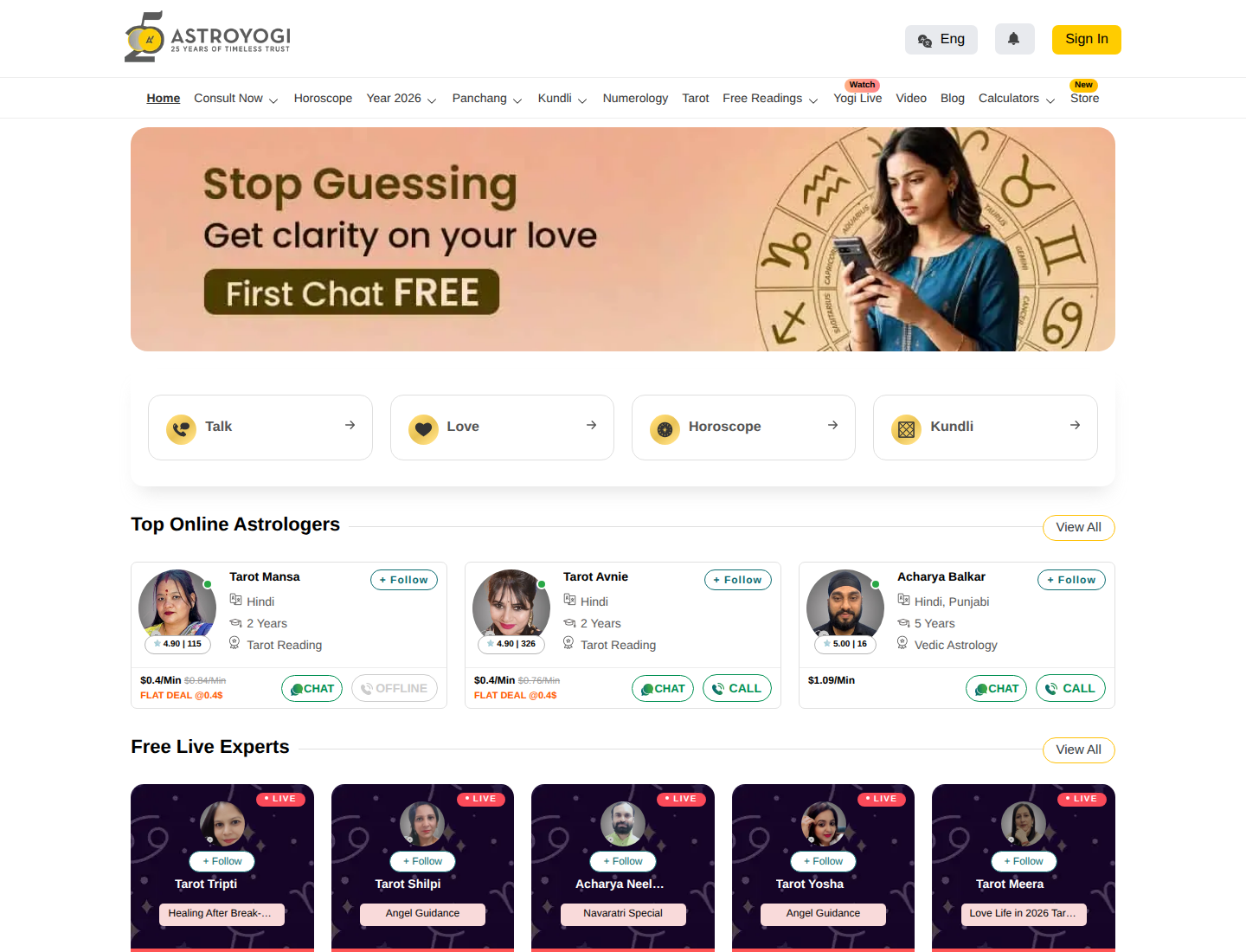
Astrotalk (“Astrotalk – Talk to Astrologer”) is consultation-first — chat and call astrologers, with a free first chat, free Kundli and horoscope, matchmaking, and an AstroMall for remedies. Free with paid consultations. “India’s most accurate astrology platform” is the company’s own claim. Family profiles: not publicly documented.
Astroyogi (listed as “Astroyogi – Astrology & Kundli” on Play and “Astroyogi Chat with Astrologer” on the App Store — the names differ by store) offers daily and annual predictions, Janam Kundli and matching, Tarot, and chat/call consultations. Freemium. Family profiles: not publicly documented.
GaneshaSpeaks (store titles vary; built on the legacy of astrologer Bejan Daruwalla) covers free Kundli, daily-to-yearly horoscopes, live consultations, matching, and a festival calendar. Freemium. Its “Bharat’s Best Astrology App” and “50M+ consultations” lines are self-reported, not independently verified. Family profiles: not publicly documented.
mPanchang is the Panchang-and-timing specialist described above — strong for muhurat-led families; Android confirmed, iOS unverified.
Two apps deserve a label so you don’t mistake them for astrology-first family tools. VAMA and Sri Mandir are devotional / puja-led platforms — online puja and chadhava, aarti and bhajan, temple services — with astrology attached as a secondary feature, not the core. Lovely for a devotional household; not built as a family astrology hub.
One thing I won’t do is pad this list with names that aren’t apps. Web platforms that get name-checked in “best app” roundups but have no verified mobile app don’t belong here, and I’ve left them out on purpose.
Where Drishti fits
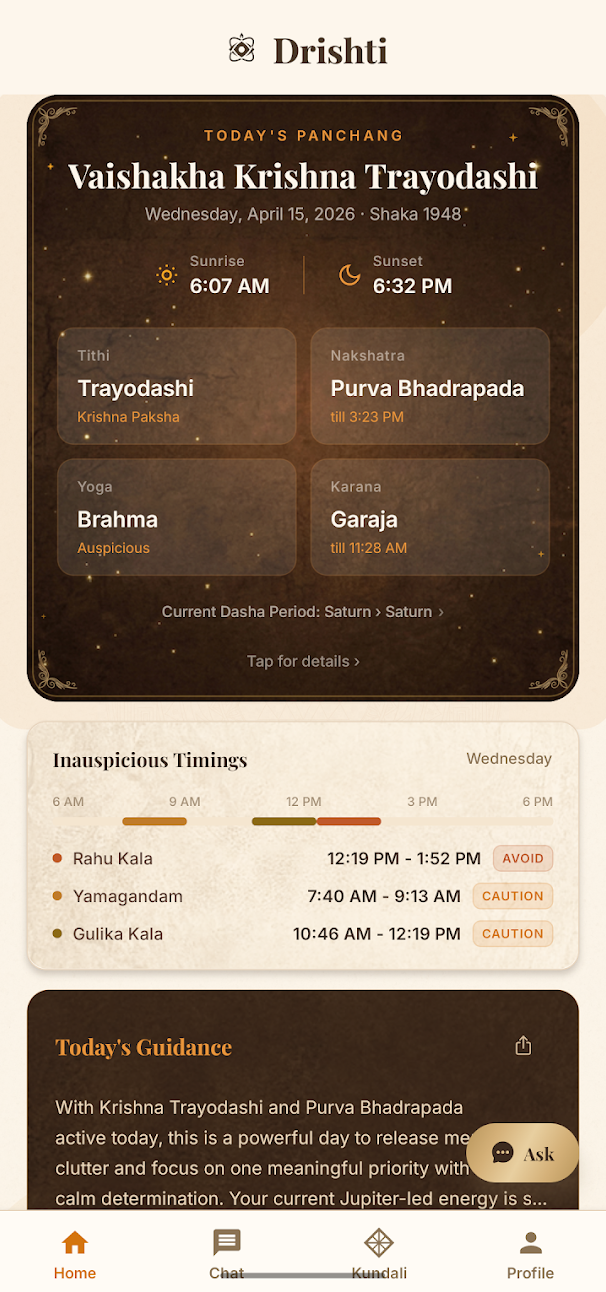
Drishti is built family-first, and the tagline says it plainly: “Your Family’s Jyotishi.” The idea is a calm, trustworthy family astrologer that shows its work, speaks your language, and never traffics in fear — closer to the old notion of a kul jyotishi, the family astrologer who knows the whole household, than to a solo daily-horoscope feed.
What Drishti is designed around: accurate Vedic Kundli generation; grounded, transparent reasoning — the “shows its work” value, so you see how a reading was reached rather than getting a bare verdict; family profiles for multiple members of a household; multilingual intent across Indian languages, with Hindi, Kannada, Tamil, and Telugu as priority; a privacy-first posture toward the sensitive birth data a family entrusts to it; and a deliberately anti-fear, decisions-over-superstition voice.
I’m keeping this capability-neutral on purpose — treat the description above as Drishti’s design intent and family-first positioning rather than a feature-by-feature guarantee, and check the current app for specifics that depend on the shipped build. What I can say with confidence is the frame: Drishti approaches astrology as calm decision support for a whole family, in the family’s own language, with the reasoning visible — precisely the gap the popular apps leave open. To help a parent or child understand what a chart is saying, our guide on reading your Kundli is a good place to start together.
FAQ
Which astrology app is best for families? The best family astrology app holds multiple saved profiles, switches between them easily, reads well in your family’s language, runs matching and muhurat for shared decisions, handles birth data responsibly, and keeps a calm tone. Drishti is built family-first around exactly this (“Your Family’s Jyotishi”). Among the popular Indian apps — AstroSage, Astrotalk, Astroyogi, GaneshaSpeaks — persistent family profiles are not publicly documented, so verify the profile feature before choosing.
Can I add family members to an astrology app? It depends on the app. A true family app saves spouse, children, and parents as separate profiles you switch between without re-entering birth details. Many popular Indian apps let you generate a chart for someone else, but whether they persistently store and switch between multiple family profiles is not publicly documented — look for a “profiles,” “family,” or “add member” section rather than a single editable birth-details field.
Is it safe to store family birth details in an app? Birth details are sensitive and permanent, so treat them carefully. Before saving a relative’s data, check where it’s stored, whether you can fully delete a profile, and how the data is used. Favor apps with a clear, privacy-first posture. A good rule: don’t store a family member’s birth details in an app you wouldn’t be comfortable showing that member.
Which astrology app supports Indian languages? Several Indian apps advertise multilingual support, but coverage varies and exact language counts are often unsettled, so don’t rely on a marketing number. The practical test is whether an elder can read the full flow — Kundli, matching, and all — in Hindi, Kannada, Tamil, or Telugu without hitting English partway through. Drishti’s multilingual intent prioritizes exactly these languages; verify the current in-app language coverage before relying on it.
Can one app handle Kundli matching for family decisions? Yes — several apps offer Kundli matching (Guna Milan / Ashtakoota, or Porutham in the Tamil tradition). AstroSage lists 36-point Ashtakoota matching; Astrotalk, Astroyogi, and GaneshaSpeaks list matchmaking or compatibility features. Read any match score as calm decision support and one input among many, not a verdict on a relationship. For a marriage decision, combine it with the fuller picture in our Kundli matching guide and compatibility report guide.