Quick answer: choose by matching depth, not only a score
Pick the app that shows how it arrived at the number, not the one that flashes the biggest total. A good Kundli matching app breaks the 36 gunas into all eight kootas so you can see where the points came from, explains Nadi, Bhakoot and Mangal dosha in plain language, and reminds you that Guna Milan is one input into a marriage conversation — not a verdict on it. Among Vedic apps, AstroSage Kundli goes deepest on chart mechanics; AstroTalk and Astroyogi pair matching with paid astrologer chat if you want a human read; GaneshaSpeaks and mPanchang cover Guna Milan with a devotional-calendar feel. If your family follows Tamil or Kerala Porutham rather than the North-Indian Ashtakoot, check for that specifically — most apps default to the 36-guna system. Below I compare them by matching depth, dosha handling, language and privacy, and I flag where Drishti fits.
What Kundli matching actually measures
Guna Milan is a compatibility scoring method, not a fortune-telling machine. It takes the Moon’s nakshatra and rashi from each person’s birth chart, runs them through eight standardised tests — the Ashtakoota, “eight factors” — each worth fixed points, and adds them into a score out of 36. That total is what people mean when they say “the gunas matched.”
What it does not do is read the whole chart. Ashta Koota looks almost entirely at the Moon’s position. It does not weigh the Lagna, the seventh house of partnership, Venus and Jupiter as significators of marriage, or the running dasha periods. So a high number tells you the Moon-level indicators line up; it stays silent on a lot the chart that a practitioner would look at. Hold that thought — it is the single most important caveat here, and the apps that respect it are the ones worth your time.
The system is old, widely used, and genuinely useful as a first screen: it gives two families a shared, neutral vocabulary for a conversation otherwise loaded with emotion. Treated as a structured starting point, it earns its place. Treated as a pass/fail gate, it overreaches — and any app that encourages that reading is doing you a disservice.
What a good matching app should show
I test these apps by running the same two birth details through each and watching what comes back. The weak ones return a number and a green tick. The strong ones return a number and their working. Here is the checklist I hold them to.
Eight kootas and individual scores
The score out of 36 is meaningless without its breakdown. Each koota measures something different and carries a different weight, and any of them can be the reason a total is high or low. An app that only shows “28/36 — Excellent!” is hiding the part you need.
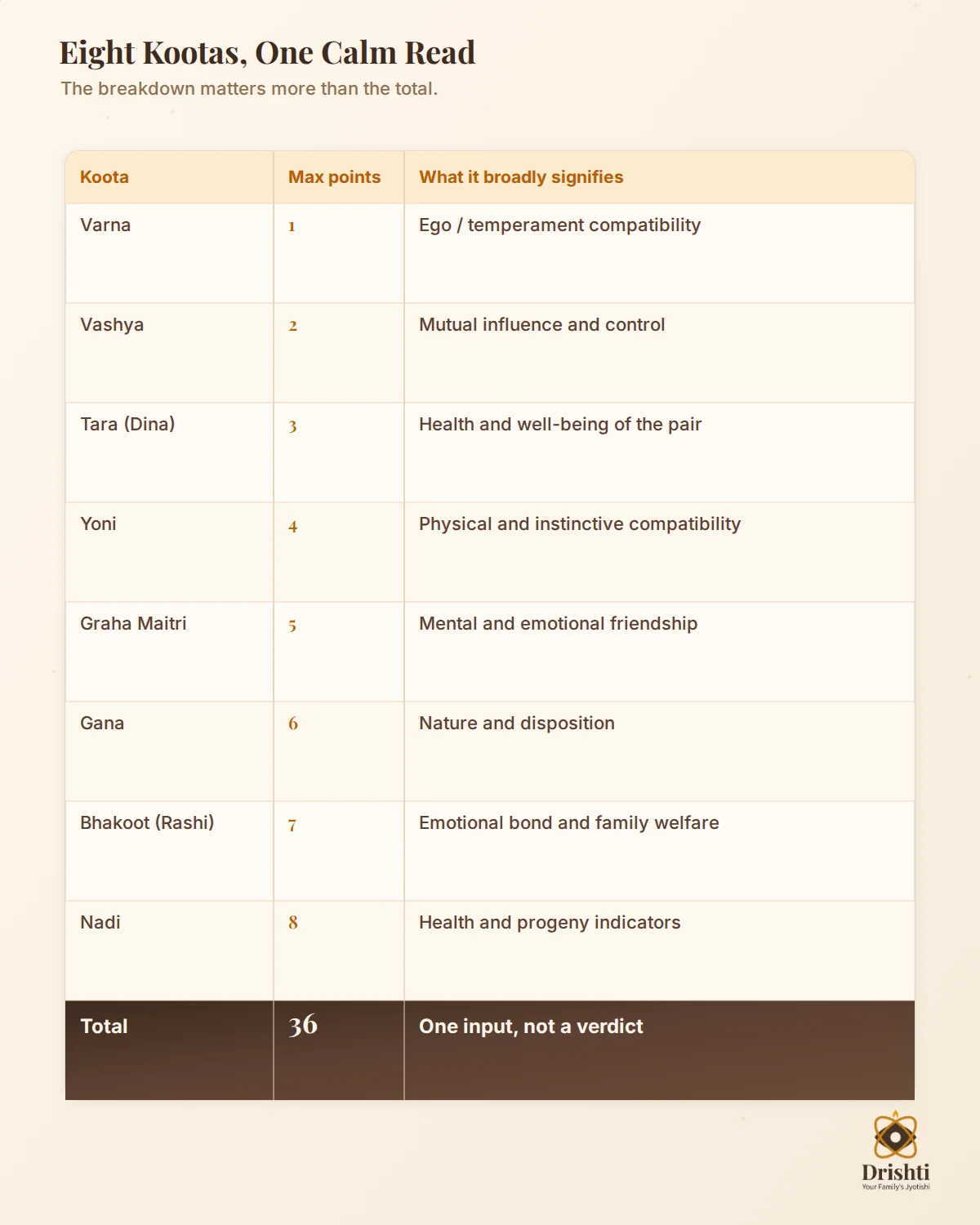
The eight kootas and their maximum points:
| Koota | Max points | What it broadly signifies |
|---|---|---|
| Varna | 1 | Ego / temperament compatibility |
| Vashya | 2 | Mutual influence and control |
| Tara (Dina) | 3 | Health and well-being of the pair |
| Yoni | 4 | Physical and instinctive compatibility |
| Graha Maitri | 5 | Mental and emotional friendship |
| Gana | 6 | Nature and disposition |
| Bhakoot (Rashi) | 7 | Emotional bond and family welfare |
| Nadi | 8 | Health and progeny indicators |
| Total | 36 | One input, not a verdict |
A good app surfaces every row, not just the sum. When Graha Maitri is full but Bhakoot is zero, that is a specific finding a couple can talk through — invisible if the app only reports the total. For the full mechanics of how each koota is calculated, our dedicated explainer walks through it step by step: understanding Gun Milan and the Ashtakoota system.
Nadi, Bhakoot, Mangal dosha handled calmly
Three findings alarm families more than any others, and they are exactly where an app’s tone matters most.
Nadi dosha occurs when both people share the same Nadi (there are three: Aadi, Madhya, Antya), zeroing out the 8-point Nadi koota — the heaviest single factor. It is traditionally associated with health and progeny considerations, and classical practice recognises several conditions under which it is considered cancelled or reduced. A calm app states the finding, notes that exceptions exist, and points you toward a full-chart reading rather than declaring an outcome.
Bhakoot dosha arises from certain rashi-to-rashi relationships (the 6-8 and 2-12 axes are the usual culprits) and can knock out the 7-point Bhakoot koota — again, a documented finding with recognised cancellation conditions, not a sentence.
Mangal dosha (being Manglik) matters because of a common confusion: it is not part of Guna Milan at all. It comes from Mars’s placement in specific houses and is checked separately from the 36-guna score. Plenty of apps blur this and let a “Manglik” flag colour the whole result. The honest ones keep them separate, note that Manglik status has widely-recognised mitigating factors, and never treat it as a red stamp. An app that turns Mangal dosha into a fear headline is one to distrust.
The through-line: dosha findings are inputs for a considered conversation — ideally with a qualified astrologer looking at both full charts — never automated bad news.
Full-chart context and Navamsa / D9
This is the gap that separates a scoring calculator from a genuine compatibility tool. A serious reading does not stop at the Moon. It looks at the Navamsa (D9) — the divisional chart traditionally weighted heavily for marriage — plus the seventh house, its lord, and the placement of Venus and Jupiter. None of that is captured in the 36 gunas.
The best apps make this explicit: they show the score, then clearly say it is a first pass and the full chart (Navamsa included) needs a proper look. That honesty is a feature, not a hedge. Since matching depends entirely on an accurate birth chart, it is worth understanding how accurate your Kundli calculation really is before you lean on any number — a wrong birth time quietly corrupts everything downstream.
Languages, privacy, and family sharing
Matching is a family activity in most Indian households, which raises three practical questions most reviews skip.
Language: Can parents and elders read the result in Hindi, Tamil, Telugu, Kannada or another language they are comfortable with? A report nobody in the room can read defeats the purpose. Most major Vedic apps offer multilingual output, though depth varies.
Privacy: Birth details of two people — including exact times — are sensitive. Many apps route you toward astrologer marketplaces and remedy stores, which means your data feeds a sales funnel. Worth knowing before you type in a birth time.
Sharing: A clean PDF two families can pass around calmly beats a screenshot war in a group chat. PDF export and matching reports are common across the paid Vedic apps. For running any of this as a family — profiles, privacy, who sees what — see our guide to family astrology workflows and privacy.
Apps compared
Facts below are drawn from official listings; pricing is given as model, not rupee prices, since published prices are not reliably fixed. Ratings, download and astrologer counts are omitted — they are volatile and I do not restate unverified numbers as fact. Marketing superlatives are flagged as each company’s own claim.
AstroSage Kundli (store name “AstroSage Kundli: AI Astrology,” by Ojas Softech, Android and iOS) is the most chart-forward of the group. It generates Rasi and Navamsa charts, runs 36-point Ashtakoota matching, and layers in Dasha and planetary analysis, KP System, Lal Kitab, multiple ayanamsa options and PDF export. Freemium — core Kundli and horoscope free, premium reports and consultations paid. It calls itself the “#1 Astrology App / #1 Kundli Software,” its own marketing line, not an independent finding. For families that want to see the mechanics behind a match, this is where the depth is.
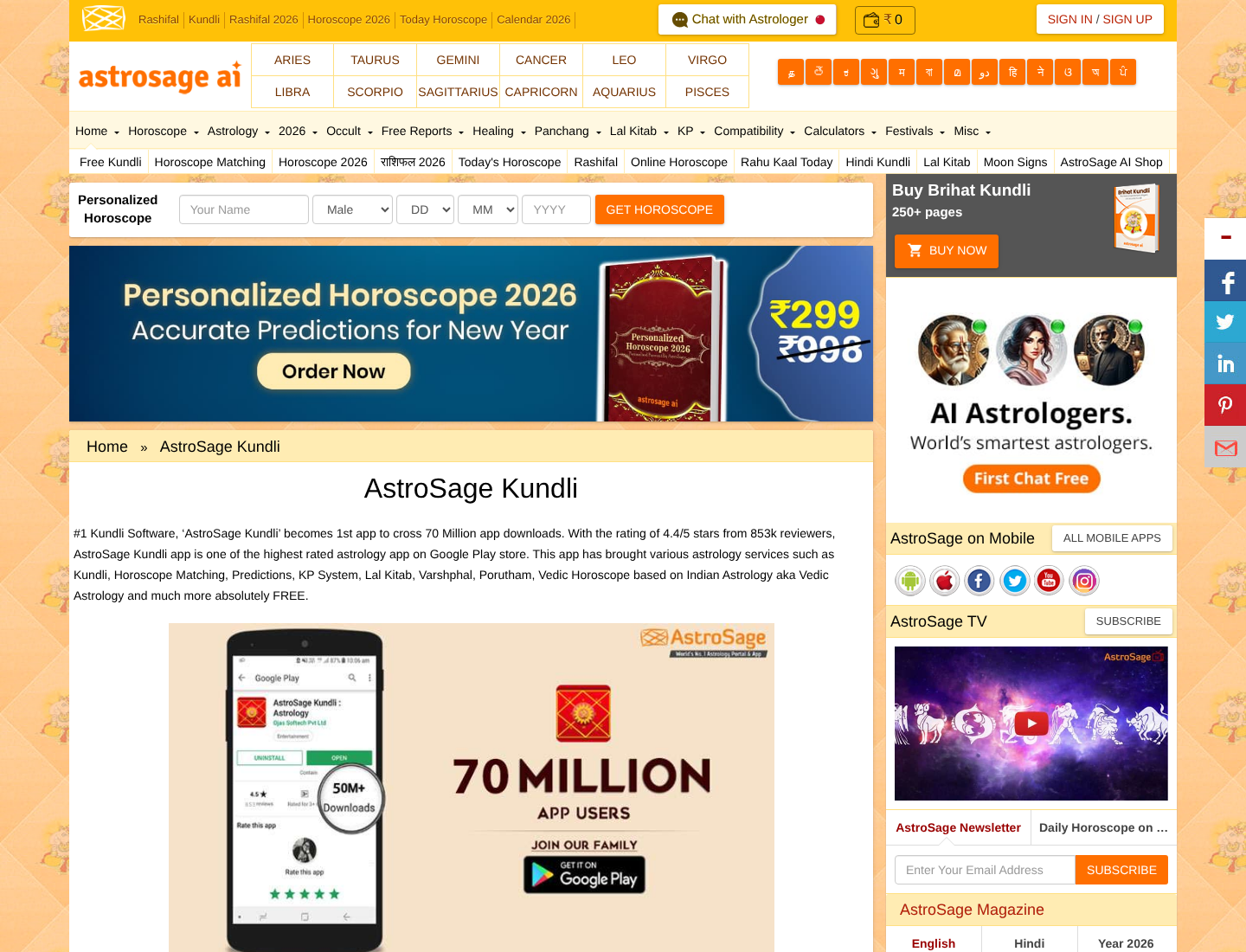
AstroTalk (“Astrotalk – Talk to Astrologer,” by Codeyeti Software Solutions, Android and iOS) is built around consulting a human. It offers free Kundli, horoscope and matchmaking, but its centre of gravity is chat and call with astrologers, with a promoted “First Chat Free.” Pricing is free with paid consultations via wallet recharge. It describes itself as “India’s most accurate astrology platform” — its claim, not a fact you can assert. A good fit if, after seeing a score, you want a person to talk it through the same evening.
Astroyogi (store names differ — “Astroyogi – Astrology & Kundli” on Play, “Astroyogi Chat with Astrologer” on the App Store; by Netway India) sits between the two: free daily horoscope and instant Kundli, Janam Kundli and Kundli matching, plus chat and call with astrologers, Tarot, Panchang and more. Freemium, with a promoted first chat free. A balanced pick when you want both a self-serve match and an easy handoff to a consult.
GaneshaSpeaks (store titles vary — “GaneshaSpeaks – Astro, Zodiac” / “GaneshaSpeaks Kundli Astrology” on Play, “GaneshaSpeaks – Astrology Chat” on the App Store; by Wellness Technologies, built on the legacy of astrologer Bejan Daruwalla) offers free Kundali, daily-to-yearly horoscopes, Kundli matching and compatibility, and live chat/call. Freemium. It markets itself as “Bharat’s Best Astrology App” and cites “50M+ consultations across 180 countries” — self-reported figures, not independently verified, which I quote only as the company’s own words.
mPanchang (“Hindu Calendar, Kundli Making and Kundali Matching,” by PCVARK Software) comes at matching from the Panchang side. It does Kundli making and Guna Milan matching alongside daily and monthly Panchang, Muhurat and Choghadiya, horoscopes and a Hindu calendar with vrats and festivals. Android is confirmed; an iOS listing is claimed by the site but not something I can confirm live, so treat “on iOS” cautiously. Freemium, with paid matching reports promoted at volatile discounts. Its “No. 1 App for Hindu Calendar” tag is its own marketing. A natural fit for households that also want muhurat and festival timing in one place.
One label to keep straight: Co-Star is Western/tropical astrology, not Vedic Jyotish, so it does not do Ashtakoota Guna Milan in any comparable form — leave it out of a Kundli-matching shortlist. And VAMA and Sri Mandir are devotional, puja-led apps where astrology is secondary; they are spiritual companions, not matching tools. For the wider astrology-app landscape beyond matching specifically, see our best astrology apps shortlist.
Comparison table
Matching-relevant capabilities only. Pricing shown as model. No ratings or download counts — those are volatile and omitted by design.
| App (store name) | Platforms | Guna Milan / matching | Chart depth for matching | Astrologer consult | Pricing model | Self-claim (their words) |
|---|---|---|---|---|---|---|
| AstroSage Kundli: AI Astrology | Android + iOS | 36-point Ashtakoota | Rasi + Navamsa, Dasha, KP, Lal Kitab | Paid | Freemium | “#1 Astrology App” |
| Astrotalk – Talk to Astrologer | Android + iOS | Matchmaking + free Kundli | Consult-led | Yes, core offering | Free + paid consults | “India’s most accurate platform” |
| Astroyogi (Play/App Store names differ) | Android + iOS | Kundli matching | Janam Kundli + matching | Yes | Freemium | — |
| GaneshaSpeaks (titles vary) | Android + iOS | Matching / compatibility | Kundli + compatibility | Yes | Freemium | “Bharat’s Best” · “50M+ consults” |
| mPanchang | Android (iOS unconfirmed) | Guna Milan matching | Kundli + Panchang context | — | Freemium | “No. 1 Hindu Calendar App” |
The takeaway from the table: no single app wins every column. If you want mechanics, AstroSage; if you want a human read, AstroTalk or Astroyogi; if you want matching folded into muhurat and calendar, mPanchang. Match the app to how your family actually makes the decision.
If your family uses South Indian matching
If you are in Tamil Nadu, Kerala or a household that follows the southern tradition, the 36-guna Ashtakoot is not the system your elders may be checking. South Indian matching uses Porutham — a set of compatibility factors (commonly ten in the Tamil tradition) with its own names and emphasis. Kerala Porutham and Tamil Porutham overlap but are not identical to North-Indian Guna Milan, and the two can give different readings for the same couple.
Two factors deserve a specific callout. Rajju Porutham is often treated as one of the most important in the southern system — it concerns the longevity and stability of the marital bond and is weighted heavily by many families. Stree Deergha (also called Dina in some framings) concerns the well-being and prosperity of the couple. If your family cares about Rajju in particular, do not assume a 36-guna score covers it — it is a distinct calculation.
The practical point: most of the big Vedic apps default to Ashtakoot. Before you rely on any of them for a southern-tradition match, confirm the app actually computes Porutham and Rajju, or you will be handing your elders a number that answers a different question than the one they asked.
A healthier way to use matching results
Here is the workflow I recommend to families — it puts the score near the start, not the end.
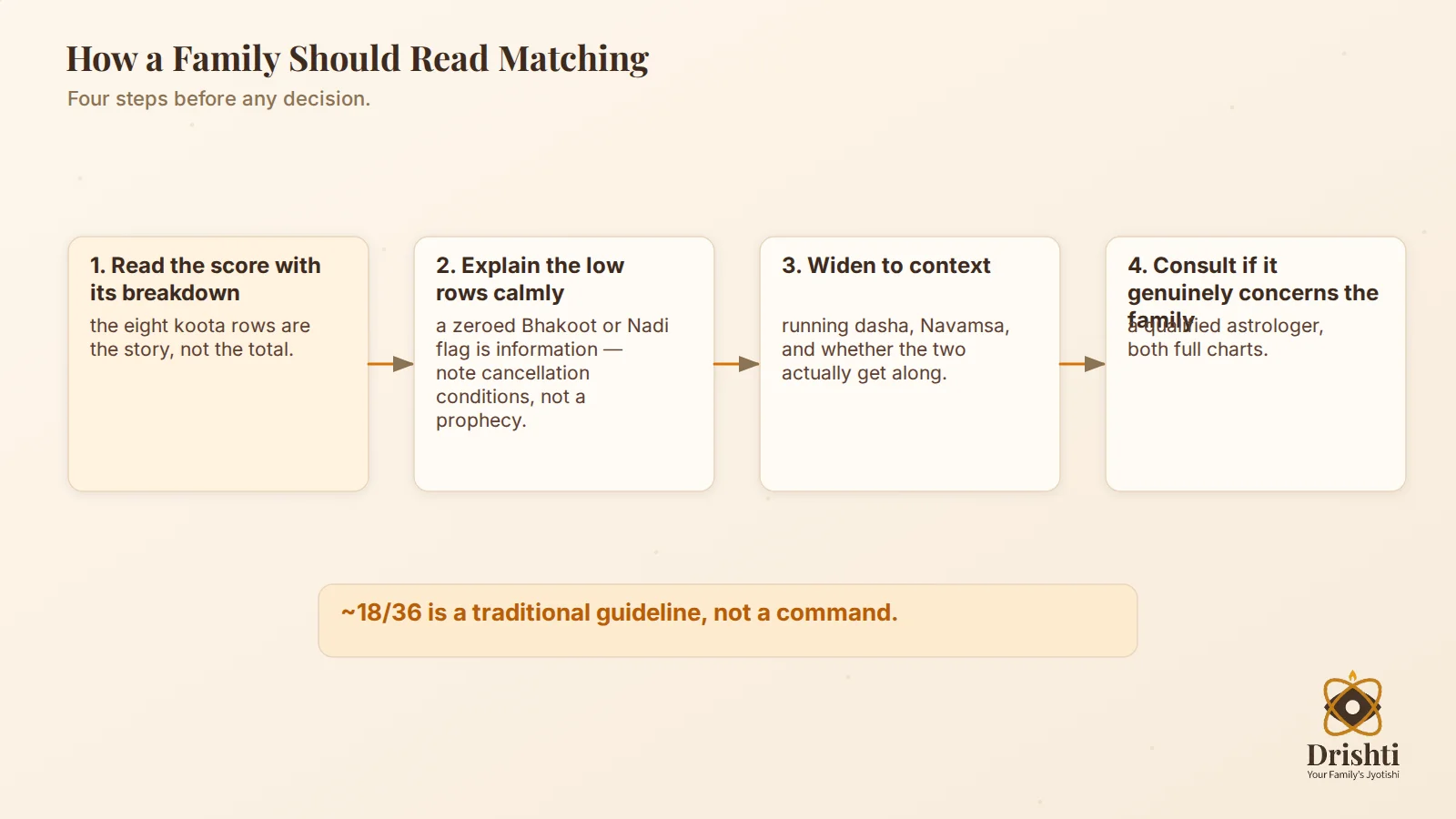
First, read the score with its breakdown. A total is a headline; the eight koota rows are the story.
Second, explain the low rows without drama. A zeroed Bhakoot or a Nadi flag is information about specific dimensions — not a prophecy. Note the recognised cancellation conditions rather than reacting to the raw finding.
Third, widen to context. What is the running dasha? What does the Navamsa suggest? Do the two people actually get along — because a chart never met either of them for coffee. Guna Milan is silent on lived compatibility, and that silence is not a small thing.
Fourth, if a finding genuinely concerns the family, consult a qualified astrologer with both full charts. That is what the score is for — surfacing what to look at, not closing the question.
On the number everyone asks about: many traditions treat around 18 out of 36 as a commonly-cited minimum, with higher totals generally regarded as more favourable. Read that as a traditional guideline, not a command. Publishing “reject any match below 18” as a rule is exactly the fear-shaped shortcut that gives matching a bad name. Plenty of long, happy marriages sit below 18; plenty of high scorers still need the full-chart look. The number opens a conversation. It does not end one.
Where Drishti fits
Drishti — “Your Family’s Jyotishi” — is built for exactly the moment this post describes: a family sitting together, wanting a calm, trustworthy read rather than a scoreboard that shouts.
The design intent is a family astrologer that shows its work. Accurate Vedic Kundli generation, grounded and transparent reasoning you can follow rather than a black-box verdict, and family profiles so more than one member lives in one place. It speaks across Indian languages — Hindi, Kannada, Tamil and Telugu are priorities — so the person who needs to read a result can read it in their own tongue. It is privacy-first by posture, which matters when two people’s birth details are on the table. And its voice is the difference: decisions over superstition, never fear. No doom headlines, no “reject below 18,” no Manglik red stamp.
That is the fit — not “the app with the biggest match percentage,” but the one that keeps a sensitive family conversation calm, legible and honest, a structured first screen presented as exactly that.
FAQ
Which app is best for Kundli matching? There is no single winner — it depends on what you need. For the deepest chart mechanics behind a match (Ashtakoota breakdown, Navamsa, Dasha), AstroSage Kundli goes furthest. For pairing a score with a human astrologer the same day, AstroTalk or Astroyogi work well. For matching folded into Panchang and muhurat, mPanchang fits. Choose by matching depth and how your family makes the decision, not by whichever app shows the highest number.
What is a good Gun Milan score? The score runs out of 36. Many traditions cite around 18 as a commonly-used minimum, with higher totals generally seen as more favourable. Treat that as a traditional guideline, not a pass/fail rule — the individual koota breakdown and the full chart matter more than the headline total, and marriages succeed across a wide range of scores.
Is Gun Milan enough for marriage? No. Guna Milan is a Moon-based first screen. It does not read the Lagna, the seventh house, Venus and Jupiter, the Navamsa (D9), or the running dasha periods — all of which a full compatibility reading considers. Use the score to decide what to look at more closely, then widen to the full chart and, if a finding concerns you, a qualified astrologer.
What is Nadi dosha? Nadi dosha occurs when both people share the same Nadi (Aadi, Madhya or Antya), which zeroes out the 8-point Nadi koota — the heaviest single factor. It is traditionally linked to health and progeny considerations, and classical practice recognises several conditions under which it is considered cancelled or reduced. It is a finding to examine with the full charts, not an automatic verdict.
Is Mangal dosha part of Gun Milan? No — this is a common confusion. Mangal dosha (being Manglik) comes from Mars’s placement in specific houses and is checked separately from the 36-guna Ashtakoota score. Manglik status also has widely-recognised mitigating factors and should never be read as a red stamp on a match.
Which app supports South Indian matching? South Indian families often use Porutham (Tamil or Kerala) rather than the 36-guna Ashtakoot, with Rajju Porutham and Stree Deergha weighted heavily. Most major Vedic apps default to Ashtakoot, so if your family follows the southern tradition, confirm on the live app listing that it actually computes Porutham and Rajju before relying on it — do not assume a guna score covers the same ground.