Quick answer: what the 36-guna score means
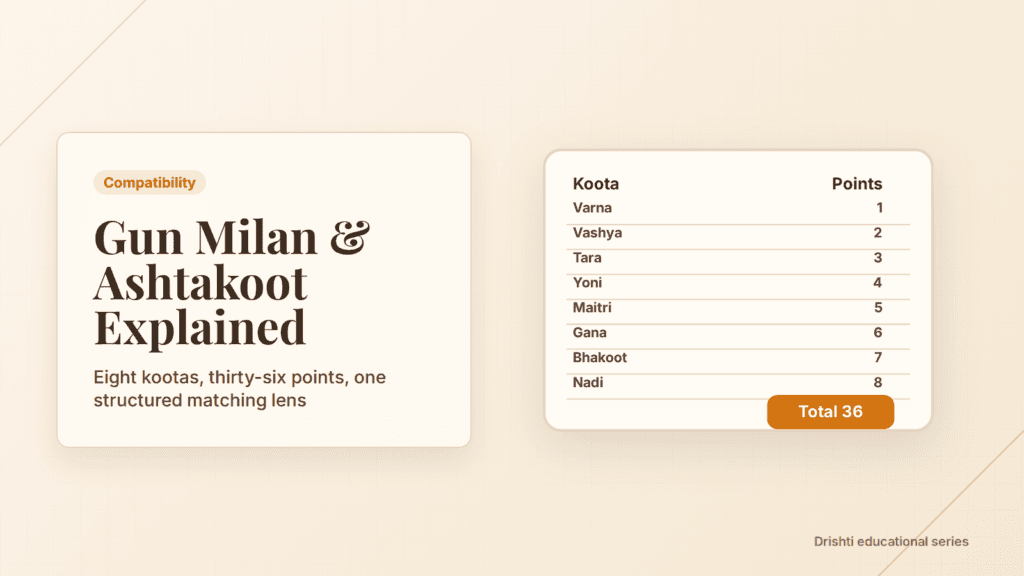
Gun Milan (also written Guna Milan) gives you a number out of 36. That number is a Moon-and-nakshatra compatibility screen — it compares the two birth Moons across eight traditional tests called the Ashtakoot, or Ashta Koota, and adds up the points each test awards. A score of 18 or more is the conventional threshold many astrologers treat as “worth proceeding to a fuller look.” That is the whole honest headline: it is a screen, not a sentence.
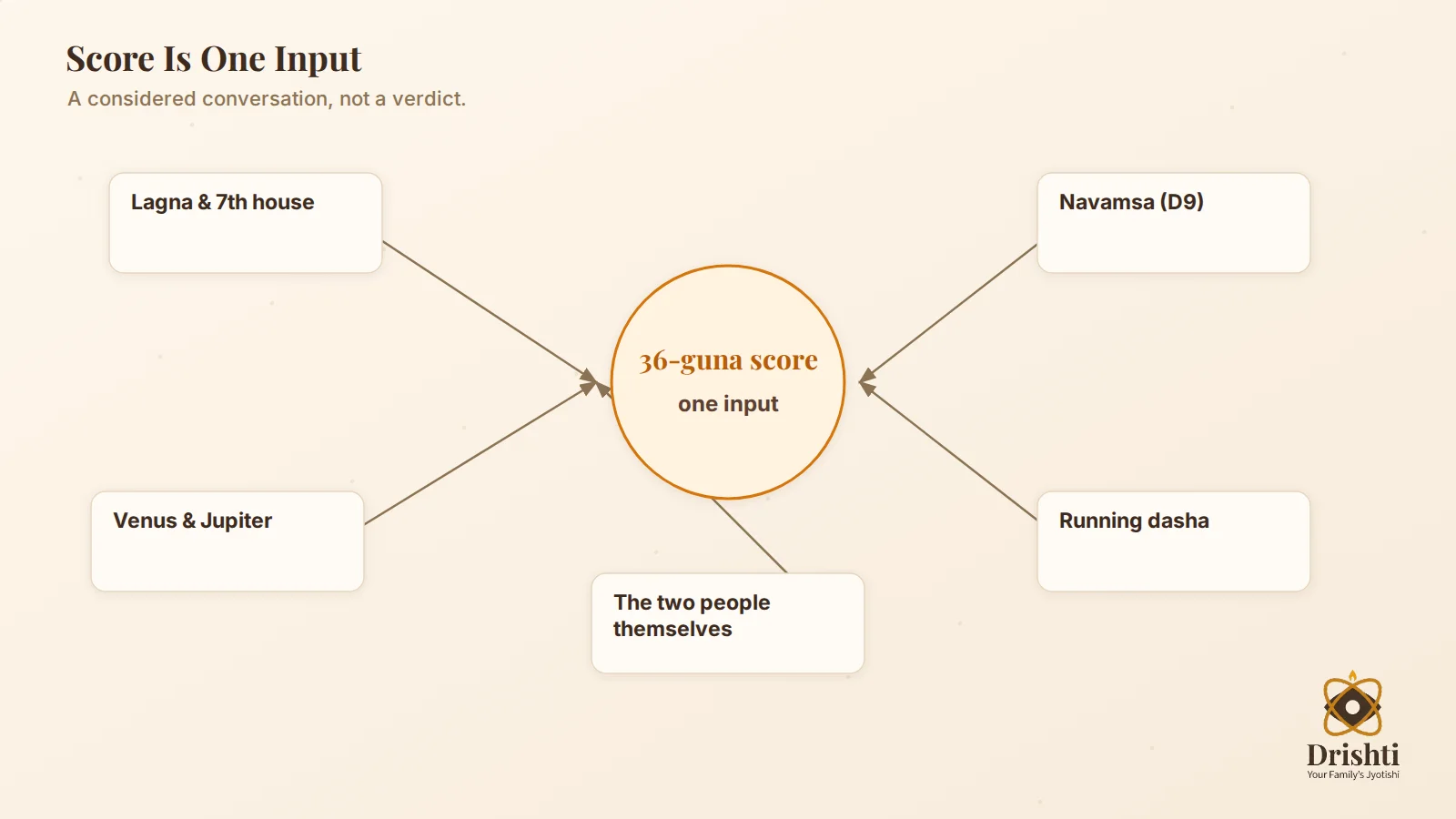
What the 36-guna score is not is a marriage verdict. It does not read careers, temperament in daily life, family finances, health, or whether two people can build a shared life. I have watched families treat a single number as a green or red light, and it deserves neither role. Use it the way it was designed — as one early input into a much larger, human conversation.
What Gun Milan actually compares
The engine underneath Gun Milan is narrow and specific: it looks at the Moon’s position in each chart. In Vedic astrology the Moon (Chandra) stands for the mind, emotional rhythm, and instinctive comfort — which is why an ancient compatibility system built around it is asking a genuinely useful question. Are these two emotional natures likely to feel at ease together?
To answer, the system reads each person’s Janma nakshatra — the lunar mansion the Moon occupied at birth — and each person’s Moon sign (Rashi). There are 27 nakshatras, each spanning 13°20′ of the zodiac, and your Moon falls in exactly one of them. If you want the underlying logic of why the nakshatra carries so much weight, our companion piece on the nakshatra basis of matching walks through it slowly; here it is enough to know that almost every koota derives from the two Moons and their nakshatras.
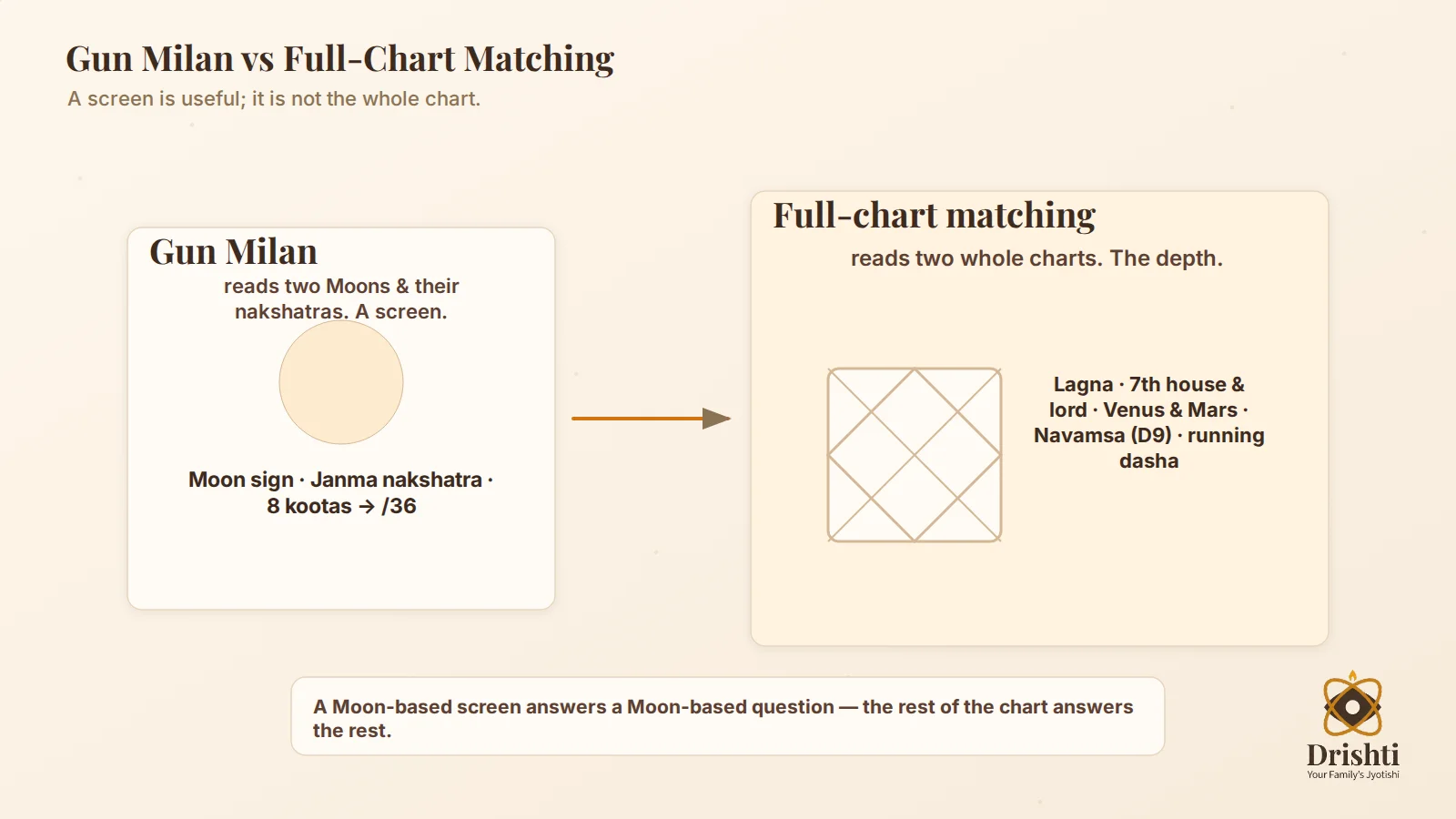
Notice what is missing. The Ascendant (Lagna), the Sun, Venus and Mars as relationship and desire significators, the whole Navamsa (D9) chart astrologers use for marriage depth, the running dasha periods that time when life actually happens — none of that lives inside the 36-guna calculation. That is not a flaw in Gun Milan. It is simply the boundary of the tool. A Moon-based screen answers a Moon-based question, and the rest of the chart answers the rest.
The eight kootas and their point weights
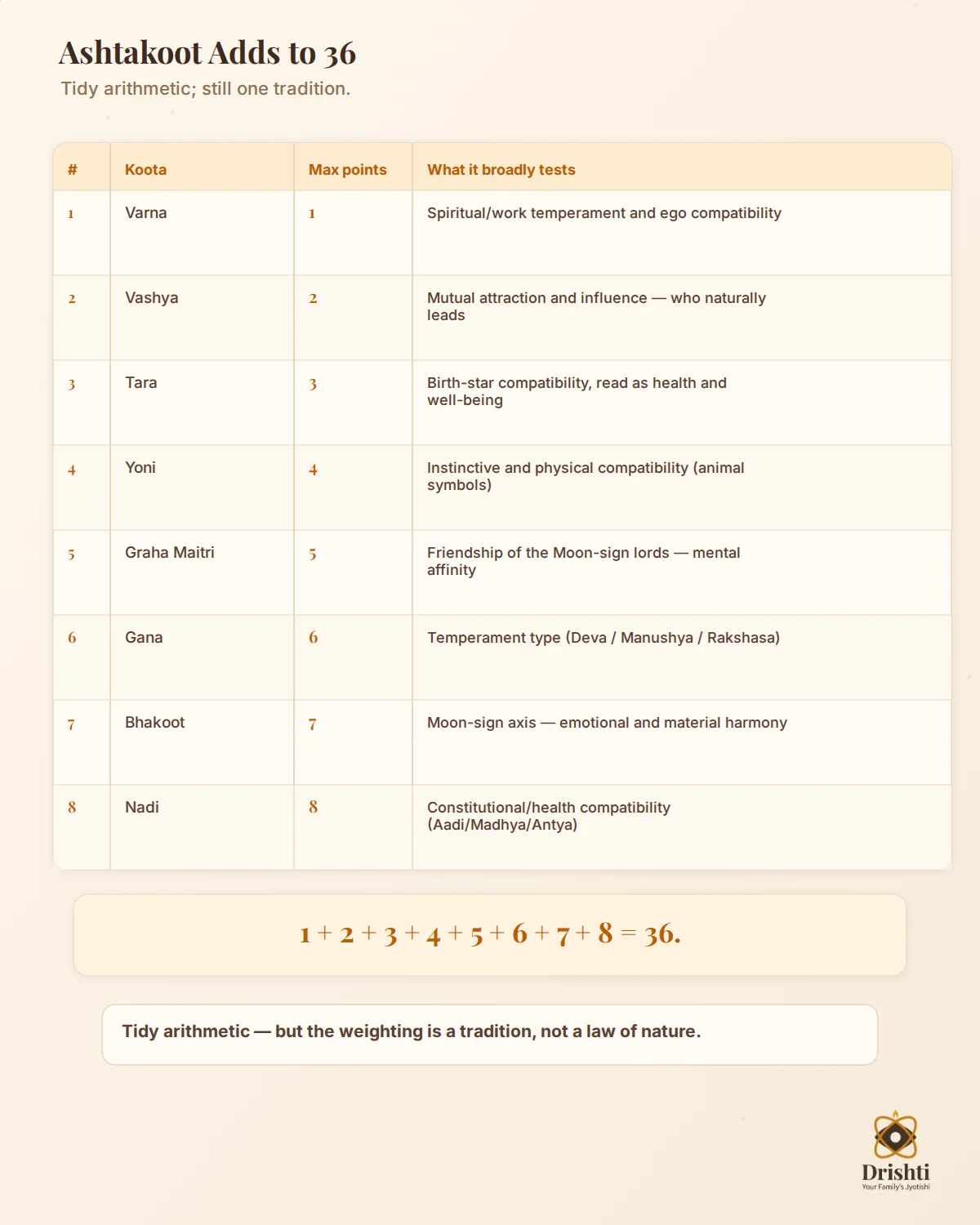
Ashtakoot means “eight kootas” — eight compatibility tests, each weighted differently, each earning a slice of the 36 points. The weights are not arbitrary; heavier weights sit on the tests classical tradition treated as more consequential for a shared life. Here is the full breakdown.
| # | Koota | Max points | What it broadly tests |
|---|---|---|---|
| 1 | Varna | 1 | Spiritual/work temperament and ego compatibility |
| 2 | Vashya | 2 | Mutual attraction and influence — who naturally leads |
| 3 | Tara | 3 | Birth-star compatibility, read as health and well-being |
| 4 | Yoni | 4 | Instinctive and physical compatibility (animal symbols) |
| 5 | Graha Maitri | 5 | Friendship of the Moon-sign lords — mental affinity |
| 6 | Gana | 6 | Temperament type (Deva / Manushya / Rakshasa) |
| 7 | Bhakoot | 7 | Moon-sign axis — emotional and material harmony |
| 8 | Nadi | 8 | Constitutional/health compatibility (Aadi/Madhya/Antya) |
| Total | 36 |
1 + 2 + 3 + 4 + 5 + 6 + 7 + 8 = 36. The tidy arithmetic is part of why the system feels authoritative — but the weighting is a tradition, not a law of nature, and different lineages apply the finer rules differently.
A few things are worth naming without turning this into a lookup manual. Nadi carries the most weight (8) and is tied to constitution and progeny in classical thinking. Bhakoot (7) reads the relationship between the two Moon signs. Gana (6) sorts each nakshatra into a temperament type. These three heavyweights are where most “worrying” scores come from — which is exactly why they deserve calm handling later, not a red flag.
How to read the total score
The conventional bands look something like this: below 18 is often labelled a weak match, 18 to 24 acceptable, 25 to 32 very good, and above 32 excellent. You will see these ranges on almost every matching tool, and they are a reasonable rough guide.
But read them as ranges of this particular Moon screen, not as a probability of a happy marriage. A 30 does not promise ease and a 17 does not promise trouble. In my testing of consumer matching tools, the same two birth details can land a point or two apart across apps because of small differences in nakshatra-boundary handling or ayanamsa settings — which tells you that treating 18 as a hard cliff is false precision. If two charts land at 17, the sensible response is “look closer,” not “walk away.” We go deeper into why tools disagree on the exact number in our note on matching calculation accuracy.
There is also a well-known quirk: some pairings score low on paper largely because of one heavy koota (usually Bhakoot or Nadi) while every other test is fine. A blunt total hides that. Always look at which kootas contributed the points before you react to the sum.
Why the total is not the whole story
The honest limitation is structural. Gun Milan reads two Moons. A marriage is read from two whole charts.
Everything that makes a relationship function over decades — how partners handle money, how their careers rise and dip, when children arrive, how they age, how they fight and repair — is timed and coloured by factors outside the eight kootas. Astrologers who take matching seriously move past the guna score to the Lagna compatibility, the seventh house and its lord in each chart, Venus and Mars placements, and above all the Navamsa (D9) chart, which is read specifically for the texture and durability of marriage. The running Vimshottari dasha periods matter too, because they show when supportive or testing phases fall for each person — context that a static score can never carry. If dasha is new to you, our dasha timing explainer lays out how those planetary periods actually work.
So when a good astrologer sees a 22, they do not stop. They ask what the rest of both charts say, and — just as importantly — what the two people are actually like. A number that skips all of that is a starting point, not a conclusion. Drishti’s whole posture on matching is to show that working, not to hand you a verdict and a fright.
Nadi, Bhakoot and Mangal dosha, calmly explained
Three terms cause most of the anxiety around matching, so let me take them one at a time — plainly, and without prescribing anything.
Nadi dosha. This appears when both charts fall in the same Nadi (Aadi, Madhya, or Antya), which zeroes out the 8 points Nadi can award — the single biggest swing in the whole system. Tradition associates Nadi with constitution and progeny, which is why it is treated seriously. It is also the koota where classical texts describe several exceptions and cancellations — for instance, cases involving the same Nadi but different nakshatras, or other chart conditions. I am flagging that those exceptions exist, not telling you which one applies to you. That is a reading for a qualified astrologer looking at both full charts, not a rule to self-apply from a blog.
Bhakoot dosha. This arises from certain Moon-sign relationships between the two charts (the 6–8 and 2–12 axes are the commonly cited ones), and it costs the 7 Bhakoot points. Again, tradition records mitigating conditions — such as particular relationships between the sign lords — that a practitioner weighs case by case. The pattern to notice across both: these are caveats to examine, not curses to fear.
Mangal dosha (Manglik). Here is the point most matching pages blur, and it matters: Mangal dosha is not part of the 36-guna score at all. It is a separate check, based on the placement of Mars (Mangal) in specific houses from the Ascendant, Moon, or Venus — nothing to do with the eight kootas. You can have a strong guna score and still carry Mangal dosha, or a modest score with none. Being described as Manglik is not a defect in a person; it is a chart placement that astrologers assess for compatibility, often by comparing whether both charts share it, and by reading the strength and aspects of Mars in context. Treat “Manglik” as information to discuss with a good astrologer, never as a label to fear or to weaponise in a conversation between families.
On remedies and cancellations generally: reputable practice looks at the whole chart before suggesting anything, and this is not the place for definitive fixes. If a page or an app hands you a one-size remedy the moment a dosha appears, be sceptical. The calm move is a proper reading, not a quick prescription.
A healthier way for families to use matching
Matching became a family ritual for a reason — it is a structured way to pause and think before a big decision. The trouble starts when the number stops being a prompt for conversation and becomes a gavel.
Here is the approach I would actually recommend to a family sitting with a score:
- Treat the number as a conversation-opener, not a decision. A screen tells you where to look next; it does not tell you what to do.
- Look at which kootas moved the score, not just the total. A low sum driven by one heavy koota with everything else healthy is a very different situation from a broadly weak match.
- Separate the doshas out. Ask specifically whether any Bhakoot, Nadi, or Mangal consideration is in play, and get it explained in plain language rather than as a verdict.
- Bring in the whole chart and a real astrologer before drawing conclusions — Lagna, Navamsa, dasha, and the people themselves.
- Never use the score as pressure. No family should push a match forward, or shut one down, on 36 points of Moon compatibility alone. The two people’s actual compatibility — values, respect, life goals — is the part no koota measures.
A family that uses matching this way gets the benefit of the tradition (a considered pause) without the harm (fear-driven snap judgements). That is the difference between astrology as decision support and astrology as anxiety.
The South-India note: Ashtakoot is not the only framework
One thing many national matching pages quietly skip: the eight-koota Ashtakoot system is the North Indian convention, not the whole of India’s practice. In much of Tamil Nadu, Kerala, and neighbouring regions, families use Porutham — a Tamil/Malayalam matching framework that counts a different set of compatibilities (commonly ten, in the widely used Dasa Porutham reckoning), overlapping with the kootas in spirit but not identical in structure or weighting.
This matters for two reasons. First, if your family follows a South-Indian tradition, an Ashtakoot score out of 36 may not be the number your elders or astrologer actually work from. Second, it is a healthy reminder that “the score” is a regional convention, not a universal verdict. Two respected systems can weigh the same couple differently, and neither is “the truth” the way a fever reading is. A good matching tool should be honest about which framework it is running.
How apps should present matching results
Most matching apps are technically fine at generating a number. Where they differ — and where they can do real harm — is in how they frame it. I have used a lot of these tools, and the framing failures are consistent: a big red total, a “not compatible” banner, an instant remedy upsell, no explanation of which koota did what, and no mention that Mangal dosha is a separate check.
The Vedic and Kundli-first apps in India mostly handle the calculation itself and offer 36-point Ashtakoota matching within a freemium model — I compare that field in detail in our best astrology apps roundup, so I won’t re-litigate features here. The point that belongs in this post is presentation. A matching result should show the koota-by-koota breakdown, state the Moon/nakshatra basis plainly, separate doshas from the guna total, and refuse fear language entirely.
That is exactly the posture Drishti is built around. As “Your Family’s Jyotishi,” the aim is to be a calm, trustworthy family astrologer that shows its work, speaks your language, and never traffics in fear — which for matching means explaining the number rather than weaponising it, keeping Mangal dosha in its own honest lane, and giving families across Indian languages a result they can actually talk through together instead of dread. A score should start a conversation, not end one. Any app worth trusting with something as tender as a marriage decision should be built to do the same.
FAQ
What is Gun Milan? Gun Milan (Guna Milan) is a traditional Vedic compatibility screen that scores two people out of 36 by comparing their birth Moons and Janma nakshatras across the eight Ashtakoot tests. It measures likely emotional and temperamental ease — not a full marriage outcome.
What are the 8 kootas? The eight kootas are Varna, Vashya, Tara, Yoni, Graha Maitri, Gana, Bhakoot, and Nadi. Each is weighted differently (1, 2, 3, 4, 5, 6, 7, and 8 points respectively), and together they add up to the 36-guna total.
What is a good score out of 36? Conventionally, 18 or above is treated as acceptable, 25–32 as very good, and above 32 as excellent, while below 18 is often called weak. Read these as bands of a Moon-based screen, not as a probability of a happy marriage — and always look at which kootas earned the points.
Is 18 gunas enough for marriage? Eighteen is the common threshold astrologers use to say “worth proceeding to a fuller look,” not a guarantee of a good marriage. A match near or below 18 is a signal to examine the whole chart and the people involved, not a reason on its own to proceed or stop.
Does low Gun Milan mean marriage will fail? No. A low Gun Milan score means the Moon/nakshatra screen flagged less alignment on that narrow test — it does not predict that a marriage will fail. Many low scores come from a single heavy koota while the rest are fine, and the guna number never reads the whole chart, the running dasha periods, or the two people’s actual compatibility.
Is Mangal dosha included in Gun Milan? No. Mangal dosha (being Manglik) is a separate check based on the placement of Mars in specific houses — it is not part of the 36-guna Ashtakoot score. You can have a high guna score and still carry Mangal dosha, or the reverse. It should be assessed on its own by a qualified astrologer, calmly and in the context of both full charts.