Quick answer: what a dasha is
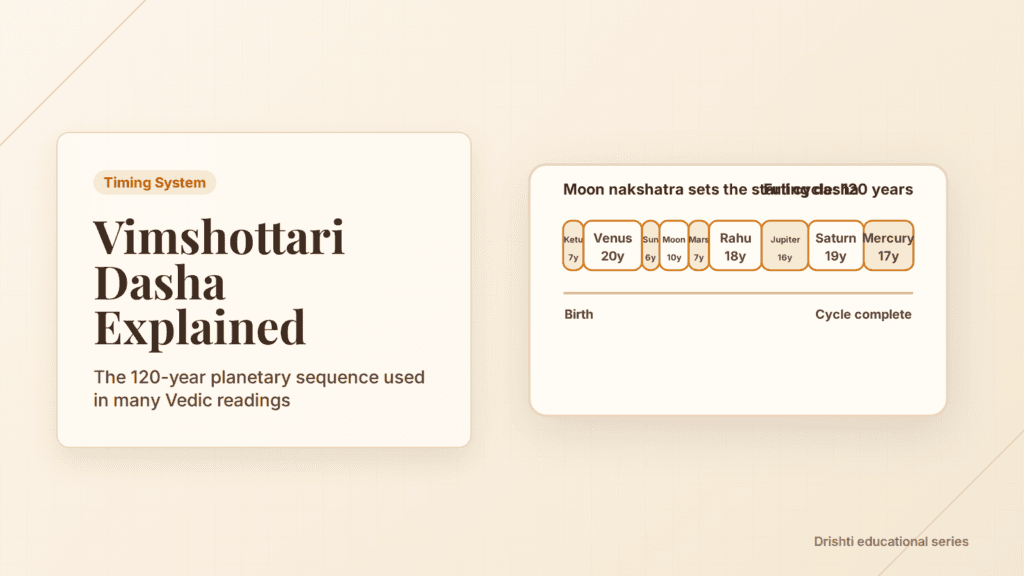
A dasha is a stretch of time that Vedic astrology assigns to one planet, and Vimshottari dasha is the most widely used system for slicing your life into those stretches. Instead of asking “what does Saturn mean in your chart” as a fixed trait, the dasha system asks “when does Saturn get the microphone.” Your whole life is divided into nine planetary periods, called Mahadashas, that always run in the same order and always add up to 120 years. Which planet speaks first is decided by the Moon’s position at your birth. So when someone tells you “you’re in your Jupiter Mahadasha,” they mean Jupiter is the planet coloring this chapter of your life — and there are smaller sub-periods nested inside it that shade the details. That’s the whole idea. The rest of this guide is just detail and calm reading.
Why Vimshottari means 120 years
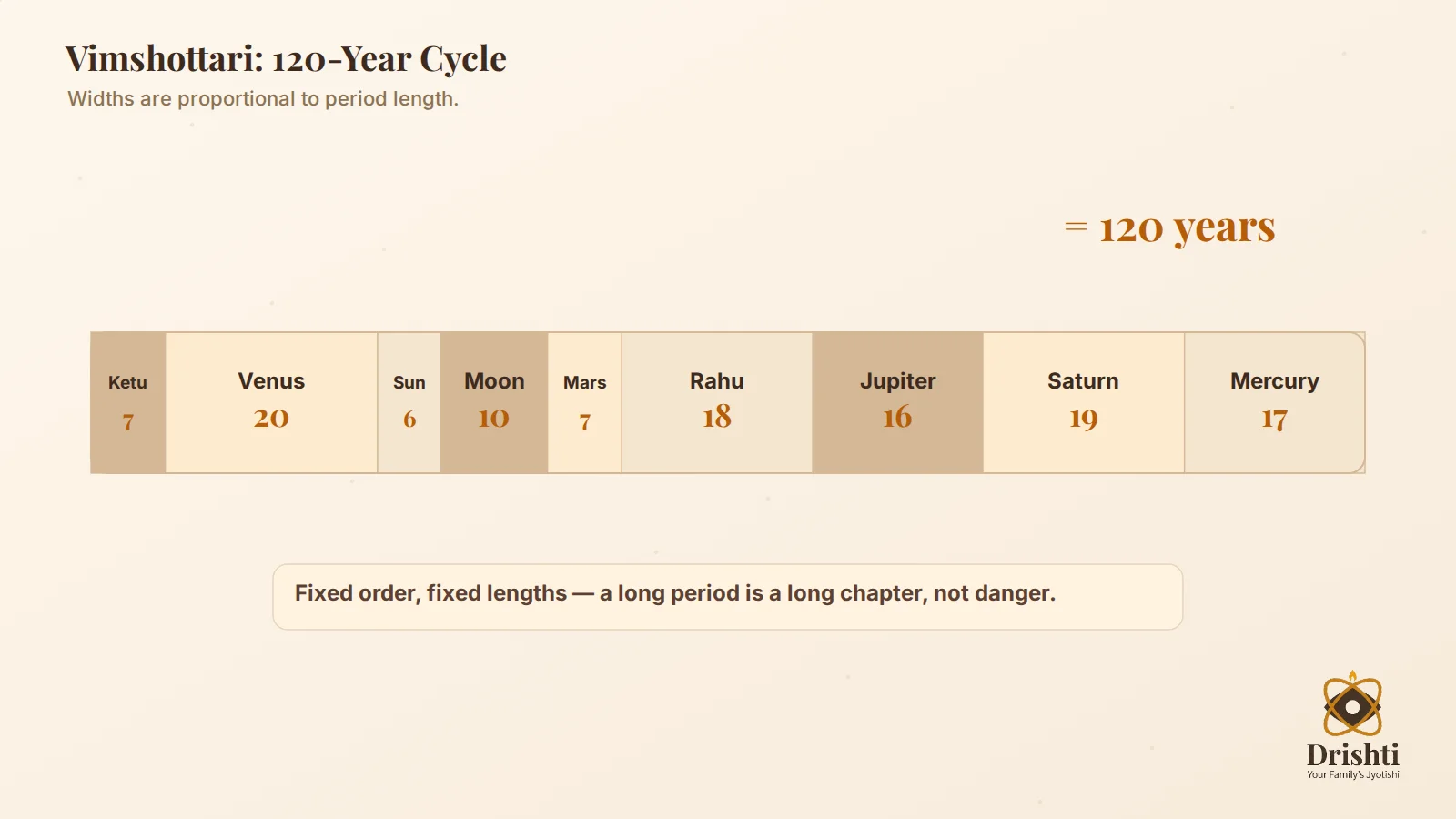
The word Vimshottari comes from the Sanskrit for “one hundred and twenty,” and that number is baked into the system by design. The nine planets it uses — the seven visible grahas plus the two lunar nodes, Rahu and Ketu — are each given a fixed span, set so the full cycle totals exactly 120 years. That figure was historically treated as a symbolic full human lifespan, a complete round of the wheel.
You will almost never live through the entire 120-year cycle in one pass, and you’re not meant to. You enter partway through, at whichever planet’s period is running when you’re born, complete that period, then move through the remaining planets in sequence, looping back to the start if you live long enough. The point of the 120 is structural: it’s the fixed denominator that makes the whole system predictable. Every span is a known fraction of it, which is why two astrologers working the same birth data produce the same timeline down to the day. This is arithmetic, not opinion — one reason dasha timing is checkable in a way vague horoscope talk never is. For how the underlying planetary positions are computed in the first place, see why calculation accuracy matters in astrology apps.
The nine Mahadashas and their durations
Each of the nine planets rules a Mahadasha of a fixed length, and the lengths are not equal. Venus gets the longest run at twenty years; the Sun gets the shortest at six. The sequence itself is also fixed — it always goes Ketu, Venus, Sun, Moon, Mars, Rahu, Jupiter, Saturn, Mercury, then repeats. You start somewhere inside that loop, not necessarily at Ketu, but once you start, the order never changes.
Here is the full table. These are standard, verifiable calculation figures — the same in every genuine Vimshottari implementation.
| Planet (Graha) | Mahadasha length (years) |
|---|---|
| Ketu | 7 |
| Venus | 20 |
| Sun | 6 |
| Moon | 10 |
| Mars | 7 |
| Rahu | 18 |
| Jupiter | 16 |
| Saturn | 19 |
| Mercury | 17 |
| Total | 120 |
A few things worth noticing. The order isn’t the days of the week, and it isn’t smallest-to-largest — it’s its own fixed ruling sequence, easier to memorise than to reason out. Rahu (18) and Saturn (19) carry the longest spans after Venus, part of why they loom so large in popular astrology chatter: they simply take up more calendar. That’s a fact about duration, not danger. A long period is a long chapter, nothing more.
How your starting dasha is chosen from the Moon’s nakshatra
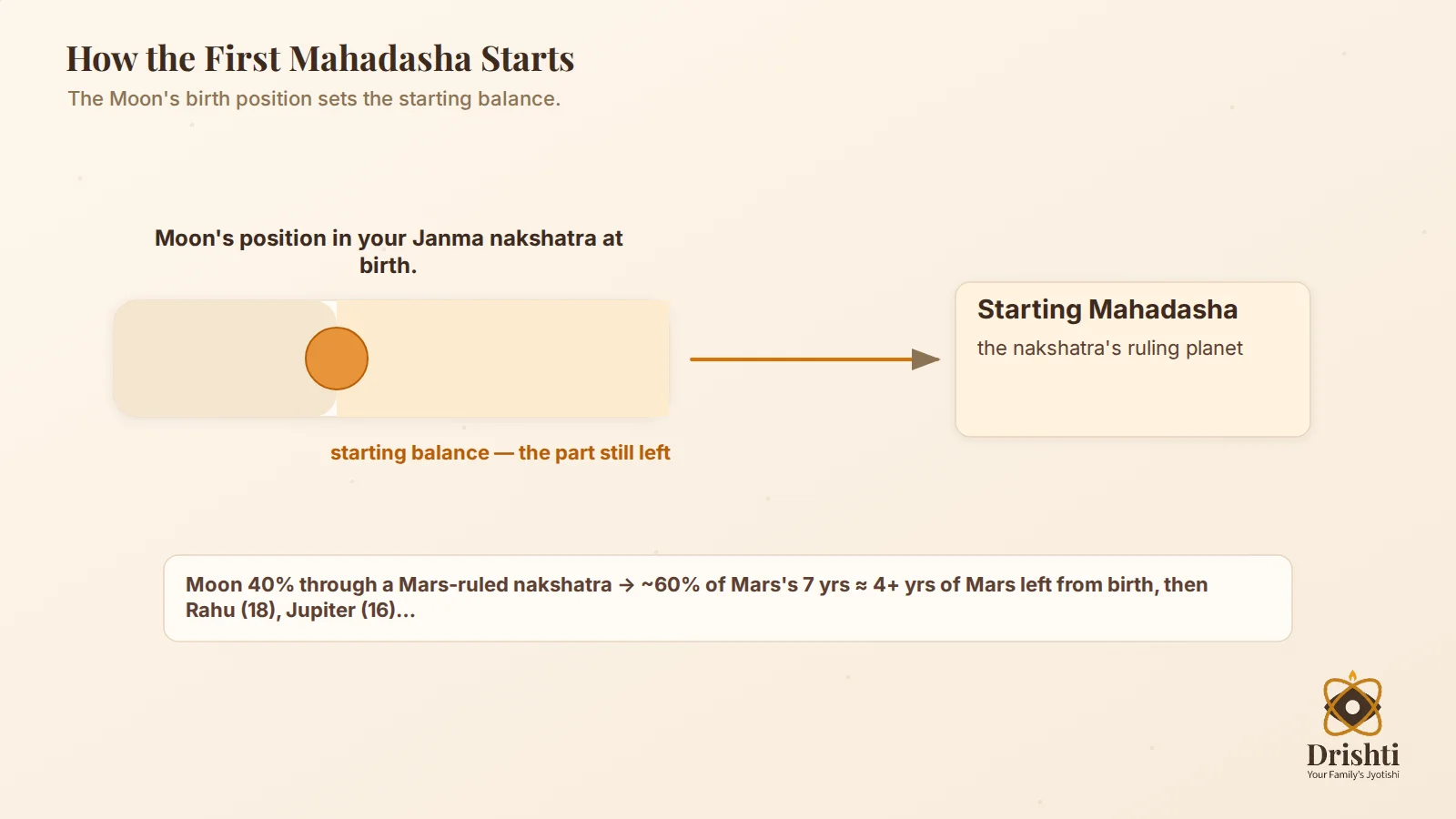
Everything about your dasha timeline hangs on one measurement: where the Moon sat among the 27 nakshatras at the moment you were born. This is your Janma nakshatra, your birth star, and it fixes your starting point in the 120-year loop.
Each of the 27 nakshatras is “ruled” by one of the nine dasha planets, cycling through the same Ketu-to-Mercury order. Whichever planet rules the nakshatra your Moon was in becomes your first Mahadasha. If your Moon was in a nakshatra ruled by Jupiter, your life begins somewhere inside a Jupiter Mahadasha; if it was ruled by Mars, you start in Mars. Simple so far.
The one wrinkle people find fiddly is the starting balance. You are almost never born exactly at the start of a nakshatra, so you don’t get the full Mahadasha from birth — you get whatever portion was still “left” when you arrived. Picture a nakshatra as a room the Moon walks across. If your Moon had already crossed two-thirds of a Ketu-ruled nakshatra at birth, then two-thirds of the Ketu period is behind you, and only the remaining third plays out before Venus takes over. That leftover slice is your starting balance, and it’s why two babies born the same afternoon can have their timeline nudged by months. Any dasha calculator handles the proportion for you, but it helps to know it’s just “how far through the nakshatra the Moon had travelled,” not something mystical.
If nakshatras themselves are new to you, they deserve their own foundation, and we cover the 27 birth stars and what the Moon’s placement means in a dedicated guide to nakshatras and the Moon’s role. For why the Moon specifically anchors this whole system, see the section further down and the FAQ.
Mahadasha, Antardasha, Pratyantardasha
A Mahadasha is the big chapter, but life doesn’t feel like one flat mood for sixteen or twenty years, and the system knows that. Each Mahadasha is subdivided into nine Antardashas — also called Bhuktis — one for each planet, running in the same fixed sequence, each lasting a slice of the parent period proportional to that planet’s own Mahadasha length.
So inside your Jupiter Mahadasha, the first Antardasha is Jupiter-in-Jupiter, then Jupiter-Saturn, then Jupiter-Mercury, and so on through all nine. The Antardasha is the planet holding the sub-microphone. It’s what most people actually feel, because a two-year Jupiter-Saturn sub-period has a distinctly different texture from a Jupiter-Venus one, even though both sit inside the same Jupiter chapter. When an astrologer says your Mahadasha and Antardasha “agree” or “pull against each other,” this is what they’re reading — the conversation between the chapter planet and the sub-chapter planet.
Go one level deeper and each Antardasha splits again into nine Pratyantardashas, the same nine planets in order, scaled down once more. This is the layer that gets you from broad years to specific months. Astrologers can keep subdividing — the next levels are Sookshma and Prana dasha — but the top three levels carry almost everything you need. Any deeper and you’re chasing precision the birth-time data usually can’t support.
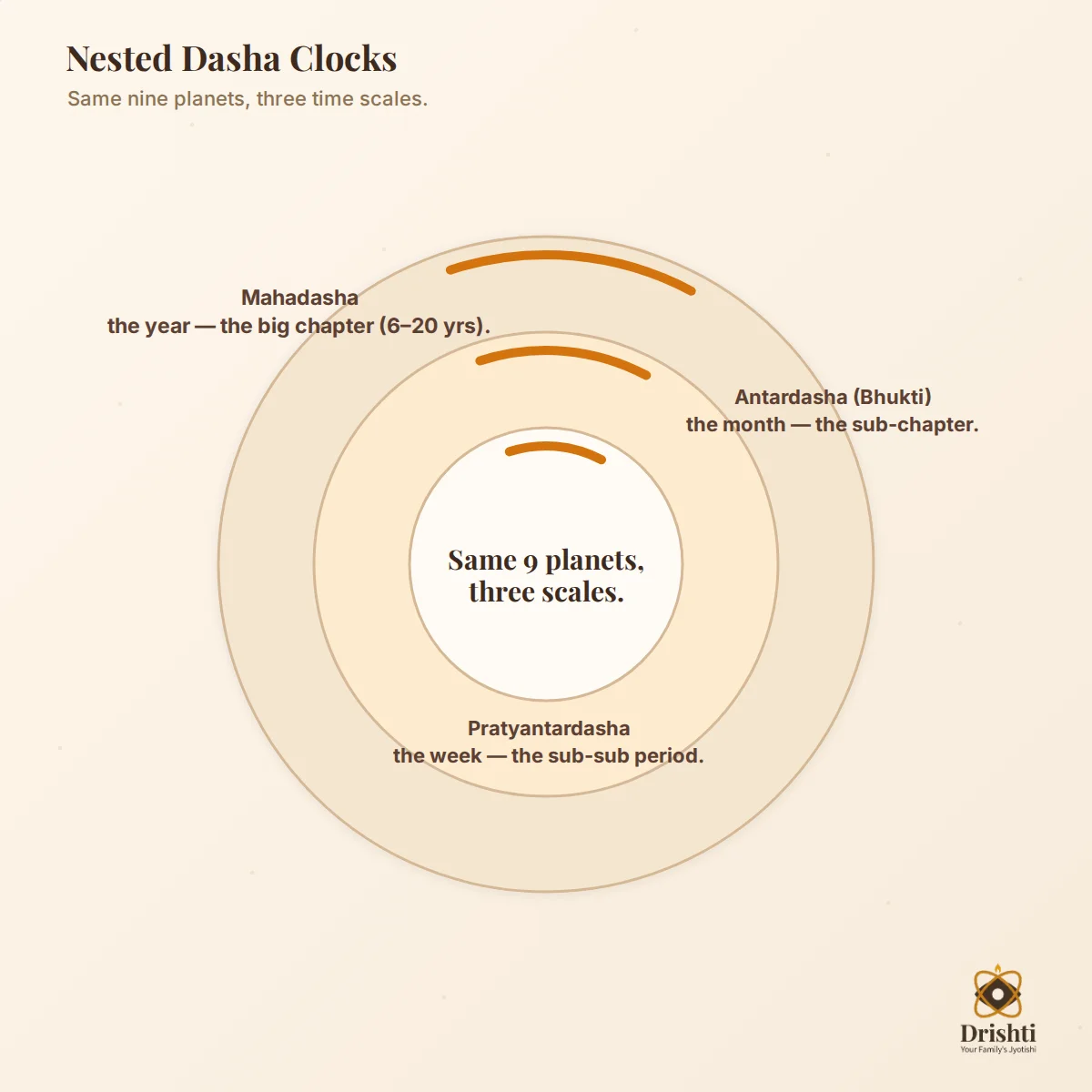
The clean way to picture it: the Mahadasha is the year, the Antardasha the month, the Pratyantardasha the week — same nine hands on three nested clocks, each turning at its own scale.
How to read your current dasha without fear
Here is where a lot of dasha writing goes wrong, and where I’ll ask you to slow down. A dasha does not deliver a verdict. A planet running its period doesn’t act out its stereotype on you — it activates whatever that planet is actually doing in your chart. That distinction is the entire craft.
Read the planet as it sits in your own kundli, not as a folklore character. The same Saturn Mahadasha reads very differently depending on where Saturn is placed, which houses it rules for you, how it’s aspected, and whether it’s dignified or stressed in your chart. “Saturn period” isn’t a sentence handed down; it’s a question — what is Saturn’s job here, and what happens when that job gets a decade of airtime? For a well-placed Saturn, its period can be the most steadying, quietly productive stretch of a life. For a strained one, it may ask for patience and structure. Neither is doom. Both are readable, and both come from the chart, not from the planet’s reputation.
This matters most for the two planets popular astrology loves to dramatise: Saturn and Rahu. Because they carry the longest spans, and because their names get attached to every hard season anyone has ever had, they collect a lot of fear. I’d retire most of it. Saturn is the planet of time, effort, boundaries and maturity; a Saturn period often coincides with the years you actually build something durable. Rahu is amplification, ambition, the unfamiliar and the foreign; its period tends to expand and unsettle in equal measure, which is not the same as harm. If your reading of a dasha is producing dread, that’s a sign it has drifted from your chart into stereotype. Come back to the chart.
A calm dasha reading has three moves. First, name the Mahadasha and Antardasha planets. Second, look at how each is placed and what it governs in your kundli. Third, describe the season those planets are likely to emphasise — themes and areas of life, not fixed events, and never fear. That’s it. This is the posture Drishti, “Your Family’s Jyotishi,” is built around: a calm, trustworthy family astrologer that shows its work, speaks your language, and never traffics in fear. Placing a planet before you judge its period is the same skill you’d use to read the whole chart, which we walk through in how to read your Kundli.
Dasha vs transit vs Sade Sati
People mix these three up constantly, so it’s worth drawing hard lines. A dasha is an internal clock derived from your birth Moon — it never changes for you, it just advances. A transit (gochara) is where the planets are in the actual sky right now, moving over your chart from the outside. The two work together: the dasha says which planet’s theme is switched on for you across a period, and the transit says what’s being triggered in the sky at this moment. A meaningful stretch is usually one where the dasha and the transit point at the same thing.
Sade Sati is a specific transit, not a dasha at all. It’s the roughly seven-and-a-half-year passage of Saturn through the sign before your Moon sign, over it, and the sign after. It gets bundled into the same fear-cloud as Saturn’s Mahadasha, but they’re different mechanisms — one is Saturn in the live sky relative to your Moon, the other is Saturn’s fixed period on your internal clock. You can be in a Saturn dasha without Sade Sati, and in Sade Sati without any Saturn dasha. And to say it plainly: Sade Sati is a period to read carefully, not a curse. A well-known season, not a sentence.
A practical example
Let’s make this concrete with a clean, invented case — no real chart, just the mechanics.
Say a baby is born with the Moon in a Mars-ruled nakshatra, having travelled about 40% of the way through it at birth. Mars gets a 7-year Mahadasha, so the starting balance is roughly 60% of 7 years — a little over 4 years of Mars still to run from birth. That child spends the first ~4 years in Mars, then the cycle moves in fixed order to Rahu (18 years), then Jupiter (16), then Saturn (19), and onward.
Now fast-forward. Suppose this person is 34 and has just entered their Jupiter Mahadasha. Its first Antardasha is Jupiter-Jupiter, running a couple of years, and inside that the Pratyantardashas tick through in weeks and months. To read where they are now, you’d say: chapter planet Jupiter, sub-chapter Jupiter, current sub-sub planet whatever the Pratyantardasha shows — then look at how Jupiter actually sits in this kundli. Well-placed and dignified? This can be an expansive, opportunity-rich chapter. Under stress? It asks for good judgement about where to grow. Either way you’ve described a season, not predicted an event, and you never once reached for fear.
That’s the honest ceiling of the tool, as the FAQ says outright below.
To find your own current dasha without any of this arithmetic by hand: enter accurate birth date, exact birth time, and birth place into a reliable dasha calculator; it computes your Janma nakshatra and starting balance and returns your current Mahadasha, Antardasha, and Pratyantardasha with dates. Everything after that is reading, not calculation. For the wider frame the dasha timeline sits inside, our birth chart overview shows how the twelve houses, the planets, and the dasha clock fit together.
FAQ
What is Vimshottari dasha? Vimshottari dasha is the most widely used Vedic system for timing life through planetary periods. It divides life into nine Mahadashas — one per planet, in a fixed order — that always total 120 years. Your starting planet is set by the Moon’s nakshatra at birth, and each period is subdivided into smaller sub-periods for finer timing.
How do I know which Mahadasha I am in? Your current Mahadasha depends on your birth date, exact birth time, and birth place, since those fix the Moon’s nakshatra and your starting balance. A dasha calculator or any accurate kundli tool computes your Janma nakshatra, places you in the 120-year loop, and shows your current Mahadasha and sub-periods with dates.
What is the difference between Mahadasha and Antardasha? The Mahadasha is the major period ruled by one planet — the big chapter, lasting six to twenty years. The Antardasha (also called Bhukti) is a sub-period inside it, one for each of the nine planets in fixed order, scaled to that planet’s own length. Think of the Mahadasha as the year and the Antardasha as the month within it.
Is Saturn dasha bad? No. A Saturn Mahadasha isn’t good or bad on its own — it depends entirely on where Saturn sits in your specific chart and what it rules for you. Saturn is the planet of time, effort, structure and maturity, and a well-placed Saturn period is often one of the most steadying, genuinely productive chapters of a life. Read it from your chart, not from Saturn’s reputation, and skip the fear.
Why is dasha based on the Moon? Because the Moon moves fastest of the classical grahas and changes nakshatra roughly every day, its position is the most sensitive anchor for personal timing — it’s what makes two births hours apart give different timelines. The Moon also governs the mind and daily life in Vedic thought, so the clock for your lived experience is tied to it rather than a slower planet.
Can dasha predict exactly what will happen? No, and any honest reading says so. A dasha shows which planetary themes are emphasised in a period and which areas of life get attention — it points at seasons, not fixed events. It can’t name a date and outcome with certainty, and it should never be used to deliver fear or a verdict. Treat it as decision support and self-understanding, not fate.