Quick answer: what nakshatras are
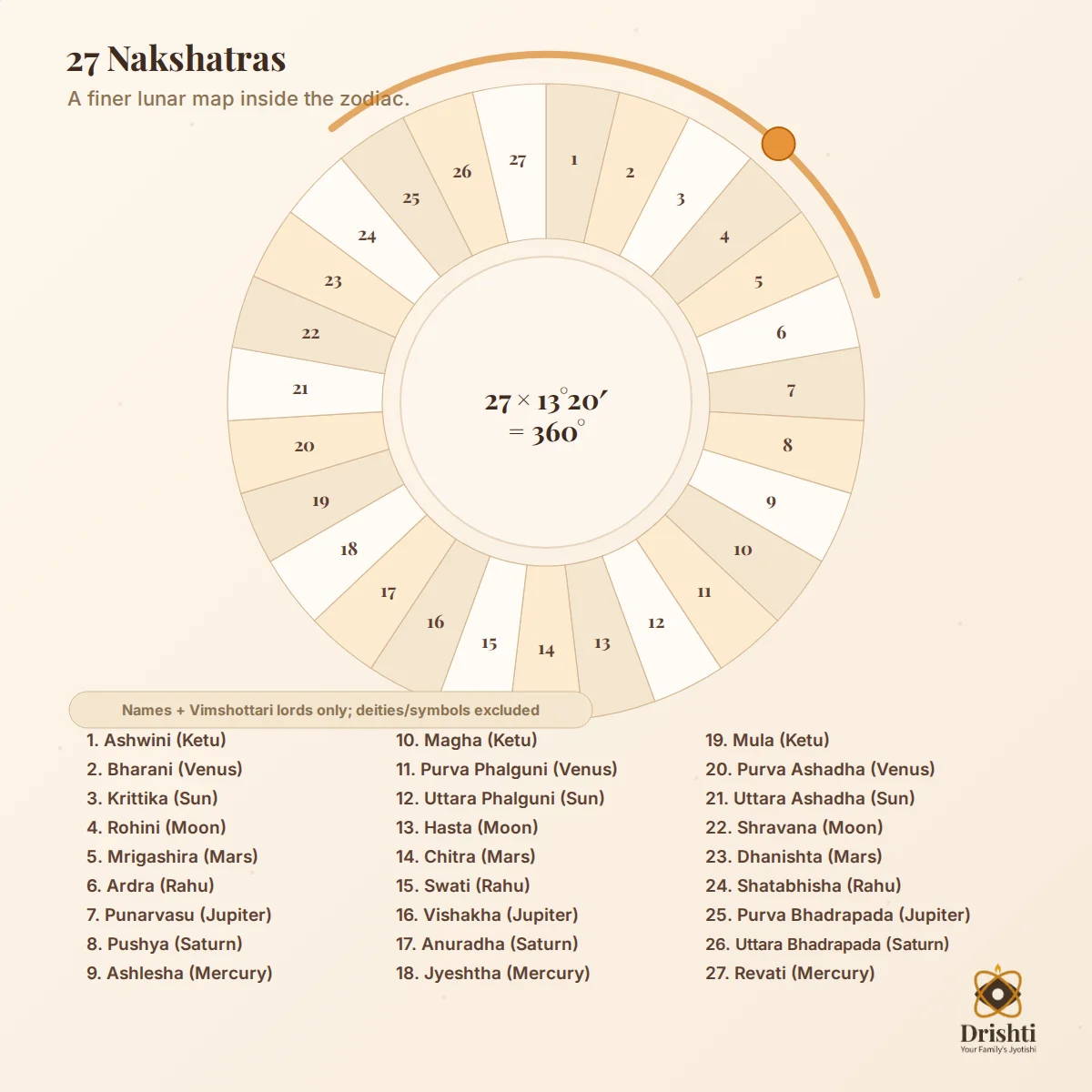
Nakshatras are the 27 equal segments the sky is divided into along the Moon’s monthly path — a finer grid than the 12 rashis (zodiac signs) most people already know. Each nakshatra, or “lunar mansion,” spans exactly 13°20′ of the 360° ecliptic. Multiply 13°20′ by 27 and you land back at 360°, which is the whole point: the 27 mansions tile the circle with no gaps and no overlaps. The Moon takes roughly 27.3 days to travel all the way around, so on any given day it is “camped” in one nakshatra. The nakshatra the Moon occupies at the moment you were born is your Janma nakshatra — your birth star — and in Vedic astrology (Jyotish) it carries more day-to-day weight than your Sun sign. If you have ever heard an elder ask a newborn’s nakshatra before anything else, this is why.
Why there are 27 lunar mansions
The number is not arbitrary and it is not mystical arithmetic. It comes straight from watching the Moon. In one sidereal orbit — one full loop against the fixed stars — the Moon takes about 27.3 days. Ancient sky-watchers across the subcontinent asked a practical question: if the Moon returns to the same star-field every 27-ish days, can we mark off 27 recognisable “stations” so we always know where it is tonight? That is what a nakshatra originally was — a named patch of sky the Moon visits, tied to a bright star or small cluster you could actually point at.
Two design choices made the system durable. The segments were made equal in span — 13°20′ each — rather than tied to the uneven real spacing of stars, so the maths stays clean. And the count was fixed at 27 rather than 28. Some older traditions used a 28th nakshatra, Abhijit, tucked between two of the others, and you will still see it referenced in specific timing (muhurta) contexts. Mainstream Jyotish calculation works with 27 equal mansions, and that is the framework this guide uses.
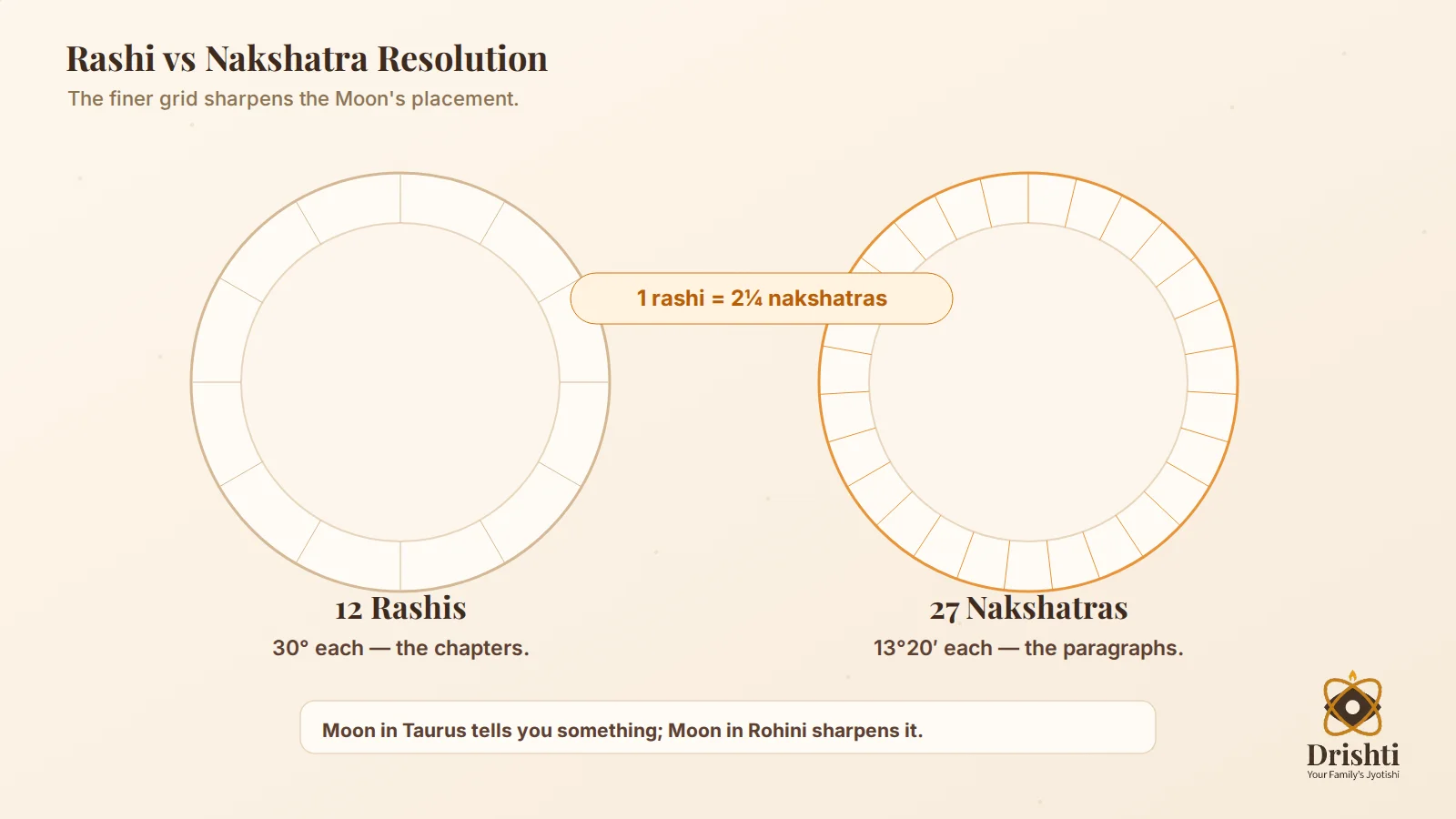
Here is the arithmetic laid out plainly. The zodiac is 360°. Divide by 27 and each nakshatra is 13°20′ (that is 13 degrees and 20 arc-minutes, or 13.333… degrees). Because a rashi is 30°, a rashi holds exactly two and a quarter nakshatras — the boundaries deliberately don’t line up, which is the whole reason the two grids give you different information. More on that next.
Nakshatras vs rashis: same sky, finer grid
A rashi is a 30° slice; a nakshatra is a 13°20′ slice. Both measure the same circle, so a nakshatra isn’t an alternative to the zodiac — it’s a higher-resolution version of it. Think of the 12 rashis as chapters and the 27 nakshatras as paragraphs. If your Moon sits in the rashi Taurus, that already tells an astrologer something; knowing it sits specifically in the nakshatra Rohini (which falls inside Taurus) sharpens the reading considerably, because you have zoomed from a 30° window to a 13°20′ one.
This matters most for the Moon. Western/tropical astrology leans heavily on the Sun sign; Vedic astrology treats the Moon as the emotional and mental anchor of the chart, and the nakshatra is the Moon’s native language. Two people born a week apart can share a Moon sign while sitting in different nakshatras — and the nakshatra difference is often the more telling one. That is the practical case for learning the finer grid rather than stopping at the twelve signs. If you’re still building intuition for the coarser layer first, our walkthrough of how to read your Kundli and the companion guide to the 12 rashis in your birth chart are the natural places to start; nakshatras sit one zoom level below both.
Janma nakshatra: your birth star
Your Janma nakshatra is fixed by one thing only: which of the 27 mansions the Moon occupied at your exact time and place of birth. Not the Sun, not the ascendant — the Moon. This is why an accurate birth time matters. The Moon moves through roughly one nakshatra per day, so being off by even a few hours can, near a boundary, shift you into the neighbouring mansion. When people say they “don’t know” their nakshatra, the fix is almost always a properly cast chart from a correct birth time, not guesswork from the date alone.
In many South Indian families the Janma nakshatra is treated as a core identity marker from day one. It’s common in Tamil, Telugu, Kannada and Malayalam households for the nakshatra (and its pada, covered below) to be recorded at birth, recited at the annual star-birthday celebration — which follows the nakshatra rather than the English calendar date — and referenced when priests set ritual timings. In my experience reviewing how Indian families actually use astrology apps, this is one of the clearest North-South differences: a Bengaluru or Chennai parent will often know a child’s nakshatra before they know the “star sign,” whereas that ordering is frequently reversed further north. A tool that treats the nakshatra as a first-class field, and can hold that detail for each member of the family rather than one profile, fits that habit far better than a Sun-sign-first app. This is where Drishti — “Your Family’s Jyotishi” — is built to sit: a calm, transparent Kundli that surfaces each family member’s nakshatra as plainly as their name.
Padas and the 108-fold division
Each nakshatra is subdivided into four equal quarters called padas (literally “feet” or “steps”). Since a nakshatra spans 13°20′, one pada spans a quarter of that — 3°20′. Four padas per nakshatra, 27 nakshatras, gives you:
27 × 4 = 108 padas across the whole zodiac.
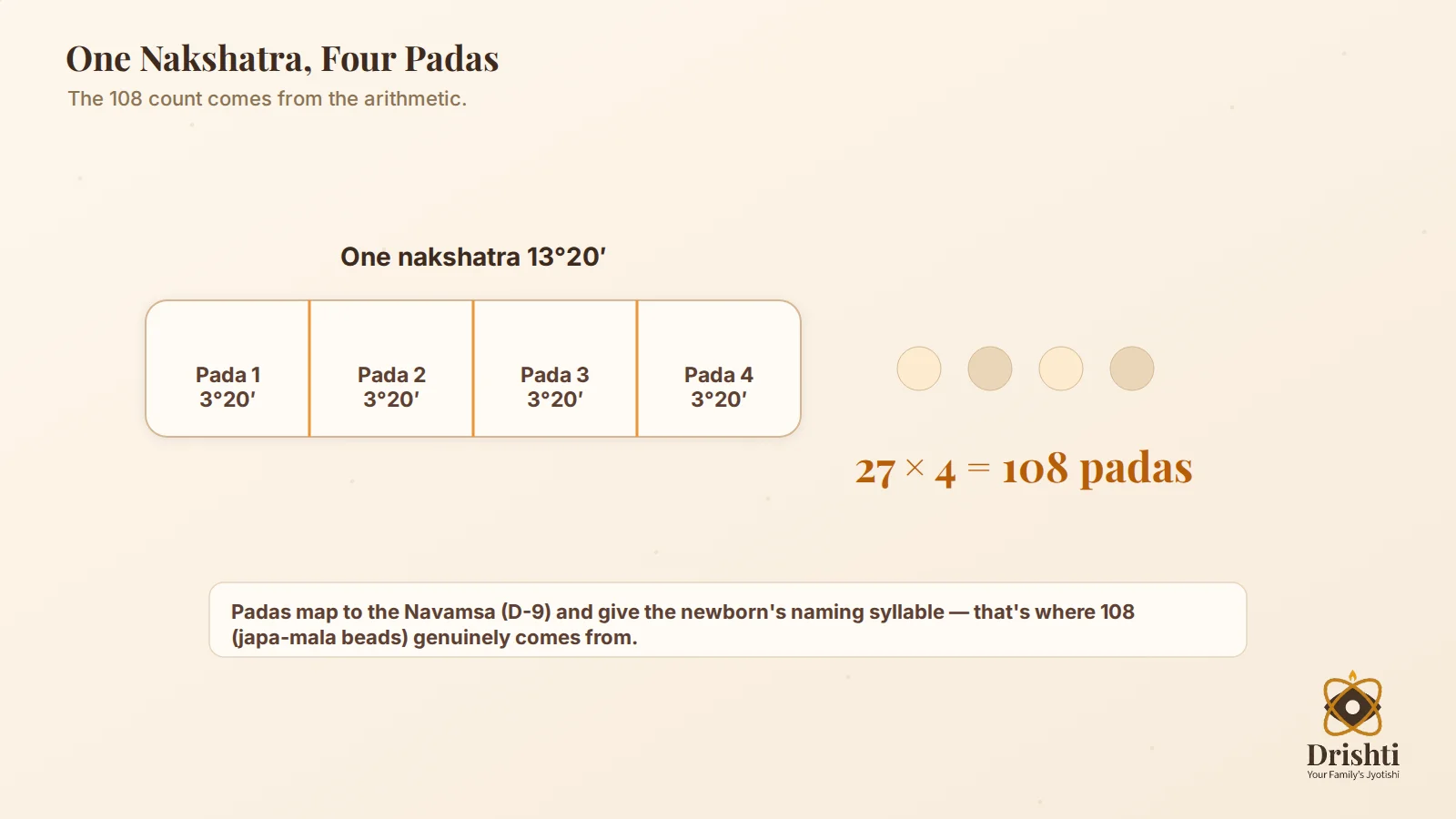
That 108 is not a coincidence layered on afterwards — it falls straight out of the geometry. It’s also why 108 recurs so often in Indian tradition: the beads on a japa mala, the number of repetitions in many practices. The nakshatra-pada division is one concrete, calculable place the number genuinely comes from, without needing to mystify it.
Padas do real work in a chart. Each pada maps to a segment of the finer Navamsa (D-9) chart, the divisional chart astrologers lean on for marriage and deeper strength analysis. Padas also drive the traditional naming syllables: each of the 108 padas is associated with a starting sound, and in many families the priest gives the newborn’s first syllable from the pada the Moon occupied at birth. That’s the origin of names beginning with a “prescribed” letter — a practice still very much alive in South Indian naming ceremonies. So the pada isn’t trivia; it’s the layer that connects the sky to the child’s actual name.
The 27 nakshatras at a glance
Here are all 27 mansions in order, with their Vimshottari dasha lords. The sequence of ruling planets — Ketu, Venus, Sun, Moon, Mars, Rahu, Jupiter, Saturn, Mercury — repeats three times to cover the 27 (9 × 3 = 27). This lordship pattern is a fixed calculation fact, which is why the table below leads with it. The traditional deity and symbol columns are widely cited but vary between sources, so I’ve flagged them for verification rather than assert them here.
| # | Nakshatra | Vimshottari lord | Deity (verify) | Symbol (verify) |
|---|---|---|---|---|
| 1 | Ashwini | Ketu | Ashwini Kumaras | Horse’s head |
| 2 | Bharani | Venus | Yama | Yoni |
| 3 | Krittika | Sun | Agni | Razor / flame |
| 4 | Rohini | Moon | Brahma | Cart / chariot |
| 5 | Mrigashira | Mars | Soma | Deer’s head |
| 6 | Ardra | Rahu | Rudra | Teardrop |
| 7 | Punarvasu | Jupiter | Aditi | Quiver of arrows |
| 8 | Pushya | Saturn | Brihaspati | Cow’s udder |
| 9 | Ashlesha | Mercury | Nagas | Coiled serpent |
| 10 | Magha | Ketu | Pitris | Throne |
| 11 | Purva Phalguni | Venus | Bhaga | Front legs of a bed |
| 12 | Uttara Phalguni | Sun | Aryaman | Back legs of a bed |
| 13 | Hasta | Moon | Savitr | Open hand |
| 14 | Chitra | Mars | Tvashtar | Bright jewel |
| 15 | Swati | Rahu | Vayu | Young shoot / coral |
| 16 | Vishakha | Jupiter | Indra-Agni | Triumphal archway |
| 17 | Anuradha | Saturn | Mitra | Lotus |
| 18 | Jyeshtha | Mercury | Indra | Earring / umbrella |
| 19 | Mula | Ketu | Nirriti | Tied bunch of roots |
| 20 | Purva Ashadha | Venus | Apas | Fan / winnowing basket |
| 21 | Uttara Ashadha | Sun | Vishvedevas | Elephant tusk |
| 22 | Shravana | Moon | Vishnu | Three footprints / ear |
| 23 | Dhanishta | Mars | Vasus | Drum |
| 24 | Shatabhisha | Rahu | Varuna | Empty circle |
| 25 | Purva Bhadrapada | Jupiter | Aja Ekapada | Front of a funeral cot |
| 26 | Uttara Bhadrapada | Saturn | Ahir Budhnya | Back of a funeral cot |
| 27 | Revati | Mercury | Pushan | Fish / drum |
Read the table by its first three columns and it’s solid, calculable ground: the names in order and the repeating nine-planet dasha cycle. The last two columns carry the classical lore — the layer we’ve marked for review rather than presented as settled fact.
How nakshatras are used in dasha, matching, naming and Panchang
The nakshatra isn’t a standalone label; it’s the input to several of Jyotish’s most-used systems.
Vimshottari dasha. The most consequential use. The lord of your Janma nakshatra sets the starting planetary period of your life, and how far the Moon had travelled into that nakshatra at birth determines how much of that first period was already “spent.” From there the periods cycle in the fixed Ketu-Venus-Sun-Moon-Mars-Rahu-Jupiter-Saturn-Mercury order. So the single fact of your birth nakshatra seeds your entire dasha timeline. We break down how those periods run and what they mean in the dedicated guide to the Vimshottari dasha system — read that next if the timing layer is what you’re after.
Marriage matching (Gun Milan). In the traditional 36-point Ashtakoota compatibility method, several of the eight kootas are computed directly from the two people’s nakshatras — including Gana (temperament grouping), Nadi (a constitutional/health factor), and Tara (a mutual-fortune count). This is why matchmakers ask for nakshatras, not just Sun signs. It’s worth being clear-eyed here: matching is decision support, a structured conversation-starter for families, not a verdict on whether a relationship can work. We cover how the kootas are read — and where their limits are — in nakshatras in marriage matching.
Naming. As covered above, the pada supplies the newborn’s starting syllable in many communities — a living use, not a historical footnote.
Panchang and muhurta. The daily Panchang (the Hindu almanac) lists the current nakshatra as one of its five core limbs. Priests and families use the day’s nakshatra to choose auspicious timings — a muhurat — for weddings, house-warmings, travel and ceremonies. That’s the nakshatra doing everyday, calendar-level work, far from any horoscope column.
What nakshatras can and cannot tell you
A nakshatra is a coordinate, and it’s worth holding that in mind. Knowing your Janma nakshatra tells you where the Moon sat at birth, seeds your dasha sequence, and gives an astrologer a sharper read than the Moon sign alone. Traditionally, each mansion also carries an associated temperament — a texture, a set of tendencies — and used descriptively, that can be a genuinely useful lens for self-reflection.
What it is not is a fixed script for your life. The reputable practice is descriptive, never deterministic: your nakshatra doesn’t decide your career, guarantee an outcome, or hand down a fate you can’t move. A nakshatra tendency is one factor among many in a full chart, and a full chart is one input among many in a life. Any tool or astrologer telling you a nakshatra dooms or guarantees anything has left astrology and entered fear-selling — which is the opposite of what this is for.
That’s the posture Drishti is built around: a family astrologer that shows its work and speaks plainly, treating your nakshatra as a genuinely useful coordinate rather than a fate to be afraid of, in the language your family actually speaks. Learn the grid, use it for reflection and timing, and hold it lightly.
FAQ
What are nakshatras? Nakshatras are the 27 equal divisions of the zodiac along the Moon’s path, each spanning 13°20′ of the 360° circle. Often called “lunar mansions,” they form a finer grid than the 12 rashis (zodiac signs) and are central to Vedic astrology, especially for reading the Moon’s placement in a birth chart.
How many nakshatras are there? There are 27 nakshatras in standard Jyotish calculation, because the Moon takes about 27.3 days to circle the zodiac and each mansion is set to an equal 13°20′ (27 × 13°20′ = 360°). Some older traditions add a 28th, Abhijit, used in specific timing contexts, but mainstream calculation works with 27.
What is my birth nakshatra? Your birth (Janma) nakshatra is whichever of the 27 mansions the Moon occupied at your exact time and place of birth. Because the Moon moves through roughly one nakshatra per day, an accurate birth time matters — the surest way to find it is to cast a proper Kundli rather than estimate from the date alone.
What are padas? Padas are the four equal quarters of each nakshatra, so one pada spans 3°20′ (a quarter of 13°20′). Across all 27 nakshatras this gives 27 × 4 = 108 padas. Padas map onto the Navamsa (D-9) chart and traditionally supply the starting syllable used to name a newborn in many Indian families.
How are nakshatras used in marriage matching? In the traditional 36-point Ashtakoota (Gun Milan) method, several compatibility factors — including Gana, Nadi and Tara — are calculated directly from the two people’s nakshatras. That’s why matchmakers ask for nakshatras rather than just Sun signs. The result is best treated as structured decision support for the family, not a verdict on the relationship.
Are nakshatras different from zodiac signs? Yes. A zodiac sign (rashi) is a 30° slice of the sky; a nakshatra is a finer 13°20′ slice, so one rashi contains two and a quarter nakshatras. They measure the same circle at different resolutions — the nakshatra simply gives a more precise reading, and in Vedic astrology it’s applied above all to the Moon.